Case Overview
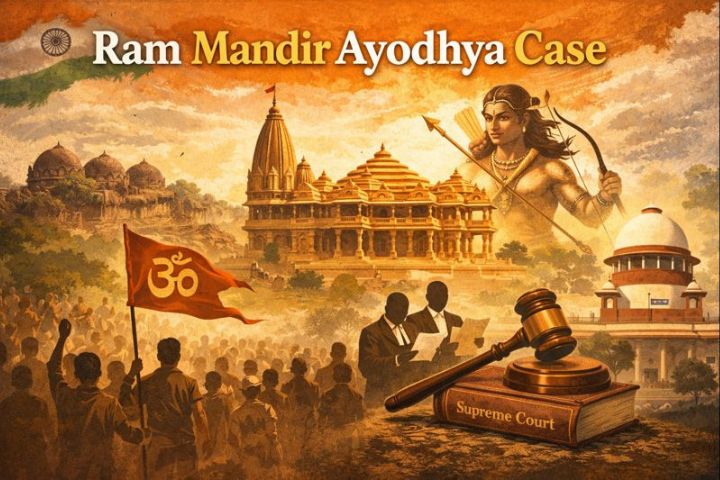
The Ram Mandir Ayodhya case, formally titled M. Siddiq (D) Through LRs vs. Mahant Suresh Das & Ors., was a civil land title dispute concerning a 2.77-acre site in Ayodhya, Uttar Pradesh. The case was finally decided by a five-judge Constitution Bench of the Supreme Court of India on 9 November 2019.
At its core, the dispute involved competing claims of ownership, possession, and worship rights by Hindu and Muslim parties. However, the legal complexity extended far beyond religious belief, requiring adjudication under property law, constitutional law, evidence law, and principles of equity.
Parties and Legal Representation
The Hindu side was represented primarily by Shri Ram Lalla Virajman, recognized by the Court as a juristic person capable of holding property. Supporting parties included the Hindu Mahasabha and Nirmohi Akhara, the latter claiming management rights over the site.
The Muslim side was represented by the Uttar Pradesh Sunni Central Waqf Board, asserting ownership and possessory rights over the disputed land.
Senior advocates who played a significant role in the proceedings included K. Parasaran, C. S. Vaidyanathan, and P. S. Narasimha for the Hindu parties, and Rajeev Dhavan, Zia Jilani, and Shekhar Naphade for the Muslim parties.
The matter was heard by a Constitution Bench comprising:
- Chief Justice Ranjan Gogoi
- Justice S. A. Bobde
- Justice D. Y. Chandrachud
- Justice Ashok Bhushan
- Justice S. Abdul Nazeer
Historical Background of the Dispute
Early Origins (Before Independence)
The earliest recorded litigation dates back to 1885, when a Hindu priest sought judicial permission to construct a temple near the disputed site. The colonial court dismissed the claim due to lack of proof of ownership. During this period, historical records indicate that Hindus worshipped the outer courtyard, while Muslims offered prayers inside the structure.
This shared but contested usage became legally significant, as it formed the foundation of later arguments regarding possession and continuity of worship.
Post-Independence Developments (1949–1989)
In December 1949, idols of Lord Ram were placed inside the disputed structure. This event led to administrative intervention, attachment of the property, and a series of civil suits filed by both communities.
Between 1950 and 1989, litigation focused on:
- Declaration of ownership
- Injunctions against interference with worship
- Management and shebait rights
In 1989, a dedicated title suit was filed on behalf of Ram Lalla Virajman, which became central to the final adjudication.
Demolition and Legal Turning Point (1992)
The demolition of the disputed structure in December 1992 marked a major escalation. While the Supreme Court later condemned the demolition as unlawful, it clarified an important legal principle: illegal acts do not extinguish lawful civil rights.
This distinction allowed the Court to separate criminal wrongdoing from civil title determination, ensuring that ownership was decided strictly on evidence and law.
Allahabad High Court Judgment (2010)
In 2010, the Allahabad High Court attempted to resolve the dispute by dividing the land into three equal parts among Ram Lalla Virajman, the Sunni Waqf Board, and Nirmohi Akhara.
However, this approach was controversial. The Supreme Court later observed that:
- Title must be determined before partition
- Courts cannot divide property purely on equitable considerations
- Compromise cannot substitute legal reasoning
These shortcomings led to appeals before the Supreme Court.
Supreme Court Proceedings and Legal Approach
The Supreme Court stayed the High Court judgment and undertook a fresh, evidence-based examination of the dispute. The Court emphasized that faith alone cannot decide title and applied the civil standard of proof based on preponderance of probabilities.
Evidence Considered
Rather than relying on isolated facts, the Court examined evidence holistically, including:
- Revenue and tax records
- Historical accounts and travelogues
- Testimonies of witnesses
- Archaeological findings
This comprehensive approach allowed the Court to reconstruct patterns of possession and worship over several centuries.
Archaeological Survey of India Findings
The Archaeological Survey of India conducted a detailed excavation under court supervision. The findings indicated the existence of a large non-Islamic structure beneath the disputed site.
Importantly, the Court exercised restraint by stating that while the evidence showed a prior structure, it did not conclusively prove deliberate demolition of a temple. This careful distinction reinforced the Court’s commitment to judicial neutrality.
Core Legal Issues Decided
Title and Possession
The Supreme Court concluded that the Hindu parties established a better claim to possession through continuous worship and historical evidence. The Muslim parties were unable to prove exclusive possession of the inner courtyard after the sixteenth century.
Juristic Personality of Ram Lalla
The Court reaffirmed a long-standing principle of Indian law: a Hindu deity can be recognized as a juristic person capable of owning property. Representation through a next friend was held to be legally valid.
Rejection of the High Court Partition
The Court firmly rejected the three-way division ordered by the High Court, holding that:
- Legal title cannot be split without determination
- Equity must follow law
- Judicial discretion cannot override statutory principles
Equitable Relief and Constitutional Balance
Despite awarding the disputed land to Ram Lalla, the Court acknowledged the injustice caused by the unlawful demolition. To balance constitutional values, it exercised powers under Article 142 to grant alternative land to the Sunni Waqf Board.
Acts and Sections Applied in the Ram Mandir Ayodhya Case (Explained in Detail)
The Ram Mandir Ayodhya case was primarily adjudicated as a civil land title dispute. However, due to its long history and related events, multiple statutes, constitutional provisions, and legal principles were examined by the Supreme Court. These laws governed evidence, civil procedure, limitation, constitutional powers, and consequences of unlawful acts.
Indian Evidence Act, 1872
The Indian Evidence Act governed how historical documents, oral testimonies, and archaeological findings were assessed by the Court.
Relevant Provisions Applied
The Court relied on provisions dealing with relevancy, admissibility, and probative value of evidence, especially ancient documents and expert reports.
Under the Evidence Act, ancient documents (documents older than thirty years) are presumed to be genuine if produced from proper custody. This principle helped the Court assess historical records, revenue documents, gazetteers, and travel accounts.
Legal Purpose of the Act
The Act ensures that courts rely on legally admissible and credible evidence rather than belief or speculation. In the Ayodhya case, this was crucial to separate faith-based claims from legally provable facts.
Punishment Aspect
The Indian Evidence Act does not prescribe punishments. It is a procedural law that determines how facts are proved in court. Punishments arise only if false evidence or perjury is proved under the Indian Penal Code.
Civil Procedure Code, 1908 (CPC)
The Civil Procedure Code regulated the entire litigation process, from filing of suits to final appeal before the Supreme Court.
Key Legal Provisions Applied
The CPC governed:
- Filing of civil suits for declaration of title
- Consolidation of multiple suits
- Recording of evidence
- Appeals from High Court to Supreme Court
The Supreme Court emphasized that courts cannot grant relief beyond pleadings and must strictly follow procedural discipline, especially in complex civil disputes.
Legal Purpose of the CPC
The CPC ensures fair trial, procedural consistency, and judicial discipline. In the Ayodhya case, it prevented arbitrary compromise and ensured the dispute was decided strictly through legal process.
Punishment Aspect
The CPC itself does not prescribe imprisonment or fines. However, non-compliance with court orders under CPC can lead to:
- Contempt proceedings
- Attachment of property
- Civil detention in limited circumstances
Limitation Act, 1963
One major argument raised was whether the claims were barred by limitation due to the age of the dispute.
Legal Issue Examined
The Court examined whether failure to file suits earlier extinguished ownership rights. It held that continuous assertion of rights and uninterrupted worship prevented limitation from defeating the Hindu parties’ claim.
Legal Purpose of the Act
The Limitation Act prevents stale claims, but it also recognizes continuous possession and recurring causes of action, especially in property disputes involving religious endowments.
Punishment Aspect
The Limitation Act does not impose punishment. It only determines whether a legal remedy is time-barred.
Constitution of India – Article 142
Article 142 played a decisive role in shaping the final outcome of the case.
Legal Description of Article 142
Article 142 empowers the Supreme Court to pass any order necessary to do “complete justice” in a matter pending before it, even if such relief is not explicitly provided under statute.
Application in Ayodhya Case
The Court used Article 142 to:
- Grant five acres of alternative land to the Sunni Waqf Board
- Direct the creation of a statutory trust for temple construction
- Balance legal ownership with constitutional morality
Punishment Aspect
Article 142 is not punitive. It is remedial and equitable, allowing the Court to correct injustice and maintain constitutional balance.
Indian Penal Code, 1860 (Contextual Reference)
Although the Supreme Court judgment focused on civil title, it explicitly condemned the demolition of the disputed structure in 1992.
Relevant Penal Provisions (Contextual)
Acts such as unlawful demolition, rioting, and destruction of property fall under the Indian Penal Code.
These offences carry punishments including:
- Imprisonment
- Fines
- Criminal liability for unlawful assembly and public mischief
Important Legal Clarification by the Court
The Supreme Court clarified that criminal wrongdoing cannot decide civil title. While criminal liability may arise separately, civil ownership must be determined independently based on evidence and law.
Juristic Personality Doctrine (Legal Principle Applied)
The Court reaffirmed that Hindu deities are recognized as juristic persons under Indian law.
Legal Meaning
A juristic person:
- Can own property
- Can sue and be sued
- Is represented through a human guardian or next friend
Importance in Ayodhya Case
This doctrine allowed Ram Lalla Virajman to be treated as a legal owner rather than a symbolic claimant.
Why These Legal Provisions Matter
The Ayodhya case is significant because it demonstrates:
- How ancient disputes are resolved using modern legal tools
- The separation of civil rights from criminal acts
- The role of constitutional equity in resolving social conflicts
- The importance of procedure over emotion in judicial decision-making
Most competing blogs focus only on the verdict. However, the application of procedural law, evidence law, and constitutional powers is what truly makes this judgment a legal landmark.
Final Supreme Court Judgment Explained
On 9 November 2019, the Supreme Court unanimously ruled that:
- The entire disputed land would be allotted to Shri Ram Lalla Virajman
- A trust would be formed to construct and manage the Ram Mandir
- Five acres of alternate land would be provided to the Sunni Waqf Board
- Constitutional values and rule of law must prevail over historical conflicts
The judgment is final and binding.
Why the Ayodhya Judgment Is a Landmark
This case is considered historic because it:
- Resolved a century-old civil dispute conclusively
- Reinforced evidence-based adjudication over faith-based claims
- Demonstrated constitutional use of equity
- Set precedent for handling historical land disputes
- Strengthened public confidence in judicial institutions
Conclusion
The Ram Mandir Ayodhya case stands as a defining moment in Indian constitutional jurisprudence. It demonstrates how courts can resolve deeply emotional and historically complex disputes through disciplined legal reasoning, evidence, and equitable justice.
For GO Legal, this judgment exemplifies the judiciary’s role in upholding the rule of law while preserving constitutional balance and social harmony.
FAQs–
1. What was the Ram Mandir Ayodhya case about?
It was a civil land title dispute over ownership of 2.77 acres in Ayodhya, involving Hindu and Muslim parties claiming historical and legal rights.
2. When was the Ayodhya judgment delivered?
The Supreme Court of India delivered the final judgment in the Ram Mandir Ayodhya case on 9 November 2019.
3. Who won the Ayodhya case?
The Supreme Court awarded the disputed land to Shri Ram Lalla Virajman while granting alternate land to the Sunni Waqf Board as equitable relief.
4. Why was the Allahabad High Court verdict rejected?
The Supreme Court held that land cannot be divided without determining legal title and that equity cannot replace established principles of property law.
5. Did the Court say a temple was demolished?
The Court acknowledged a non-Islamic structure beneath the site but did not conclusively rule that a temple was deliberately demolished.
6. What role did ASI play in the case?
The Archaeological Survey of India provided excavation findings that supported the existence of a pre-existing structure, aiding the Court’s evidentiary assessment.
7. Who represented Ram Lalla in court?
Senior Advocate K. Parasaran and his legal team represented Shri Ram Lalla Virajman before the Supreme Court.
8. Who represented the Sunni Waqf Board?
Senior Advocates including Rajeev Dhavan and Zia Jilani appeared for the Uttar Pradesh Sunni Central Waqf Board.
9. What is Article 142 used for?
Article 142 allows the Supreme Court to pass orders necessary to do complete justice beyond strict statutory limitations.
10. Why was alternate land given to Muslims?
The Court granted alternate land to remedy injustice caused by unlawful demolition and to uphold constitutional values of fairness and equity.
11. Was the judgment unanimous?
Yes, all five judges of the Constitution Bench delivered a unanimous verdict.
12. Can the Ayodhya judgment be challenged?
The judgment is final. Review petitions were dismissed, and no further legal remedy remains.
13. Is this case important for property law?
Yes, it clarifies principles of title determination, possession, limitation, and evidence in historical land disputes.
14. Did religion decide the verdict?
No, the verdict was based on civil law principles, evidence, and constitutional reasoning, not religious belief alone.
15. Why is this judgment considered historic?
It resolved a century-old dispute through lawful means while reinforcing constitutional values, judicial discipline, and social harmony.