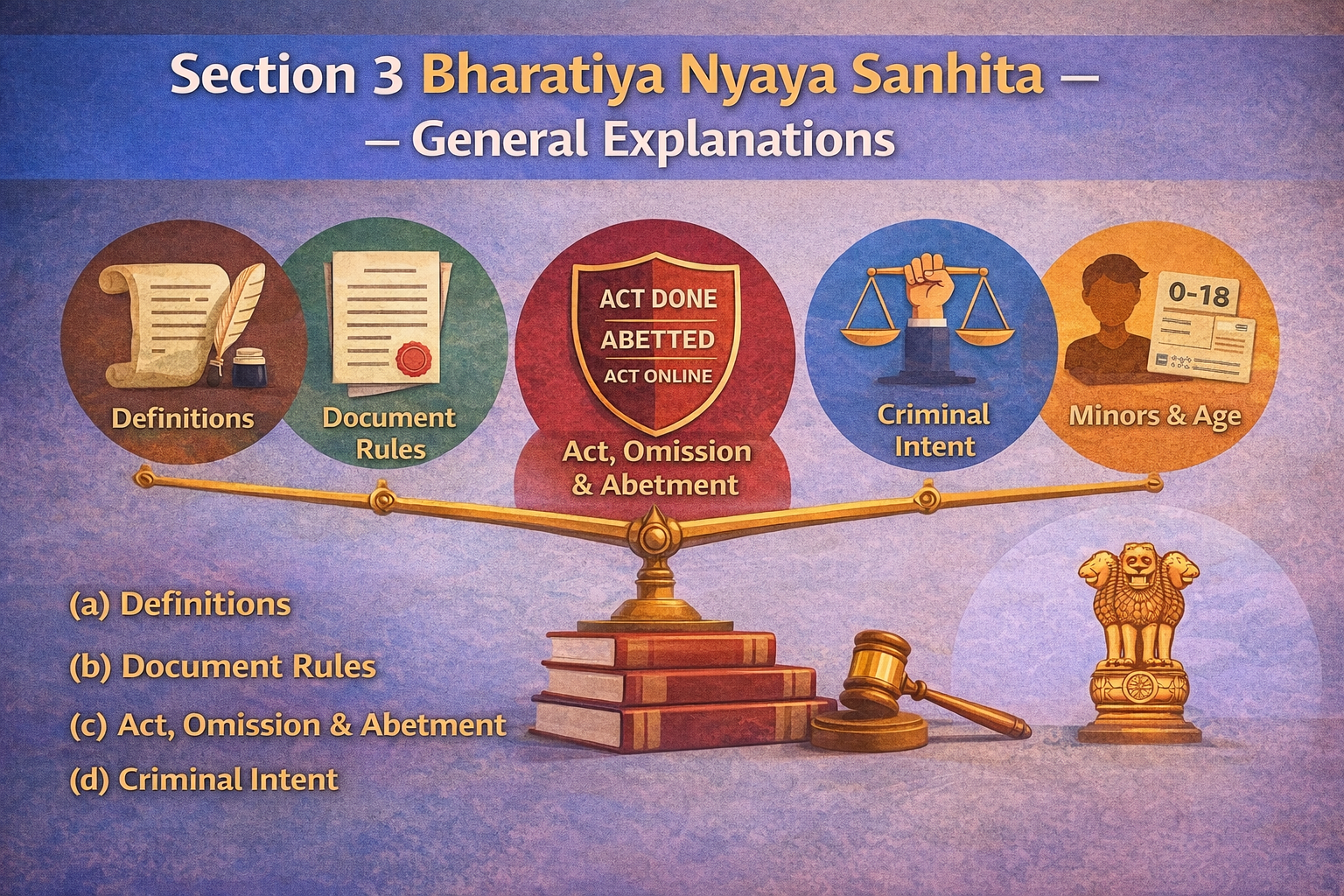
The Bharatiya Nyaya Sanhita (BNS), 2023 marks a fundamental shift in India’s criminal law framework by replacing colonial-era provisions with a modern and indigenous approach. Among its foundational provisions, Section 3 Bharatiya Nyaya Sanhita plays a critical role by laying down General Explanations that guide the interpretation and application of the entire statute. These explanations ensure clarity, consistency, and uniform understanding of criminal liability across courts.
Section 3 Bharatiya Nyaya Sanhita does not define offences directly; instead, it establishes interpretative principles that apply to every offence, punishment, and legal consequence under BNS. Without these explanations, the application of criminal law would remain uncertain and inconsistent.
Importance of Section 3 Bharatiya Nyaya Sanhita in Criminal Law
- It provides uniform interpretative rules applicable throughout the BNS
- It reduces ambiguity in understanding criminal intention, conduct, and consequences
- It assists courts in determining liability when express definitions are absent
- It ensures fairness and predictability in criminal justice
The relevance of Section 3 Bharatiya Nyaya Sanhita lies in its ability to connect legislative intent with judicial reasoning, making it the backbone of statutory interpretation under BNS.
Section 3 Bharatiya Nyaya Sanhita – General Explanations
Section 3 Bharatiya Nyaya Sanhita contains nine sub-sections, each clarifying how certain expressions, mental states, and legal consequences must be understood. These explanations apply unless the context indicates otherwise.
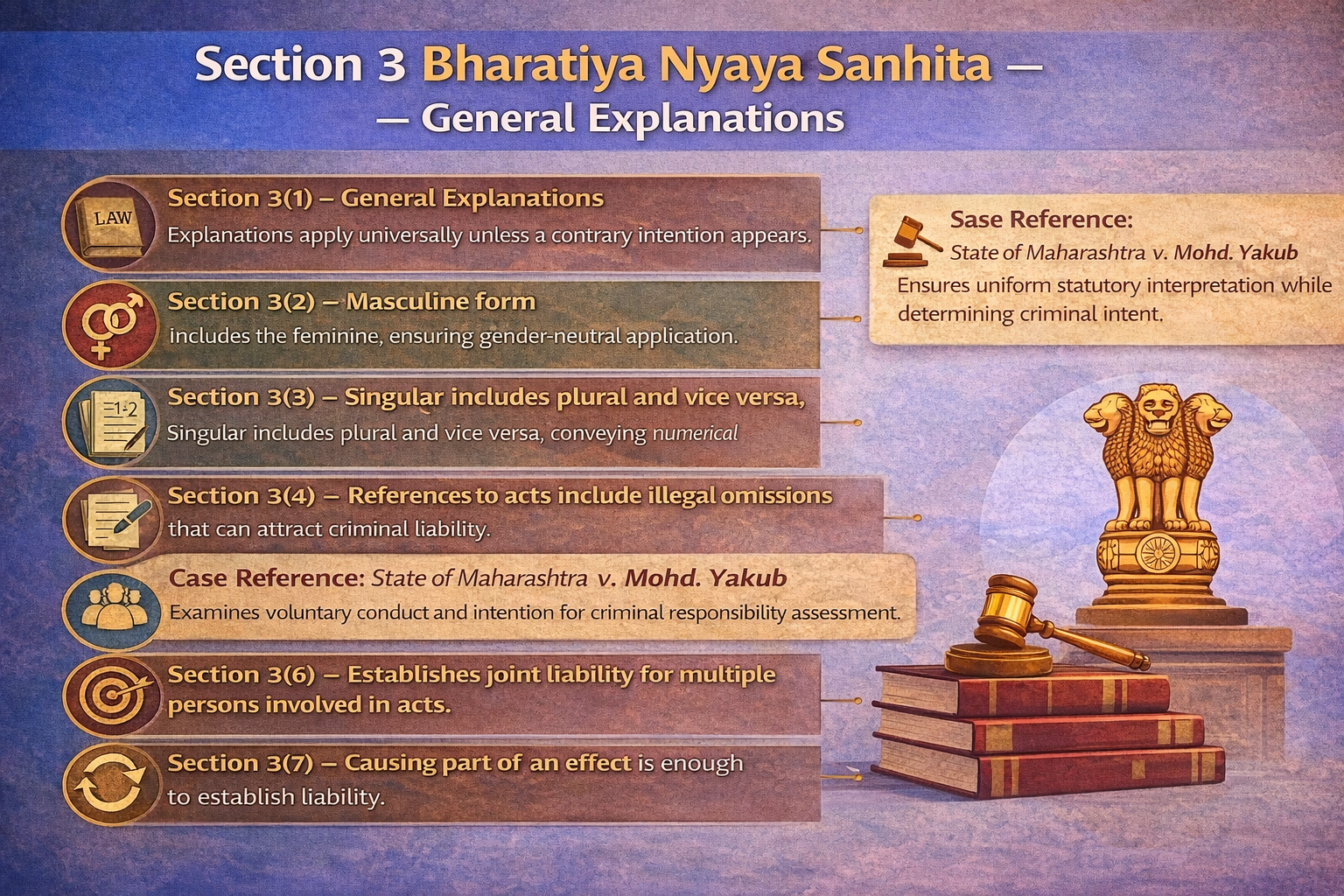
Section 3(1) – General Explanations
- This provision clarifies that explanations provided under BNS apply universally unless a contrary intention appears.
- It ensures that common interpretative rules are not limited to individual sections.
- Courts rely on this clause to maintain consistency in applying definitions and principles.
Case Reference:
State of Maharashtra v. Mohd. Yakub – The court emphasized uniform interpretation of statutory explanations while determining criminal intent.
Section 3(2) – General Explanations
- This sub-section explains that words used in masculine form include the feminine.
- It removes gender-based limitations in criminal liability.
- This provision supports gender-neutral interpretation under criminal law.
Section 3(3) – General Explanations
- It clarifies that the singular includes the plural and vice versa.
- This avoids technical objections related to numerical interpretation.
- Courts apply this principle while interpreting offences involving multiple acts or persons.
Section 3(4) – General Explanations
- This provision explains how references to acts include illegal omissions.
- It establishes that failure to act can attract criminal liability.
- Many offences under BNS rely on this explanation to establish culpability.
Section 3(5) – General Explanations
- It clarifies the concept of voluntary conduct.
- Actions accompanied by knowledge or intention fall within this explanation.
- This provision strengthens the assessment of mens rea under criminal law.
Case Reference:
Nathulal v. State of Madhya Pradesh – The court examined voluntary conduct and intention while determining criminal responsibility.
Section 3(6) – General Explanations
- This clause explains joint liability in acts done by multiple persons.
- It supports the principle that shared intention attracts shared responsibility.
- Courts use this explanation while deciding cases involving group offences.
Section 3(7) – General Explanations
- It clarifies that causing an effect includes causing part of that effect.
- Partial consequences are sufficient to establish liability.
- This prevents offenders from escaping responsibility due to incomplete outcomes.
Section 3(8) – General Explanations
- This provision explains the continuity of offences.
- Repeated or continuous acts may constitute a single offence.
- It assists courts in determining limitation and punishment.
Section 3(9) – General Explanations
- It clarifies interpretation of knowledge, belief, and reason to believe.
- Courts rely on this clause to assess subjective mental states.
- This explanation is vital in offences involving fraud, deception, and intent.
Judicial Significance of Section 3 Bharatiya Nyaya Sanhita
Courts frequently rely on Section 3 Bharatiya Nyaya Sanhita while interpreting offences under BNS. These explanations bridge the gap between statutory language and real-life conduct. By providing interpretative clarity, Section 3 ensures that criminal law remains predictable, fair, and consistent.
Conclusion: Why Section 3 Bharatiya Nyaya Sanhita Is Foundational
Section 3 Bharatiya Nyaya Sanhita serves as the interpretative framework upon which the entire Bharatiya Nyaya Sanhita operates. Its General Explanations guide courts in understanding intention, conduct, omissions, and consequences under criminal law. Without Section 3, the application of BNS would lack coherence and certainty.
By embedding uniform principles of interpretation, Section 3 Bharatiya Nyaya Sanhita strengthens India’s modern criminal justice system and ensures that legal reasoning aligns with legislative intent.