
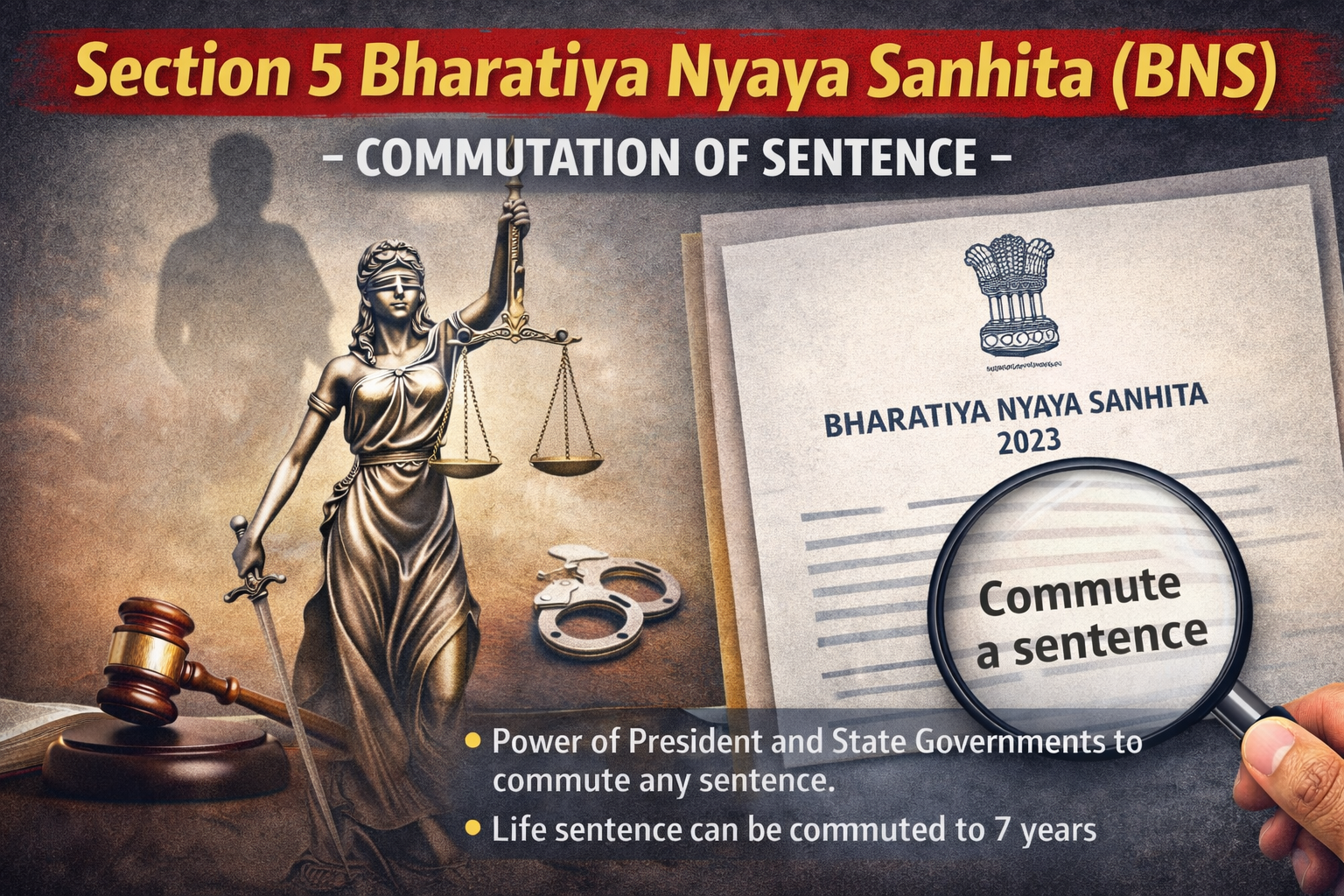
India’s criminal law system receives its first major transformation from The Bharatiya Nyaya Sanhita 2023 which replaces the Indian Penal Code from 1860. The crucial function of Section 5 BNS – Commutation of Sentence exists to maintain equilibrium between penal punishment and reformative justice systems. The government body needs to carry out this section because it needs to change the punishment which exists currently for a convicted individual without changing their conviction status.
Legal professionals, law students, prisoners and citizens need to understand Section 5 BNS – Commutation of Sentence because it affects three areas which include sentencing policies, executive powers and the legal rights of convicted individuals in contemporary criminal justice systems.
Understanding Section 5 Bharatiya Nyaya Sanhita
The government can exchange one type of punishment for a less severe punishment which the law permits through Section 5 BNS – Commutation of Sentence. Commutation changes the type of punishment without disputing the legal validity of the conviction while appeals and revisions do challenge it.
The Bharatiya Nyaya Sanhita 2023 legislation uses this provision to base its punishment system on both humanitarian principles and proportionality needs.
Key foundation of Section 5:
- Conviction remains unchanged
- Only punishment is modified
- Executive power exercised within legal limits
Section 5 BNS Explained: Meaning and Scope
Section 5 BNS explained simply means replacing a harsher punishment with a milder one. For example:
- Death sentence → Life imprisonment
- Life imprisonment → Rigorous imprisonment
- Rigorous imprisonment → Simple imprisonment
The governmental authority which controls the Power to commute sentence under BNS possesses this power to determine commutation based on the nature of the offense which requires either State Government or Central Government authorization.
The judicial system uses this power to alternate between different punishment lengths when fixed sentences would create unfair outcomes.
Commutation of Sentence Under BNS: Legal Nature
Commutation of sentence under BNS is a discretionary executive power. It may be exercised:
- Without the consent of the convicted person
- At any time after conviction
- Based on mercy, public interest, or reformative grounds
This provision is especially relevant for prisoners showing good conduct or cases involving humanitarian factors such as age, health, or prolonged incarceration.
Types of Commutation Permitted Under Section 5 BNS
Under BNS commutation of punishment, the following substitutions are legally permissible:
- Death penalty may be commuted to life imprisonment
- Life imprisonment may be commuted to imprisonment for a term
- Rigorous imprisonment may be commuted to simple imprisonment
- Any sentence may be commuted to a fine
These substitutions must remain within the framework of law and judicial precedents.
Commutation of Death Sentence Under BNS
One of the most sensitive aspects of Section 5 BNS – Commutation of Sentence is the Commutation of death sentence under BNS. This power allows the government to convert a death sentence into life imprisonment without altering the conviction.
The provision connects with constitutional human dignity values and judicial restraint standards which judges follow during death penalty proceedings. The provision supports clemency authority of both the President and the Governor through Articles 72 and 161 of the Constitution.
Difference Between Remission and Commutation
Understanding the Difference between remission and commutation is vital:
- Remission reduces the duration of punishment
- Commutation changes the nature of punishment
For example:
- Remission shortens a life sentence
- Commutation converts life imprisonment into a lesser sentence
Section 5 BNS – Commutation of Sentence deals strictly with commutation, not remission.
Role of Government in Sentence Commutation
The Role of government in sentence commutation is central to Section 5. The executive evaluates:
- Nature of offense
- Conduct of the convict
- Societal impact
- Humanitarian considerations
The government’s decision must be reasonable and non-arbitrary. Courts may review commutation decisions if they violate constitutional principles.
Rights of Convicted Person Under BNS
Rights of convicted person under BNS are strengthened under modern criminal law. While commutation is not a legal right, a convicted person has:
- Right to apply for commutation
- Right to fair consideration
- Right to protection against arbitrary denial
Section 5 supports reformative justice by recognizing that punishment should not be purely retributive.
CrPC vs BNS Commutation of Sentence
The CrPC vs BNS commutation of sentence comparison highlights continuity with clarity:
- CrPC provided commutation under executive powers
- BNS consolidates and modernizes the provision
- Language under BNS is clearer and aligned with constitutional values
Section 5 BNS – Commutation of Sentence retains the essence of CrPC while fitting into a modern statutory framework.
Importance of Section 5 BNS in Criminal Justice
The significance of Section 5 BNS – Commutation of Sentence lies in:
- Preventing disproportionate punishment
- Promoting rehabilitation
- Allowing mercy in deserving cases
- Maintaining executive oversight
This provision reflects the evolving philosophy of criminal justice in India.
Practical Example of Commutation Under BNS
A person who receives a life imprisonment sentence can obtain an early release when he displays outstanding rehabilitation achievements through his humanitarian work. The government may invoke Section 5 BNS – Commutation of Sentence to convert life imprisonment into a fixed-term sentence.
Such action ensures justice remains humane and responsive.
Conclusion
Section 5 of the Bharatiya Nyaya Sanhita (BNS)– Commutation of Sentence balances two opposing forces of punishment and mercy. The law permits government authorities to change existing sentences while maintaining the original guilty verdicts which results in flexible sentencing that upholds just treatment of offenders and promotes their rehabilitative process.
The provision strengthens the Bharatiya Nyaya Sanhita 2023 provisions by aligning criminal punishment with constitutional morality and human dignity. The BNS Section 5 BNS – Commutation of Sentence establishes an understanding of justice which extends beyond the constraints of traditional punishment according to the new Indian criminal law system.