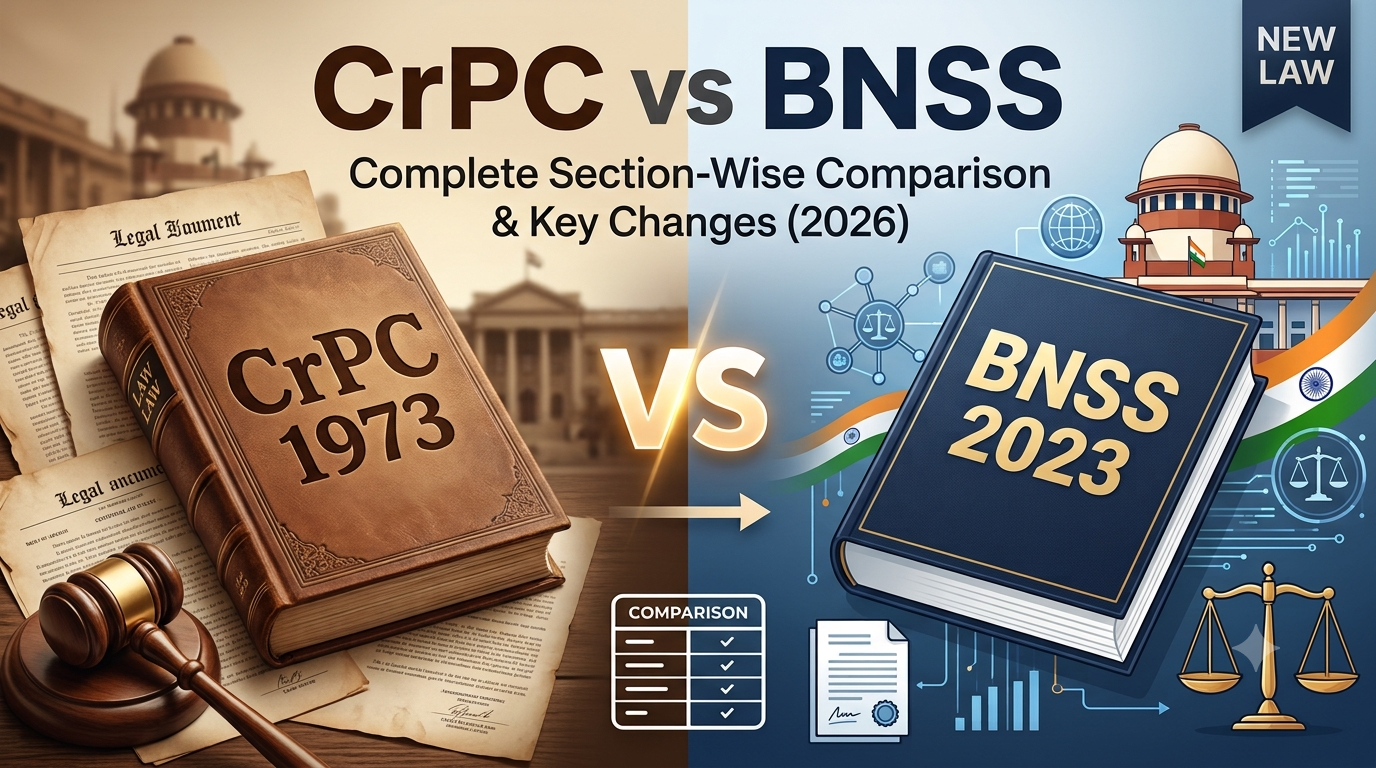
Criminal law in India establishes essential legal distinctions between bailable and non-bailable offenses because this classification determines an individual’s freedom rights. The Bharatiya Nagarik Suraksha Sanhita 2023 (BNSS) which replaces the Code of Criminal Procedure 1973 (CrPC) has generated fresh demands to study bail procedures in the new legal system.One of the most searched and legally significant topics today is Non-Bailable Offenses Explained Under CrPC and BNSS.
This article provides a comprehensive explanation of non-bailable offenses, their legal meaning, court discretion, and how the position under BNSS compares with the earlier CrPC regime.
What Are Non-Bailable Offenses?
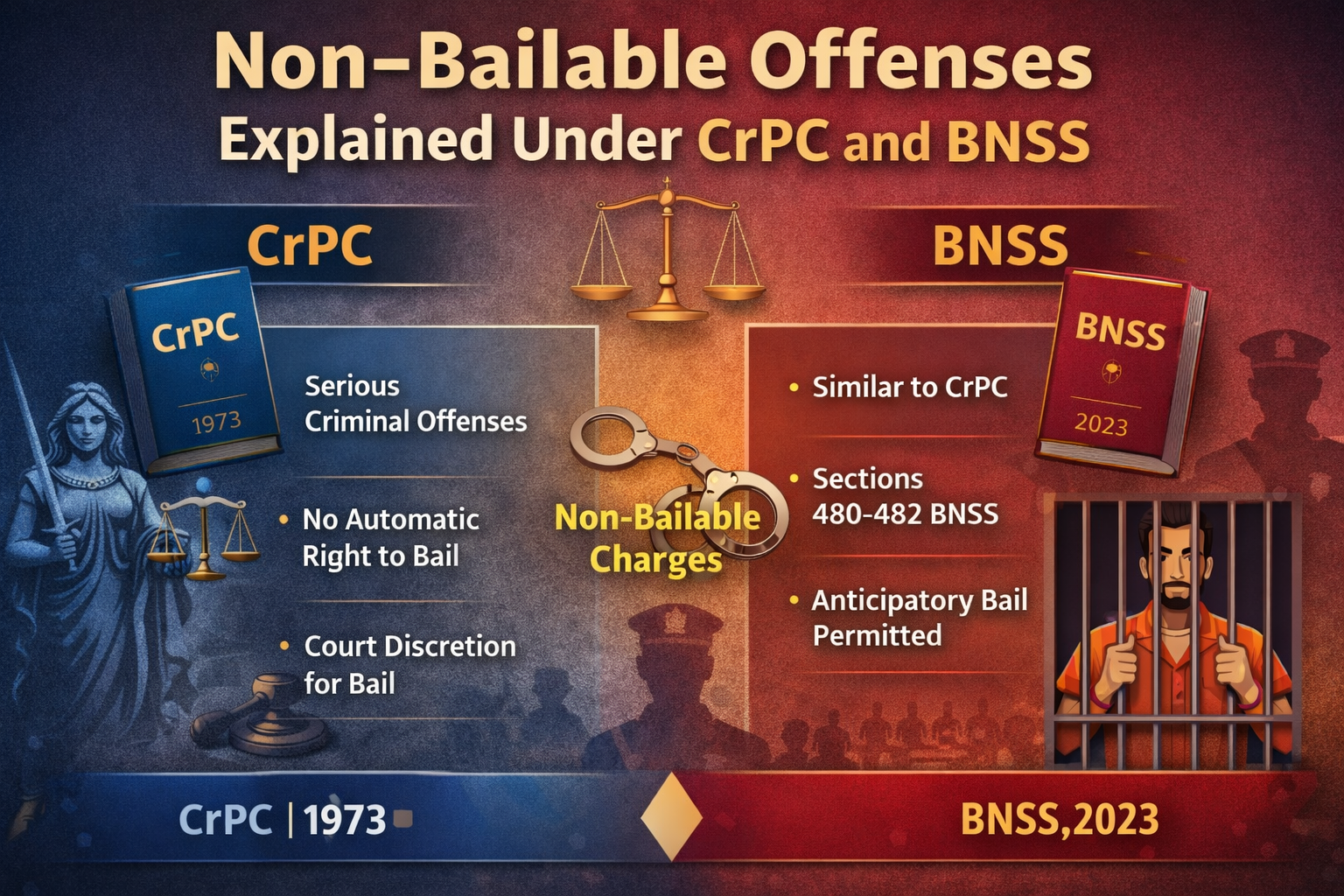
Non-bailable offenses are those criminal offenses in which bail is not a matter of right. The court makes decisions about non-bailable offenses because they require judicial discretion, while bailable offenses mandate the release of accused persons through bail.
The classification of an offense as Non-Bailable requires understanding three main factors which include the crime’s severity, its possible punishments, and its effect on society according to the explanation provided in Non-Bailable Offenses Explained Under CrPC and BNSS.
Legal Basis of Non-Bailable Offenses Under CrPC
The CrPC framework established non-bailable offenses through its Sections 436 to 439 implementation. Section 437 CrPC established bail regulations for non-bailable offenses, which permitted Magistrates to exercise restricted discretionary authority but granted higher courts broader judicial power.
Courts under CrPC considered factors such as:
- Gravity of the offence
- Nature of allegations
- Possibility of the accused absconding
- Likelihood of tampering with evidence
- Criminal antecedents
Thus, even under CrPC, non-bailable offenses did not automatically mean denial of bail, but rather required judicial scrutiny.
Non-Bailable Offenses Under BNSS: What Has Changed?
The BNSS largely retains the structure and philosophy of CrPC, while reorganising and renumbering provisions for clarity. Bail provisions under BNSS are now found mainly in Sections 479 to 481, while anticipatory bail is provided under Section 482 BNSS.
When we examine Non-Bailable Offenses Explained Under CrPC and BNSS, it becomes clear that BNSS emphasizes:
- Speedier procedures
- Digital processes
- Clearer timelines
However, the core discretion of courts in non-bailable offenses remains intact.
Key Features of Non-Bailable Offenses Under BNSS
1. Bail Is Discretionary
Under BNSS, bail in non-bailable offenses is not automatic. Courts must evaluate facts and circumstances before granting or rejecting bail.
2. Magistrate’s Limited Powers
Magistrates cannot grant bail in serious non-bailable offenses punishable with death or life imprisonment if there appear reasonable grounds for guilt.
3. Higher Courts’ Broad Authority
Sessions Courts and High Courts have wide powers to grant bail in non-bailable offenses under BNSS, similar to CrPC.
This continuity is a major aspect of Non-Bailable Offenses Explained Under CrPC and BNSS.
Difference Between Bailable and Non-Bailable Offenses
| Basis | Bailable Offenses | Non-Bailable Offenses |
| Right to Bail | Bail is a right | Bail is discretionary |
| Nature of Crime | Less serious | Serious and grave |
| Court’s Role | Minimal | Extensive judicial scrutiny |
| Examples | Simple hurt, defamation | Murder, rape, terrorism |
Understanding this distinction is essential while studying Non-Bailable Offenses Explained Under CrPC and BNSS.
Examples of Non-Bailable Offenses in India
Some commonly known non-bailable offenses include:
- Murder (IPC Section 302 / corresponding BNS provision)
- Rape
- Kidnapping for ransom
- Dowry death
- Terrorism-related offenses
- Serious economic offenses
These crimes have serious social impact, which is why bail is not granted as a matter of routine.
Anticipatory Bail in Non-Bailable Offenses
One of the most misunderstood areas is whether anticipatory bail can be granted in non-bailable offenses. Under Section 482 BNSS, anticipatory bail may be granted even in non-bailable offenses, subject to strict conditions.
Courts consider:
- Nature of allegations
- Possibility of false implication
- Cooperation with investigation
Thus, Non-Bailable Offenses Explained Under CrPC and BNSS also includes the protective role of anticipatory bail against misuse of arrest powers.
Judicial Approach: “Bail Is the Rule, Jail Is the Exception”
Indian courts have consistently held that personal liberty under Article 21 must be protected even in non-bailable offenses. Detention before conviction should not become punitive.
While deciding bail in non-bailable offenses, courts under both CrPC and BNSS assess:
- Whether custody is necessary for investigation
- Whether the accused poses a threat to society
- Whether trial will take a long time
This judicial philosophy continues unchanged under BNSS.
Practical Importance of Understanding Non-Bailable Offenses
The topic Non-Bailable Offenses Explained Under CrPC and BNSS is not only academically important but also practically significant:
- Filing the correct bail application depends on offence classification
- Delay in seeking bail may lead to prolonged custody
- Legal remedies differ at pre-arrest and post-arrest stages
For advocates, litigants, and law students, a clear understanding helps in navigating criminal proceedings effectively.
Section-Wise Citations With Important Case Laws
Section 437 CrPC / Section 480 BNSS
(Bail in Non-Bailable Offences)
Legal Position:
Bail is not a matter of right. The court must exercise judicial discretion based on facts and circumstances.
Key Case Laws:
- State of Rajasthan v. Balchand (1977)
Supreme Court held: “Bail is the rule and jail is the exception.” - Gudikanti Narasimhulu v. Public Prosecutor (1978)
Emphasised that bail decisions must balance personal liberty and social interest. - Prahlad Singh Bhati v. NCT of Delhi (2001)
Gravity of offence and likelihood of misuse of liberty are crucial factors.
These principles apply equally under BNSS Section 480.
Section 439 CrPC / Section 481 BNSS
(Special Powers of High Court and Sessions Court)
Legal Position:
Higher courts have wide discretionary powers to grant bail in non-bailable offences.
Key Case Laws:
- Sanjay Chandra v. CBI (2012)
Detention should not become punishment before conviction. - P. Chidambaram v. Directorate of Enforcement (2019)
Economic offences are serious, but bail cannot be denied mechanically.
Under Section 481 BNSS, these principles continue unchanged.
Section 438 CrPC / Section 482 BNSS
(Anticipatory Bail in Non-Bailable Offences)
Legal Position:
Anticipatory bail can be granted even in non-bailable offences, subject to conditions.
Key Case Laws:
- Gurbaksh Singh Sibbia v. State of Punjab (1980)
Landmark judgment: anticipatory bail is part of personal liberty under Article 21. - Sushila Aggarwal v. State (NCT of Delhi) (2020)
Anticipatory bail can continue till the end of trial unless cancelled.
These rulings directly guide interpretation of Section 482 BNSS.
Article 21 of the Constitution (Applied Under Both Laws)
Legal Position:
Personal liberty cannot be curtailed except by procedure established by law.
Key Case Law:
- Maneka Gandhi v. Union of India (1978)
Procedure must be fair, just, and reasonable — foundation of bail jurisprudence.
Conclusion
The concept of non-bailable offenses shows how society regulates personal freedom through its legal system. BNSS brings procedural changes and updates to its system but maintains existing standards for non-bailable offense bail procedures which follow CrPC rules.
The study Non-Bailable Offenses Explained Under CrPC and BNSS demonstrates that the term non-bailable indicates that defendants must wait for judicial approval before they can receive bail. Courts protect individual freedom rights while they impose strict lawful penalties against people who commit serious criminal offenses.