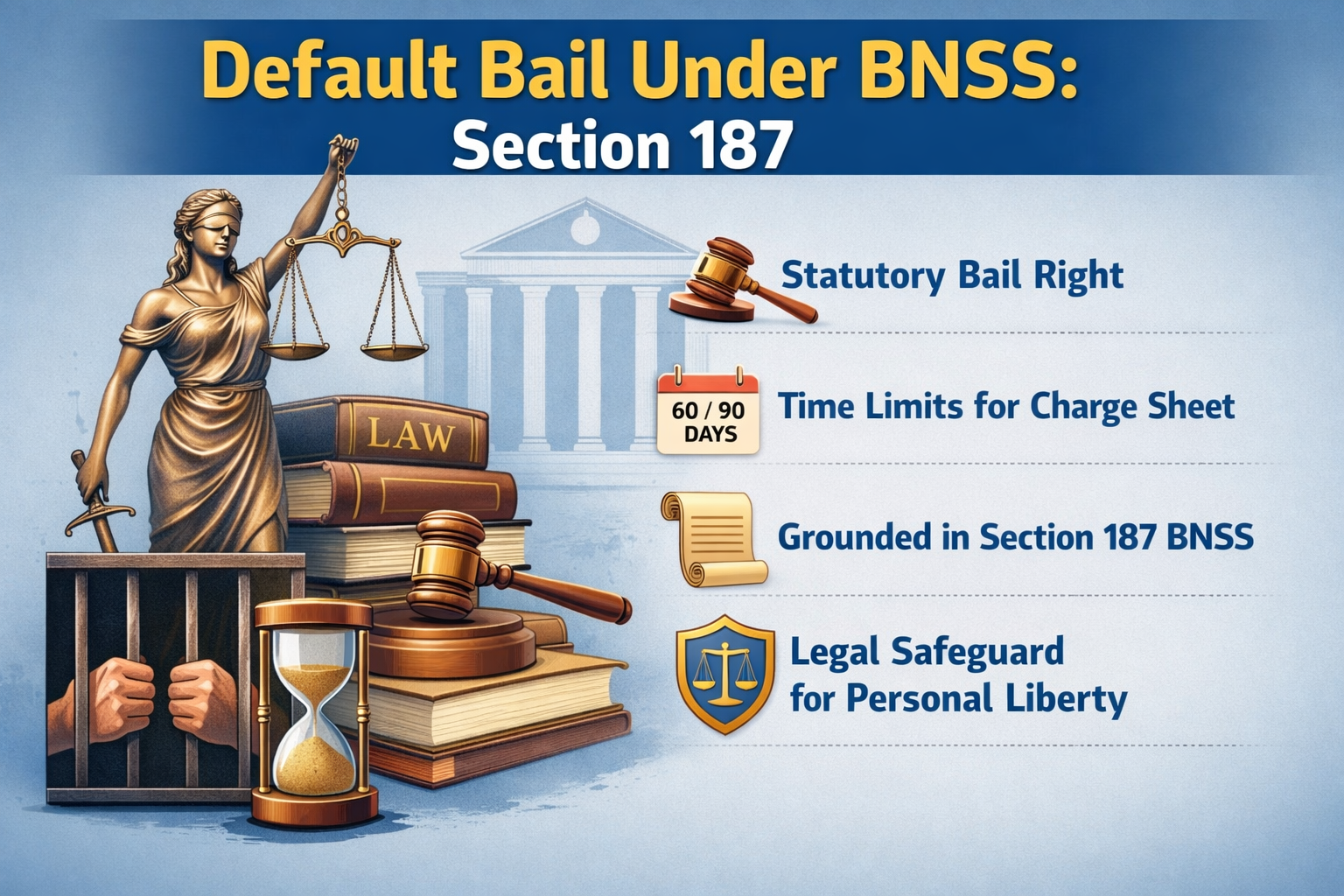
Bail functions as the essential component of Indian criminal law as it establishes a system which permits police work while protecting citizens’ right to freedom. The Bharatiya Nagarik Suraksha Sanhita 2023 (BNSS) introduced Default Bail Under BNSS which has become one of the most important legal protections through its various bail types.
Default bail does not get granted because of the case’s worth. The investigating agency loses its right to keep someone detained after it fails to finish its investigation within the required time. The new Code of Criminal Procedure 1973 (CrPC) requires people to comprehend Default bail under BNSS which Section 187 BNSS explains through its specific details.
This article explains the statutory foundation, judicial interpretation, procedural aspects, and constitutional significance of default bail under the new criminal procedure regime.
Understanding Default Bail Under BNSS
Default Bail Under BNSS establishes a legal right which allows an accused person to obtain bail when the investigative body fails to submit a charge sheet within the legally established time period. This right exists because Article 21 of the Constitution protects personal liberty.
The court must grant default bail after the accused person fulfills all necessary requirements whereas regular bail gives the court authority to decide whether to grant bail.
Statutory Basis: Section 187 BNSS
Section 187 BNSS – Legal Framework
The legal basis for default bail exists in Section 187 BNSS, which establishes the rules that match Section 167(2) CrPC from the previous legislation. The numbering system has been altered, yet the lawmakers’ original purpose continues to exist.
Section 187 BNSS governs:
- Maximum period of police or judicial custody
- Time available to the investigating agency to file the charge sheet
- The accused’s statutory right to seek bail upon delay
This provision reinforces the principle that investigation cannot be endless at the cost of personal liberty.
Time Limit for Default Bail Under BNSS
Statutory Time Limits Explained
The time limit for default bail depends on the nature and gravity of the offence:
- 60 days
- Applicable where the offence is punishable with imprisonment of less than ten years
- Applicable where the offence is punishable with imprisonment of less than ten years
- 90 days
- Applicable where the offence is punishable with death, life imprisonment, or imprisonment of ten years or more
If the charge sheet is not filed within these periods, the accused becomes entitled to Statutory bail under BNSS, provided an application is filed before the charge sheet is submitted.
Right to Default Bail in India
An Indefeasible Statutory Right
The right to default bail in India has been consistently recognised by the Supreme Court as an “indefeasible right”. This means:
- The right arises immediately upon expiry of the statutory period
- The court cannot deny bail once the right has accrued
- Filing of a charge sheet after expiry does not defeat an already-availed right
Under Default Bail Under BNSS, this right exists independent of the seriousness of the offence or the strength of evidence.
Default Bail Under BNSS vs Regular Bail
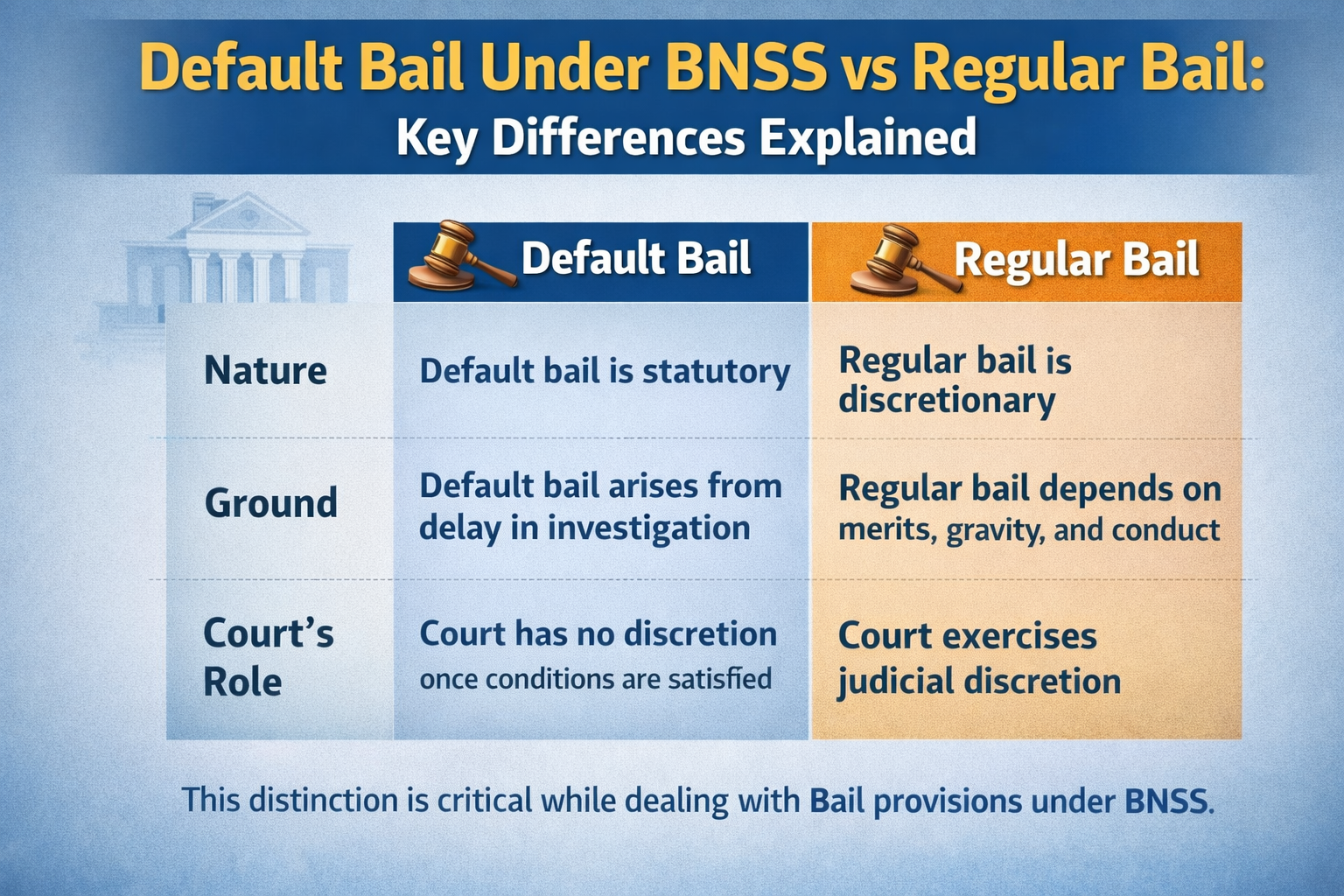
Key Differences Explained
- Nature
- Default bail is statutory
- Regular bail is discretionary
- Ground
- Default bail arises from delay in investigation
- Regular bail depends on merits, gravity, and conduct
- Court’s Role
- Court has no discretion once conditions are satisfied
- Court exercises judicial discretion
This distinction is critical while dealing with Bail provisions under BNSS.
Default Bail Under CrPC vs BNSS
Section 167(2) CrPC vs Section 187 BNSS
The comparison of Default bail under CrPC vs BNSS shows continuity rather than change:
| Aspect | CrPC | BNSS |
| Provision | Section 167(2) CrPC | Section 187 BNSS |
| Time Limits | 60/90 days | 60/90 days |
| Nature of Right | Indefeasible | Indefeasible |
| Judicial Interpretation | Liberty-centric | Liberty-centric |
Thus, the principles governing default bail remain firmly entrenched under the BNSS regime.
Charge Sheet Delay and Bail
Effect of Delay in Filing Charge Sheet
Charge sheet delay and bail are directly linked under Section 187 BNSS. The legal consequences are:
- If the charge sheet is not filed within 60 or 90 days, the accused becomes entitled to default bail
- Filing of the charge sheet after expiry does not nullify the right if bail is already sought
- Courts must release the accused upon furnishing bail bonds
However, if the accused does not apply for bail before the charge sheet is filed, the right stands extinguished.
Procedure to Claim Default Bail Under BNSS
To successfully claim Default Bail Under BNSS, the accused must:
- Calculate the statutory period correctly
- Ensure custody exceeds 60 or 90 days
- File a bail application asserting statutory right
- Express readiness to furnish bail bonds
Courts cannot impose additional conditions unrelated to the statute.
Cancellation of Default Bail
Default bail, once granted, can be cancelled only on well-established grounds such as:
- Misuse of liberty
- Tampering with evidence
- Threatening witnesses
- Absconding
The mere filing of a charge sheet after grant of default bail is not a valid ground for cancellation.
Important Supreme Court Judgments on Default Bail
1. Uday Mohanlal Acharya v. State of Maharashtra (2001)
- The Supreme Court held that default bail is an indefeasible right which arises immediately upon expiry of the statutory period.
2. Rakesh Kumar Paul v. State of Assam (2017)
- The Court clarified the interpretation of the 60-day and 90-day rule and reaffirmed the primacy of personal liberty.
3. S. Kasi v. State (2020)
- Even during extraordinary situations, statutory timelines cannot be suspended to deny default bail.
4. M. Ravindran v. Intelligence Officer, DRI (2021)
- The right to default bail must be exercised before filing of the charge sheet; otherwise, it lapses.
These rulings continue to guide courts while interpreting Default bail under BNSS explained.
Constitutional Significance of Default Bail
Default bail is not merely procedural. It is a constitutional safeguard ensuring:
- Protection against arbitrary detention
- Accountability of investigating agencies
- Respect for Article 21
Under Section 187 BNSS, this balance between investigation and liberty is preserved with clarity and certainty.
Conclusion
Default Bail Under BNSS represents a vital legal safeguard that prevents misuse of investigative powers and protects the dignity of personal liberty. While the BNSS introduces structural reforms, the essence of default bail remains unchanged from the CrPC regime.
The legislature has shown through Section 187 BNSS that without proper investigation there should be no detention of individuals. Advocates and accused persons and students of criminal law need to understand Statutory bail under BNSS together with its procedural timelines and judicial interpretation.