
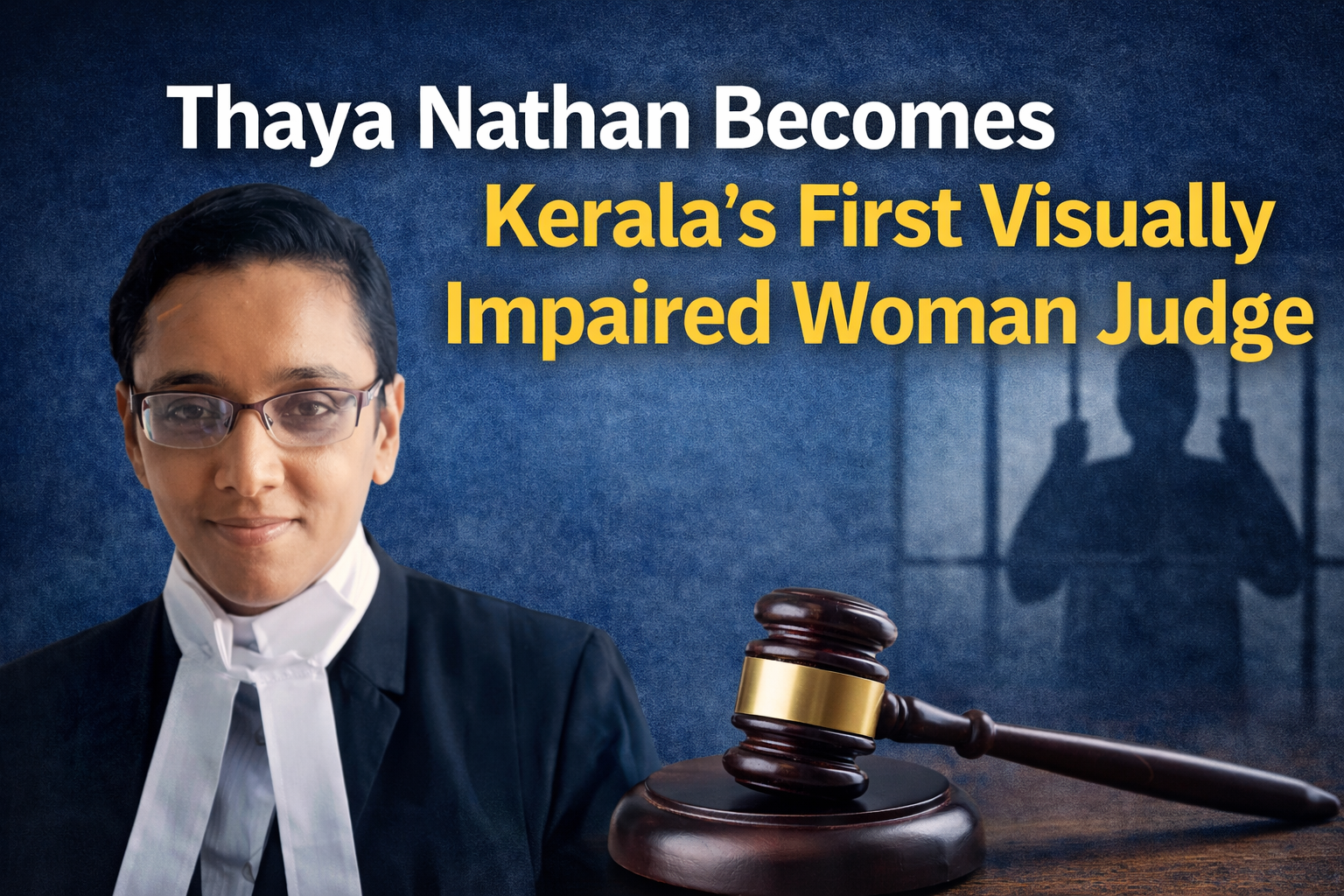
The appointment of Thaya Nathan as Kerala’s first visually impaired woman judge represents a crucial moment for the Indian judiciary system. Her elevation is not merely a personal success story but a landmark event in the evolution of judicial inclusivity in India. The appointment establishes new standards for understanding disability and merit and constitutional equality rights which judges use to administer justice.
The path of Thaya Nathan becomes Kerala’s first visually impaired woman judge demonstrates how her determination and constitutional values and judicial reform efforts succeeded against enduring institutional obstacles. Her success demonstrates that disability should not prevent individuals from participating when their abilities and skills have been proven.
The historic development establishes enduring effects which impact both judicial history in India disability rights law and constitutional equality interpretation.
Background of Thaya Nathan.
Thaya Nathan comes from the Kasaragod district which is located in Kerala. She is a visually impaired advocate who pursued her legal education with distinction despite the challenges posed by visual disability. She started her legal career as an advocate after completing her law degree and she established her professional reputation through her work in the legal field.
Her academic and professional journey demonstrates that visual impairment does not limit intellectual ability or judicial competence. She used assistive technologies which included screen-reading software and Braille resources to complete her legal education and professional work.
The moment Thaya Nathan becomes Kerala’s first visually impaired woman judge, it sends a strong message that the judiciary is evolving beyond traditional assumptions about physical ability.
Judicial Services Examination and Merit Selection
The Kerala Judicial Services Examination stands as the most important achievement which Thaya Nathan successfully completed through his academic excellence. She secured her position under the category for persons with disabilities, ranking first among candidates with benchmark disabilities.
The judicial system selected her for the position because of her qualifications instead of treating her appointment as a special privilege. The selection process for judicial positions achieved its goals because of this particular appointment which confirmed judicial recruitment standards.
Her eligibility to receive recognition of her skills establishes legal grounds for implementing disability reservations according to both constitutional and statutory provisions.
Legal Context: Rights of Persons with Disabilities
Thaya Nathan becomes Kerala’s first visually impaired woman judge from the visually impaired community of Kerala should be contextualized among the broader queer legal discourse in the country.
Constitutional Provisions
The Indian Constitution guarantees:
- Article 14 – establishes that all individuals must be treated equally under the law.
- Article 15 – establishes that all forms of discrimination must be banned.
- Article 16 – guarantees all people the right to compete for government jobs without facing discrimination.
- Article 21- establishes that every person has the right to live with dignity.
These provisions collectively mandate inclusion and non-discrimination in state employment, including judicial services.
Role of the Rights of Persons with Disabilities Act, 2016
The Rights of Persons with Disabilities Act, 2016 (RPwD Act) contributed much to the achievement.
Key provisions include:
- Reservation in government employment
- Reasonable accommodation
- Equal opportunity in public offices
The RPwD Act recognizes visual impairment as a benchmark disability and requires the state to remove structural barriers.
The appointment of Thaya Nathan aligns squarely with the legislative intent of the RPwD Act.
Supreme Court Judgment That Changed the Landscape
A turning point in this journey came with a Supreme Court judgment delivered in March 2025, which clarified that persons with visual disabilities are eligible for judicial service.
The Court held that:
- Disability cannot be equated with incompetence
- Judicial functions rely on reasoning, interpretation, and application of law
- Assistive technology sufficiently enables visually impaired judges to perform duties
This judgment laid the legal foundation upon which Thaya Nathan becomes Kerala’s first visually impaired woman judge.
Breaking Stereotypes in the Judiciary
Traditionally, the judiciary was viewed as requiring physical abilities such as reading printed files, observing witnesses visually, and handling paper-based records. Thaya Nathan’s appointment dismantles these outdated notions.
Modern judicial systems rely on:
- Digital case records
- Assistive technology
- Court support infrastructure
Her elevation proves that judicial competence is intellectual, not physical.
Significance for Judicial History in India
The event where Thaya Nathan becomes Kerala’s first visually impaired woman judge represents a milestone in Indian judicial history for several reasons:
- First visually impaired woman judge in Kerala
- Strengthening diversity in judiciary
- Implementation of constitutional equality
- Recognition of disability rights in judicial offices
This achievement will be cited as a precedent for inclusive judicial appointments across India.
Impact on Women and Persons with Disabilities
The intersection of gender and disability makes this achievement even more significant.
Key impacts include:
- Empowerment of women with disabilities
- Increased representation in judiciary
- Motivation for law students with disabilities
- Reframing social perceptions of disability
Her appointment sends a powerful message that intersectional discrimination has no place in constitutional governance.
Judicial Duties and Assistive Accommodations
As a judge, Thaya Nathan will perform duties such as:
- Conducting trials
- Writing judgments
- Interpreting statutes
- Upholding constitutional values
With reasonable accommodations such as:
- Screen readers
- Digital files
- Court staff assistance
There is no legal or functional barrier to her judicial role.
Public and Institutional Response
The legal fraternity, disability rights activists, and constitutional scholars have widely welcomed the appointment. It is seen as:
- A victory for inclusive governance
- A progressive step in judicial reform
- A practical implementation of constitutional morality
The event where Thaya Nathan becomes Kerala’s first visually impaired woman judge has been celebrated nationally.
Challenges Ahead
While the achievement is historic, challenges remain:
- Uniform infrastructure across courts
- Sensitization of judicial staff
- Policy clarity across states
However, her appointment sets the groundwork for future systemic improvements.
Long-Term Legal and Social Implications
This development is likely to:
- Influence judicial recruitment policies nationwide
- Strengthen disability rights litigation
- Promote inclusive interpretation of service rules
- Encourage constitutional courts to expand equality jurisprudence
It reinforces the idea that justice must be accessible not only to litigants but also to those who deliver it.
Conclusion
The moment Thaya Nathan becomes Kerala’s first visually impaired woman judge stands as a defining chapter in India’ constitutional and judicial evolution. The achievement demonstrates how merit succeeds over bias and inclusion prevails over exclusion and constitutional principles triumph over institutional resistance.