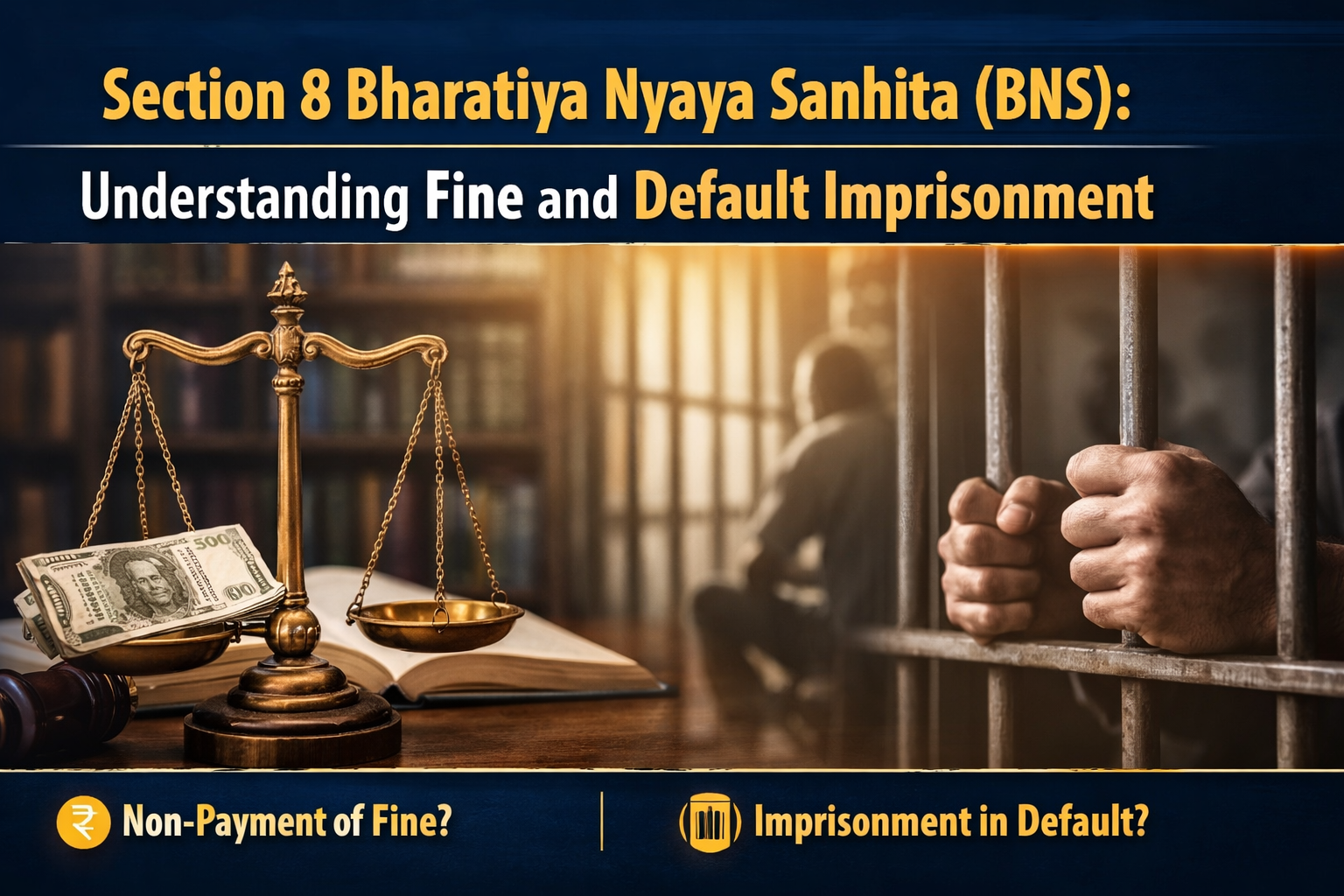
Section 8 Bharatiya Nyaya Sanhita (BNS): Understanding Fine and Default Imprisonment
The Bharatiya Nyaya Sanhita (BNS) implementation, which begins on July 1, 2024, will completely change the Indian legal system. For individuals and businesses in Rajasthan and Gujarat, understanding the new rules regarding monetary penalties is crucial.
The Section 8 BNS as a new law that supersedes existing Indian Penal Code (IPC) provisions about fines. The document explains how courts can impose fines extra penalties for not paying fines and the introduction of Community Service as a new punishment option.
The Shift from IPC to BNS: What has changed?
The BNS Section 8 BNS serves as a unified document which combines the content of IPC Sections 63 through 70.
- Consolidation: The BNS system provides an easier process for users to find information because it uses a seven-clause system instead of multiple section links.
- Modernization: The existing fine slabs have undergone substantial expansion to establish current economic standards.
- New Concept: Community Service has become a newly introduced element which now functions as an essential part of standard punishment systems.
Detailed Breakdown of Section 8 BNS (Clauses 1 to 7)
Section 8(1) – Amount of Fine
- Old Provision: IPC Section 63
- Legal Rule: Where no specific sum is expressed in the law for a fine, the amount to which the offender is liable is unlimited, but shall not be excessive. * Expert Note: Courts in Rajasthan and Gujarat must balance the gravity of the offense with the financial capacity of the accused.
Section 8(2) – Liability in Default of Payment
- Old Provision: IPC Section 64
- Legal Rule: The court has the power to impose a specific prison sentence which will be served after the offender finishes their current prison term when an offender does not pay their required fine.
Section 8(3) – Limit of Imprisonment for Non-Payment
- Old Provision: IPC Section 65
- Legal Rule:The maximum imprisonment term for a punishment that includes both jail time and financial penalties will be limited to one-fourth (1/4th) of the highest sentence established for the specific crime.
- Example: If the maximum punishment for a crime is 4 years, the default jail for not paying the fine cannot exceed 1 year.
Section 8(4) – Nature of Default Imprisonment
- Old Provision: IPC Section 66
- Legal Rule: The imprisonment imposed for non-payment of a fine or non-compliance with Community Service may be of any description (Rigorous or Simple) to which the offender might have been sentenced for the offense.
Section 8(5) – Fine-Only Offenses and Community Service
- Old Provision: IPC Section 67
- Legal Rule: This clause applies to minor offenses where the punishment is only a fine or community service. The imprisonment for default is always Simple Imprisonment. The new BNS slabs are:
| Fine Amount | Maximum Default Imprisonment |
| Up to ₹5,000 | 2 Months |
| Up to ₹10,000 | 4 Months |
| Any other case (Above ₹10,000) | Up to 1 Year |
Section 8(6) – Termination upon Payment
- Old Provision: IPC Sections 68 & 69
- Legal Rule: The imprisonment will terminate as soon as the fine is paid. If a portion of the fine is paid during the jail term, the imprisonment will be reduced proportionally.
Section 8(7) – Recovery of Fine and Liability of Property
- Old Provision: IPC Section 70
- Legal Rule: The government can recover the fine within 6 years of the sentence. If the imprisonment term is longer than 6 years, the fine can be recovered until the term ends.
- Crucial Point: The death of the offender does not discharge the liability. The fine can still be recovered from the deceased person’s property.
Comparison Table: IPC vs. BNS Section 8
| Feature | IPC (Old) | BNS Section 8 (New) |
| Structure | Scattered Sections (63-70) | Consolidated (Clauses 1-7) |
| Monetary Slabs | Outdated (₹50, ₹100) | Modernized (₹5,000, ₹10,000) |
| Community Service | Not Mentioned | Explicitly included in default rules |
| Max Default (Fine-only) | 6 Months | Up to 1 Year |
Why Rajasthan & Gujarat Clients Choose Go Legal Consultancy?
Navigating the Bharatiya Nyaya Sanhita requires more than just reading the law; it requires strategic application. At Go Legal Consultancy, we specialize in:
- BNS Compliance: Ensuring your legal strategy is updated for the 2024 reforms.
- Fine Mitigation: Representing clients in Rajasthan and Gujarat High Courts to ensure fines are not “excessive.”
- Property Protection: Protecting the estate of a deceased from aggressive fine recovery under Section 8(7).
Frequently Asked Questions (FAQs)
- Can the court seize my property for an unpaid fine? Yes, under Section 8(7), the court can authorize the attachment and sale of property to recover the fine.
- What is Community Service in BNS? It is a new form of punishment for petty offenses. Failure to perform it leads to simple imprisonment under Section 8(5).