
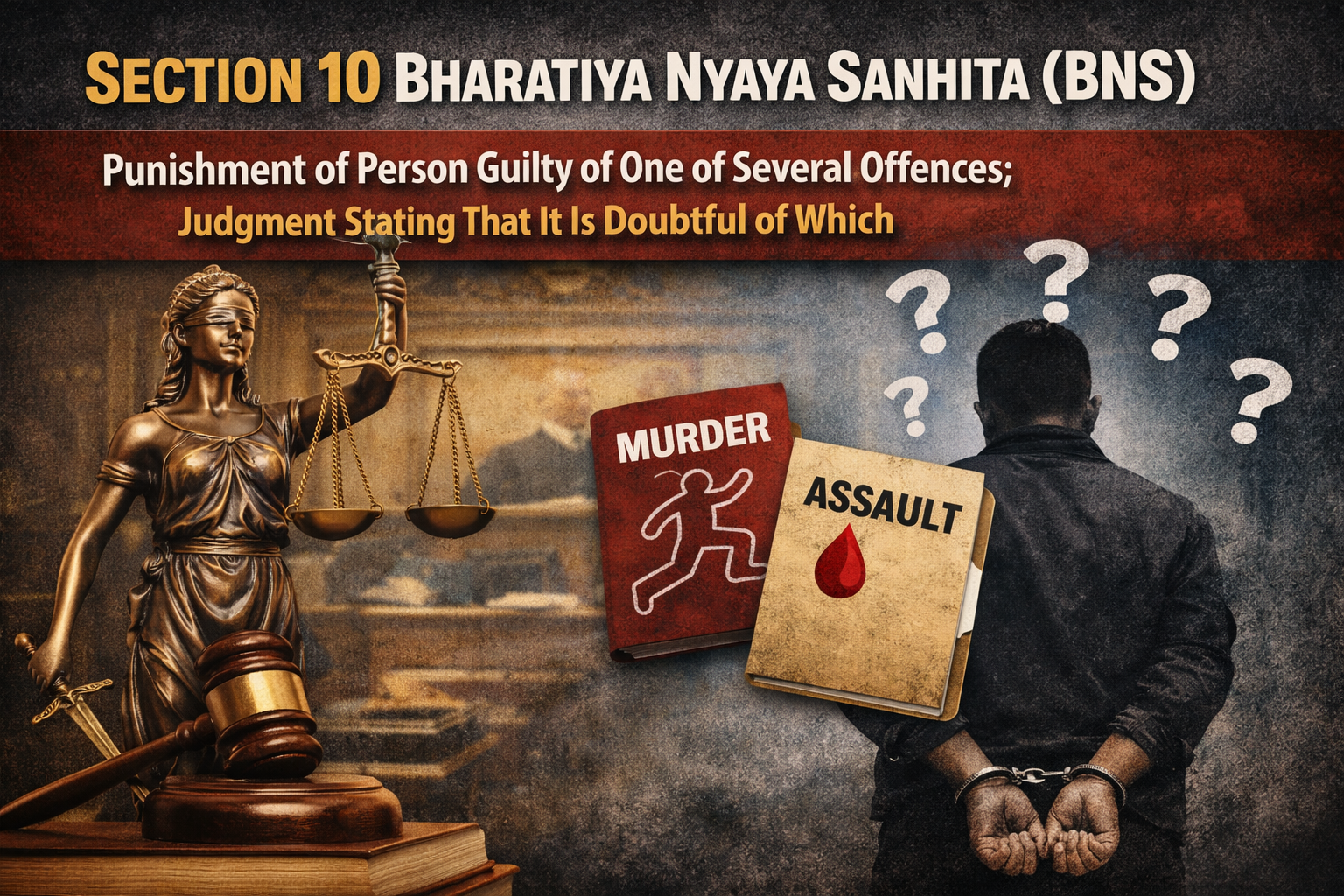
The Bharatiya Nyaya Sanhita establishes new foundation for India’s criminal law because it replaces existing Indian Penal Code. The main procedural-substantive safeguard of the system exists in Section 10 BNS – Punishment of person guilty of one of several offences which establishes the punishment for offenders whose guilt survives a court’s determination of multiple charges against them.
Criminal trials handle cases where multiple offenses share common evidence. The evidence may establish guilt but the assessment remains uncertain regarding which specific offense was committed. Section 10 BNS – Punishment of person guilty of one of several offences establishes clear guidelines for handling such situations while delivering justice that upholds fairness standards.
Understanding Section 10 BNS – Punishment of person guilty of one of several offences
This provision applies when:
- The accused is charged with multiple offences.
- Evidence establishes that one of those offences has been committed.
- The court is doubtful about which particular offence is proved.
- All the offences carry different punishments.
In such circumstances, Section 10 BNS – Punishment of person guilty of one of several offences authorizes the court to punish the accused with the punishment prescribed for the offence carrying the lowest punishment among those offences.
Key Objective
- Prevent wrongful excessive punishment.
- Maintain fairness when classification of offence is uncertain.
- Balance judicial discretion with protection of accused rights.
This section directly addresses the issue of Doubtful offence under BNS, ensuring that ambiguity does not result in disproportionate sentencing.
Legal Principle Behind the Provision
The foundation of Section 10 BNS – Punishment of person guilty of one of several offences lies in the doctrine of benefit of doubt and proportional sentencing.
Why It Matters
- Criminal law requires proof that exceeds all reasonable doubts.
- The court can only impose severe penalties for the case when all details about the crime remain uncertain.
- The prosecution needs to present clear evidence which establishes guilt for the defendant’s more serious charges.
The Bharatiya Nyaya Sanhita system requires proof of guilt before any punishment can be applied.
When Does Section 10 BNS Apply?
The provision operates in specific situations:
1. Multiple charges under BNS
When a person is charged with several offences based on the same set of facts, and the evidence supports guilt but not precise categorization.
Example:
- An act may amount to grievous hurt or simple hurt.
- If the court is unsure which is established, punishment must correspond to the lesser offence.
2. Judgment when offence is uncertain BNS
When the court records conviction but explicitly states doubt regarding which specific offence applies.
3. Sentencing in alternative offences BNS
Where alternative offences are framed in charge, and ambiguity persists at the time of judgment.
Court Powers Under Section 10 BNS
The Court powers under Section 10 BNS are limited yet significant. The court:
- May convict the accused.
- Must choose the offence with the lesser punishment.
- Cannot impose the higher punishment unless clearly established.
This ensures that judicial discretion does not override fairness.
Important Safeguard
The provision protects the accused from:
- Arbitrary sentencing.
- Excessive penal consequences.
- Misclassification of offence leading to higher punishment.
Thus, Section 10 BNS – Punishment of person guilty of one of several offences strengthens procedural justice within substantive law.
Difference Between Section 10 BNS and Section 71 IPC
To understand its significance, it is useful to compare it with the earlier framework under the Indian Penal Code.
Difference between Section 10 BNS and Section 71 IPC
- Section 71 IPC dealt with limitation of punishment when an act constituted several offences.
- It primarily focused on preventing double punishment.
- Section 10 BNS – Punishment of person guilty of one of several offences specifically addresses doubt about which offence has been committed.
- The BNS provision is more structured in dealing with uncertain classification at the stage of conviction.
While Section 71 IPC restricted cumulative punishment, Section 10 BNS directly addresses sentencing in cases of uncertainty.
Practical Application in Criminal Trials
In real courtroom situations, facts are rarely simple. A single act may:
- Fall within two different penal provisions.
- Raise ambiguity about intention.
- Create uncertainty regarding degree of harm.
In such cases, the court applies Section 10 BNS – Punishment of person guilty of one of several offences to ensure fairness.
Example Scenario
If an accused is charged with:
- Attempt to murder
- Causing grievous hurt
But the evidence clearly proves harm without clear proof of intent to kill, the court may punish under the lesser offence due to Doubtful offence under BNS.
BNS Punishment Provisions Explained
The BNS punishment provisions explained under Section 10 emphasize proportionality.
Core Principles:
- Punishment must match proven offence.
- Ambiguity benefits the accused.
- Sentencing must not exceed the minimum proven threshold.
This reinforces constitutional protections under Articles 20 and 21 of the Indian Constitution, safeguarding liberty and due process.
Impact on Criminal Liability Under Bharatiya Nyaya Sanhita
The provision plays a central role in shaping Criminal liability under Bharatiya Nyaya Sanhita.
How It Protects Accused Persons:
- Prevents conviction under a harsher category without certainty.
- Ensures clarity in judicial reasoning.
- Reduces wrongful sentencing risks.
At the same time, it does not allow offenders to escape liability entirely. Conviction is still recorded; only punishment is moderated.
Importance in Sentencing in Alternative Offences BNS
Framing alternative charges is common in criminal trials. Courts often:
- Frame two or more charges for safety.
- Leave final determination to trial evidence.
When ambiguity persists even after full trial, Sentencing in alternative offences BNS becomes guided by Section 10.
This ensures that:
- Judicial errors in classification do not harm the accused.
- Justice remains balanced.
- Public confidence in criminal courts is maintained.
Why Section 10 BNS Is Crucial in Modern Criminal Law
The modern criminal justice system demands:
- Fair trial standards.
- Transparent reasoning in judgments.
- Balanced sentencing practices.
Section 10 BNS – Punishment of person guilty of one of several offences reflects these principles. It bridges gaps between evidentiary uncertainty and final sentencing.
By clearly defining the court’s approach in Judgment when offence is uncertain BNS, the law prevents misuse of discretion and strengthens judicial accountability.
Conclusion
Section 10 BNS – Punishment of person guilty of one of several offences is a vital safeguard within the Bharatiya Nyaya Sanhita. It applies when guilt is established but uncertainty remains regarding the exact offence committed. In such cases, the court must impose punishment corresponding to the lesser offence.
Through this mechanism, the provision addresses Doubtful offence under BNS, regulates Multiple charges under BNS, clarifies Court powers under Section 10 BNS, and distinguishes itself in the Difference between Section 10 BNS and Section 71 IPC. It also reinforces fair Sentencing in alternative offences BNS and clarifies Criminal liability under Bharatiya Nyaya Sanhita.
Section 10 BNS – Punishment of person guilty of one of several offences demonstrates that legal penalties should only be applied based on evidence which has reached full certainty. The provision protects against excessive punishment because it establishes doubt as a barrier which must not lead to heavier penalties.