The Bharatiya Nyaya Sanhita 2023 BNS establishes a fundamental transformation of India’s criminal justice system through its implementation. The most controversial aspect of the law exists within its Section 11 Bharatiya Nyaya Sanhita Solitary Confinement provision, which extends the existing system of Section 73 from the IPC. Although the wording remains unchanged, the current text requires new interpretation because it exists in contemporary constitutional and human rights frameworks.
This article provides a detailed and expert-level analysis of Section 11 Bharatiya Nyaya Sanhita Solitary Confinement which includes statutory limits and judicial safeguards and constitutional boundaries and international standards and practical application.
Section 11 Bharatiya Nyaya Sanhita Solitary Confinement – Statutory Foundation
The core concept of Section 11 Bharatiya Nyaya Sanhita Solitary Confinement is that isolation is not an independent punishment. It can only be imposed when the convict is already sentenced to rigorous imprisonment.
Under Types of punishment under BNS Section 11, the recognized punishments include:
- Death penalty
- Imprisonment for life
- Rigorous or simple imprisonment
- Forfeiture of property
- Fine
The law regards solitary confinement as a distinct category of strict prison detention. The BNS Section 11 punishment cannot be applied when the sentence consists of basic imprisonment only.
Nature and Purpose of Solitary Confinement under BNS
Solitary Confinement under BNS involves the physical isolation of a convicted prisoner from other inmates for a defined period. The objective historically has been deterrence and disciplinary control.
The Solitary Confinement punishment in BNS 2023 is designed to:
- Impose additional severity for grave offences
- Maintain prison discipline
- Act as a deterrent for violent or disruptive convicts
The current interpretation of constitutional law demands that punishment should not be administered through methods which inflict cruel or degrading treatment upon individuals.
BNS 2023 Solitary Imprisonment Rules: Duration Limits
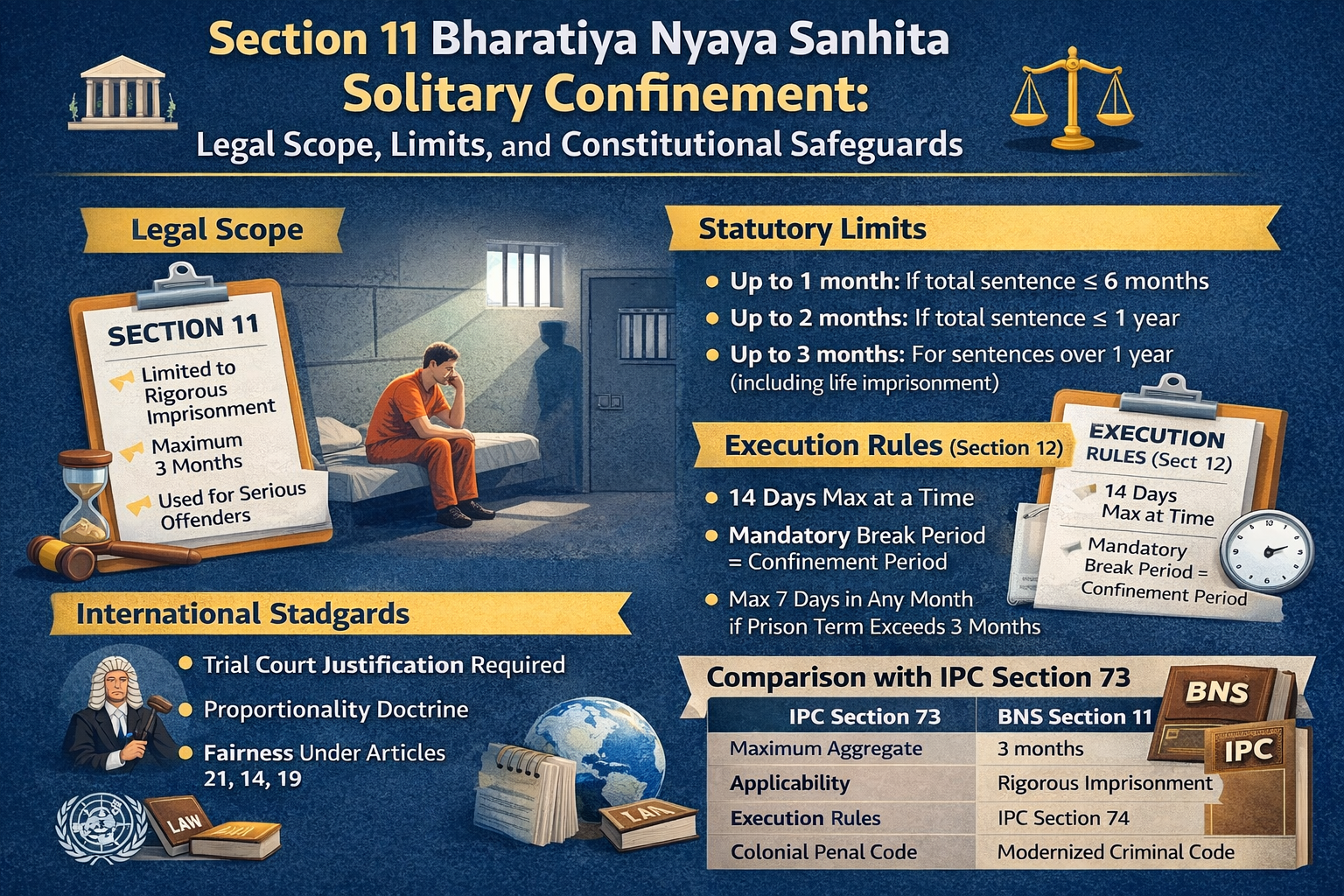
One of the most important features of Section 11 Bharatiya Nyaya Sanhita Solitary Confinement is its mathematical proportionality framework.
The BNS 2023 solitary imprisonment rules divide maximum isolation into three categories:
1. Imprisonment up to Six Months
The maximum sentence is six months, in which solitary confinement may not exceed a number of months, in order to fulfill Article 7 of this Convention.
2. Six Months to One Year
Isolation may not extend for more than 2 months if the sentence is between six months and one year.
3. Exceeding One Year
The maximum duration of solitary confinement for prisoners serving sentences longer than one year, which includes life imprisonment, reaches three months.
The three-month limit applies solely to the total time of solitary confinement, which people will spend in their entire prison sentence.
The 2023 Indian Solitary confinement law establishes a system that maintains proportionality through its current framework.
Execution Safeguards: Reading Section 11 with Section 12
To fully understand Section 11 BNS explained, one must read it alongside Section 12 of the BNS (successor to IPC Section 74).
Execution restrictions include:
- 14-Day Maximum at a Stretch: The idea of extended solitary confinement in excess of 14 days is simply ridiculous.
- Mandatory Intervals: The pause between two solitary states must allow for a lapse of at least the time taken up by the isolation itself.
- Monthly Cap: No one may be held in solitary confinement in excess of seven consecutive days in one mo . recess than ninety days.
The rules establish two primary goals which serve to identify both the mental damage caused by extended periods of isolation and the need to control imprisonment procedures according to Bharatiya Nyaya Sanhita Section 11.
Constitutional Framework Governing Section 11
Article 21 – Right to Life and Personal Liberty
The Supreme Court has consistently held that prisoners maintain essential rights until the government establishes legal restrictions on those rights. The application of Section 11 Bharatiya Nyaya Sanhita Solitary Confinement requires assessment through three specific criteria which include fairness, non-arbitrariness, and proportionality.
Article 14 – Equality Before Law
Solitary confinement cannot be selectively imposed without rational classification. Discriminatory application may violate Article 14.
Article 19 – Reasonable Restrictions
While in detention, essential freedoms become restricted, but all restrictions should be valid and relative.
The doctrine of proportionality now forms the backbone of reviewing New criminal law solitary confinement provision.
Landmark Judicial Interpretations
Sunil Batra v. Delhi Administration
The Supreme Court held that solitary confinement without statutory sanction or excessive isolation violates constitutional guarantees. The Court emphasized that jail walls do not separate prisoners from fundamental rights.
Charles Sobhraj Case
The judiciary reiterated that punitive isolation must follow statutory authority and cannot be imposed arbitrarily by prison officials.
These judgments shape how Section 11 BNS Solitary Confinement is interpreted today.
Difference Between Solitary and Separate Confinement
A critical distinction under Solitary confinement law in India 2023 is between:
- Solitary Confinement – While in detention, essential freedoms become restricted, but all restrictions should be valid and relative.
- Separate Confinement – Conditions are worthy of fulfillment.
Section 11 of “Bharatiya Nyaya Sanhita” includes only the later as a solitary punishment.
International Human Rights Perspective
Under the United Nations Standard Minimum Rules for the Treatment of Prisoners (Mandela Rules):
- Prolonged solitary confinement beyond 15 days is considered potentially cruel or degrading.
- Indefinite solitary confinement is discouraged.
Although Indian law allows up to three months aggregate isolation, the structured intervals reflect partial alignment with global standards.
The New criminal law solitary confinement provision must be interpreted harmoniously with international human rights obligations.
Practical Application in Courts
In reality, BNS Section 11 punishment is rarely imposed for minor offences. Courts generally reserve it for:
- Violent offenders
- Organized crime participants
- Repeat offenders posing discipline threats
- Grave offences involving brutality
Judges must record reasons while ordering solitary confinement, ensuring transparent judicial discretion under Section 11 Bharatiya Nyaya Sanhita Solitary Confinement.
Critical Analysis: Reformative vs Deterrent Philosophy
The BNS introduces progressive measures such as community service in other provisions. However, by retaining Solitary Confinement punishment in BNS 2023, the legislature preserves the deterrent model of punishment.
This raises critical questions:
- Does solitary confinement align with reformative justice?
- Can psychological isolation rehabilitate offenders?
- Should future judicial interpretation narrow its application?
The balance between deterrence and human dignity will determine how Section 11 Bharatiya Nyaya Sanhita Solitary Confinement evolves.
Key Differences: IPC Section 73 vs BNS Section 11
| Feature | IPC Section 73 | BNS Section 11 |
| Maximum Aggregate | 3 Months | 3 Months |
| Applicability | Rigorous Imprisonment | Rigorous Imprisonment |
| Execution Rules | IPC Section 74 | BNS Section 12 |
| Context | Colonial Penal Code | Modernized Criminal Code |
While structurally similar, Solitary confinement law in India 2023 functions within a more rights-conscious judicial climate.
Conclusion: Controlled Severity within Constitutional Boundaries
The inclusion of Section 11 Bharatiya Nyaya Sanhita Solitary Confinement demonstrates that isolation remains a legally recognized punitive tool in India. The system contains strict statutory caps and execution safeguards and constitutional oversight which prevent it from operating in an arbitrary manner.
The framework ensures:
- Aggregate limit of three months
- Maximum 14 days at a stretch
- Mandatory intervals
- Judicial discretion
- Constitutional review
Given the court’s reading of Section 11 of the BNS Act and solitary confinement, concerns with proportionality and human dignity may continue to dominate the legal interpretation in the future.