The Bharatiya Nyaya Sanhita (BNS) 2023 serves as a significant legal framework which brought contemporary updates to Indian criminal statutes. Section 16 BNS functions as a fundamental protective measure which guards both ordinary people and government officials who execute judgment or order of Court. The provision protects individuals from criminal charges when they follow judicial orders because the court later determines that the order was issued without proper authority.
The law protects all individuals who conduct their activities according to the judgment or order of Court . This blog examines Section 16 BNS in depth, covering its scope, underlying principles, practical application, and its transition from the old law (Section 78 IPC) to the new law (Section 16 BNS).
What Is Section 16 BNS? Understanding the Judgment or Order of Court Defence
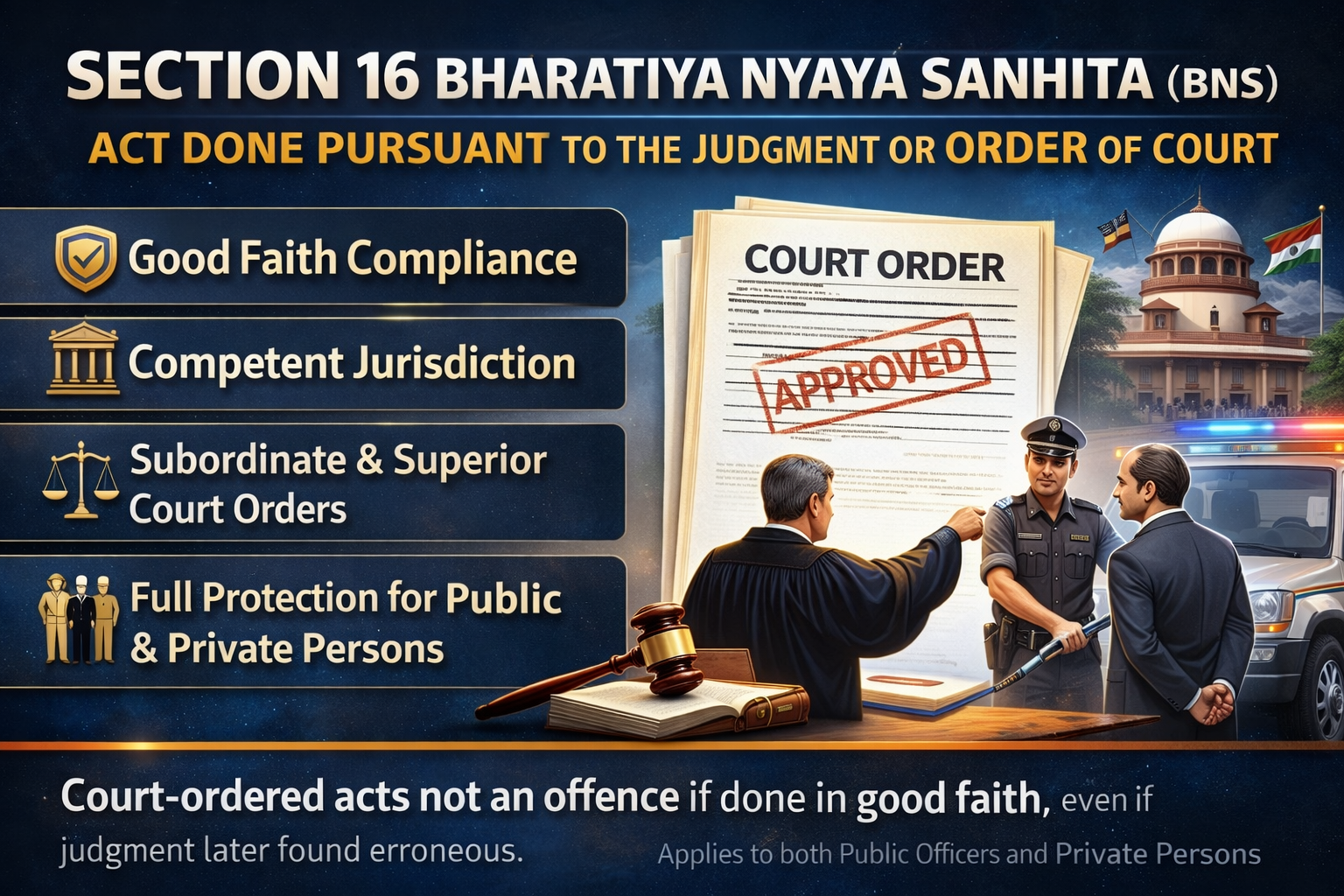
The Bharatiya Nyaya Sanhita Section 16 establishes that criminal offenses do not exist when individuals execute their actions according to a valid Judgment or Order of Court which they believe the court had authority to issue and they perform their tasks with honest intentions.
This section is the equivalent to Section 78 IPC, the corresponding provision under the old Indian Penal Code, 1860. The BNS 2023 repealed the IPC yet the legislation maintained this protection because it serves as a fundamental element of a street operational rule-of-law system.
Core Elements of Section 16 BNS
- Existence of a Judgment or Order of Court: A court’s decree, judgment, warrant, or writ must be in writing.
- Competent Jurisdiction: The court needed to possess judicial authority which allowed it to issue the order during the time period when the order was issued. An order by a court lacking jurisdiction does not attract the protection of Section 16 BNS.
- Bona fide compliance: The act must be done honestly, without fraud, malice, or any ulterior purpose. This is the central test under Section 16 BNS.
- Absence of Bad Faith: A person who manipulates the judicial process to obtain an order for personal gain cannot claim the shield of Section 16 BNS.
Scope and Limitations of Protection Under Section 16 BNS
The scope and limitations of protection under Section 16 BNS are carefully drawn by the legislature. The section is not a blanket immunity clause — it has defined boundaries that courts have consistently recognised.
What Is Covered
- Acts done in compliance with a Judgment or Order of Court of a court having competent jurisdiction.
- Acts performed by public officers as well as private individuals acting on judicial directions.
- Acts that result in harm to a third party — if done in bona fide compliance with a court’s direction, criminal liability is excluded.
- Acts carried out pursuant to a subordinate court order or a superior court direction — both receive equal protection under Section 16 BNS.
What Is NOT Covered
- Acts done beyond the terms of the Judgment or Order of Court — exceeding the scope of the order is not protected.
- Acts performed with prior knowledge that the court lacked jurisdiction.
- Acts involving fraud, bad faith, or collusion — bona fide compliance is a non-negotiable requirement.
- Acts done after a stay or suspension of the court order by a higher court.
Binding Nature of Court Order and No Mens Rea – Twin Pillars of Protection
Two of the most critical legal principles underpinning Section 16 BNS are the binding nature of court order and the concept of no mens rea / absence of guilty mind. Together, they form the twin pillars on which this provision rests.
Binding Nature of Court Order
A Judgment or Order of Court issued by a court of competent jurisdiction is legally binding on the parties and all persons directed to act upon it. Once an order is validly passed, the law expects compliance — and that compliance is legally protected. The binding nature of court order ensures that persons who follow a court’s directions are not left exposed to criminal prosecution simply because the order was later challenged or reversed.
No Mens Rea / Absence of Guilty Mind
Criminal liability under Indian law generally requires both a wrongful act (actus reus) and a guilty mind (mens rea). A person who follows a Judgment or Order of Court performs an act that does not contain criminal intent because he acts according to judicial authority. The legal defense of no mens rea / absence of guilty mind functions as a strong protection because criminal liability cannot exist without criminal intent.
Erroneous Judgment – Effect on Liability
Perhaps the most practically significant aspect of Section 16 BNS concerns the erroneous judgment – effect on liability. The law establishes absolute clarity which states that a person who acted according to a Judgment or Order of Court yet later learned that the legal basis was incorrect still enjoys complete protection from criminal charges because he acted in good faith.
The principle serves two functions which protect public order and secure courtroom compliance. If every person who executed a court’s directions faced criminal risk whenever a judgment was overturned on appeal, no one would dare to act on court orders. The law protects individuals who follow orders in good faith because it understands that legal orders can be challenged in court.
- Illustration 1: A court officer carries out an arrest pursuant to a warrant issued by a Magistrate. The High Court later cancels the warrant. The officer cannot be prosecuted for wrongful arrest because he acted in good faith to follow a legitimate Judgment or Order of Court which existed at that moment.
- Illustration 2: A private individual hands over custody of goods under a court’s restitution order. The order is reversed on appeal. The individual is protected from criminal liability since the act was performed in good faith pursuant to a Judgment or Order of Court.
Subordinate Court Order vs. Superior Court Direction
The Indian judicial system functions through its established hierarchical system. The protection under Section 16 BNS applies equally to all orders which come from subordinate courts like Civil Judges and Judicial Magistrates and Family Courts and to all orders which come from superior courts like High Courts and Supreme Courts.
- A subordinate court order for property attachment acts as full legal authority for the person executing it, provided competent jurisdiction existed.
- A superior court direction for contempt proceedings, demolition, or restoration of possession — when acted upon in good faith — attracts the full protection of Section 16 BNS.
- The distinction between subordinate and superior courts does not affect the availability of the protection — bona fide compliance with either is fully protected.
Execution of Decree – Practical Importance of Section 16 BNS
The execution of decree is one of the most common real-world situations in which Section 16 BNS becomes immediately relevant. Courts in India pass thousands of decrees every year in civil suits concerning money, property, maintenance, and specific performance. These decrees must be executed — often by court officials acting on the authority of a Judgment or Order of Court.
- Attachment and sale of a judgment-debtor’s property in execution of a money decree.
- Physical eviction of a tenant following a decree for possession.
- Delivery of movable goods under a restitution or specific delivery order.
- Recovery of maintenance amounts under a family court’s Judgment or Order of Court.
In each of these situations, the person carrying out the execution of decree is protected under Section 16 BNS — even if the decree is later challenged — provided the act was done in bona fide compliance with the court’s direction.
Public Officer Executing Court Order – Scope of Protection
Section 16 BNS has particularly significant implications for a public officer executing court order. Police officers, revenue officials, court receivers, bailiffs, district magistrates, and other government servants are frequently called upon to act on judicial directions. Without the protection afforded by the Judgment or Order of Court defence, public servants would be perpetually exposed to the threat of criminal prosecution.
- A police officer executing an arrest warrant issued by a Magistrate is fully protected — the Judgment or Order of Court in the form of the warrant is sufficient legal authority.
- A revenue officer attaching agricultural land pursuant to a civil court’s order acts lawfully — even if the order is reversed on appeal.
- A public officer executing court order for sealing a commercial establishment is protected from criminal prosecution by Section 16 BNS, provided the seal was applied before any stay order was granted.
Private Person Acting on Court Direction – Equal Protection
Section 16 BNS is not limited to public servants. A private person acting on court direction is equally entitled to its protection. This often-overlooked aspect of the section is critically important for individuals who receive court orders requiring them to take certain actions.
If a court appoints a private individual as a court receiver, or directs a party to hand over property, collect rents, or perform any other act — and the person does so in bona fide compliance with the Judgment or Order of Court — that person is protected from criminal liability even if the act harms another party.
Acting Under Compulsion of Law and Ignorance of Illegality as a Valid Defence
Two further principles closely connected to Section 16 BNS are acting under compulsion of law and the doctrine that ignorance of illegality – valid defense can protect an honest actor.
Acting Under Compulsion of Law
Many persons who comply with a Judgment or Order of Court do not do so voluntarily — they are legally compelled to act. A person who receives a court’s direction to deliver property, vacate premises, or perform an act is acting under compulsion of law. This compulsion is a well-recognised basis for excluding criminal liability.
Ignorance of Illegality – Valid Defence
The law does not expect ordinary citizens or even trained officers to independently scrutinise and verify the jurisdictional competence of every court that issues an order. If a person genuinely did not know that the Judgment or Order of Court was ultra vires or beyond the court’s powers, the ignorance of illegality – valid defense is available. This is closely tied to the good-faith requirement of Section 16 BNS.
Civil vs. Criminal Immunity – A Critical Distinction
It is essential to understand the precise nature of the protection offered by Section 16 BNS. The section grants civil vs. criminal immunity — specifically, immunity from criminal liability. It does not automatically extinguish civil liability.
- A person protected from criminal prosecution under Section 16 BNS may still face a civil suit for damages — particularly if the Judgment or Order of Court relied upon is subsequently reversed and the aggrieved party suffers a proven loss.
- Courts have held that restitution and compensation under civil law remain available to affected parties even when criminal liability is excluded by Section 16 BNS.
- The civil vs. criminal immunity distinction ensures fairness — honest compliance is shielded from penal consequences, while civil accountability is preserved for those who suffer loss.
Section 78 IPC vs. Section 16 BNS – Old Law to New Law: A Detailed Comparison
The Bharatiya Nyaya Sanhita, 2023 replaced the Indian Penal Code, 1860 in its entirety. Section 78 IPC — the predecessor to Section 16 BNS — has been carried forward into the new legal framework. The table below presents a comprehensive side-by-side comparison to help practitioners, law students, and the public understand exactly what changed and what remained the same.
| Parameter | Section 78 IPC (Old Law) | Section 16 BNS (New Law) |
| Governing Legislation | Indian Penal Code, 1860 | Bharatiya Nyaya Sanhita, 2023 |
| Section Number | Section 78 | Section 16 |
| Core Principle | Act done pursuant to a Judgment or Order of Court is not an offence if done in good faith | Identical protection retained — no substantive change in the core principle |
| Good Faith Requirement | Mandatory — act must be done in good faith | Mandatory — bona fide compliance is the central test |
| Competent Jurisdiction | Court issuing order must have competent jurisdiction | Same requirement — court must have competent jurisdiction |
| Protection for Public Officers | Applicable to public officers executing court orders | Fully applicable; reinforced under the BNS framework |
| Protection for Private Persons | Available to private persons acting on court direction | Equally and explicitly available to private persons |
| Erroneous Judgment | Protection available even if judgment is later found erroneous | Identical protection — erroneous orders do not strip good-faith actors of protection |
| Subordinate Court Order | Covered — subordinate court orders are sufficient authority | Covered — no change in treatment of subordinate court orders |
| Superior Court Direction | Covered — High Court and Supreme Court directions carry full authority | Covered — identical treatment |
| Civil vs. Criminal Immunity | Criminal immunity only; civil liability may still arise | Same position — criminal immunity only; civil remedies preserved |
| Ignorance of Illegality | Valid defence where good faith is proven | Valid defence — same principle retained under BNS |
| Language & Drafting | Victorian-era English; archaic drafting style of IPC | Modernised, plain-language drafting consistent with BNS style |
| Penalty for Bad Faith | No protection if act done in bad faith or with malicious intent | Same — bad faith excludes all protection under Section 16 |
| Effect of Repeal | Repealed by the BNS, 2023 | Replaces Section 78 IPC; judicial precedents under Section 78 remain applicable |
The table makes it unmistakably clear that Section 16 BNS is the direct equivalent to Section 78 IPC in every material respect. The legislature did not weaken or modify the substantive protection — it simply renumbered and modernised the language. All judicial precedents built under Section 78 IPC over more than 160 years of application remain fully applicable when interpreting Section 16 BNS before courts today.
Key Takeaways from the Old-to-New Transition
- The Judgment or Order of Court defence is wholly preserved under the BNS, 2023.
- Bona fide compliance remains the non-negotiable central requirement under both the old and new law.
- The scope and limitations of protection have not been narrowed — both laws provide identical boundaries.
- The binding nature of court order, no mens rea / absence of guilty mind, and acting under compulsion of law principles remain equally applicable under Section 16 BNS.
- Legal practitioners can confidently cite Section 78 IPC precedents in arguments under Section 16 BNS.
Conclusion
Section 16 of the Bharatiya Nyaya Sanhita, 2023 is a vital provision that upholds the rule of law while offering meaningful protection to those who act in good faith on a Judgment or Order of Court. Whether it is a public officer executing court order, a private person acting on court direction, or a party involved in the execution of decree, Section 16 BNS ensures that honest compliance with judicial authority does not become the foundation of criminal liability.
The principles of bona fide compliance, no mens rea / absence of guilty mind, acting under compulsion of law, and ignorance of illegality – valid defense all converge to make this section a powerful safeguard. The careful treatment of erroneous judgment – effect on liability and the nuanced distinction between civil vs. criminal immunity reflect a mature and balanced legal framework.
As the equivalent to Section 78 IPC, Section 16 BNS carries forward over a century of settled legal principle into the modern era. The Judgment or Order of Court — whether from a subordinate court order or a superior court direction — remains a powerful shield for those who carry it out with honesty and integrity. The binding nature of court order and the scope and limitations of protection provided by Section 16 BNS will continue to guide Indian courts and legal practitioners for generations to come.