The year 2024 marked a watershed moment in Indian legal history. The Bharatiya Nyaya Sanhita (BNS) and the Bharatiya Nagarik Suraksha Sanhita (BNSS) and the Bharatiya Sakshya Adhiniyam 2023 (BSA) first became operational on July 1 2024 through their unified implementation. The three laws which together form this legal system represent the most important Indian criminal justice reform of 2023 which has occurred since the previous 150 years. Section 1 Bharatiya Sakshya Adhiniyam functions as the main element which defines the BSA through its title and territorial scope and operational start date.
Section 1 BSA may look like an ordinary introduction to the BSA act. The BSA act establishes three main legal functions which identify the Bharatiya Sakshya Adhiniyam 2023 as the official Law title. The BSA 2023 legislation establishes its geographic and subject matter limitations while the law specifies its enforcement date which marks the end of the Indian Evidence Act 1872 and the start of the new evidence law system in India 2023. The blog examines all three functions through a comprehensive analysis which compares the previous legal system with the current legal framework.
What Does Section 1 BSA Provide? Short Title, Application and Commencement
The Bharatiya Sakshya Adhiniyam 2023 operates according to three fundamental elements which Section 1 BSA establishes as its governing framework. The three elements together create legal validity which requires people to comprehend each element as an individual component.
1. Short Title — Bharatiya Sakshya Adhiniyam 2023
The short title given by Section 1 BSA to the statute is the Bharatiya Sakshya Adhiniyam 2023 (BSA). The Indian Evidence Act 1872 which British colonial authorities established now receives its first official name change through this legislation. The renaming is not merely cosmetic. The Indian criminal justice reforms 2023 agenda establishes decolonisation of India’s criminal law framework through its transition from an anglicised title to a name based on indigenous Sanskrit roots. The Bharatiya Sakshya Adhiniyam 2023 must become the official name for all legal citations court documents and academic materials that refer to this statute.
2. Application — Scope of BSA 2023
The scope of BSA 2023 as defined by Section 1 completes its objectives through its extensive and comprehensive boundaries. The provision applies to all judicial proceedings before any court in India, including courts martial — except those convened under the Army Act, the Naval Discipline Act, or the Indian Navy (Discipline) Act, or the Air Force Act. The following statement explains:
- Application of evidence law in criminal cases: The Bharatiya Sakshya Adhiniyam 2023 governs all criminal trials and court proceedings across India which include all courts from the lowest Magistrate’s court to the Supreme Court..
- Civil proceedings: The BSA applies equally to civil cases, just as its predecessor, the Indian Evidence Act 1872, did. The BSA establishes the rules for determining relevance and admissibility as well as proof procedures used in civil courts.
- Exclusion of military tribunals: The Army, Navy, and Air Force disciplinary proceedings follow their specific service Acts which operate outside BSA 2023 regulations. The current exclusion mirrors the previous rule established by the Indian Evidence Act 1872.
- Territorial application:Section 1 of BSA establishes its jurisdiction throughout all regions of India which includes both States and Union Territories without any exceptions. The law establishes consistent evidence standards which Indian courts must follow throughout the country.
3. Commencement — Effective Date of BSA 2023
The Central Government announced through a notification the start date for new criminal laws 2023. The three new criminal laws which include the Bharatiya Sakshya Adhiniyam 2023 became effective on July 1 2024. The BSA became effective as the legal replacement for the Indian Evidence Act 1872 on this date. The Bharatiya Sakshya Adhiniyam 2023 governs all judicial proceedings that started on or after July 1 2024 while the Indian Evidence Act 1872 has been repealed. The old Act continues to apply to proceedings that began before this date according to transitional provisions.
Why Section 1 BSA Is More Than a Preliminary Provision
Students and practitioners sometimes overlook Section 1 BSA as a mere procedural formality. This is a fundamental error. The short title, application, and commencement clause of any statute is the gateway to its correct application — and errors in understanding this provision can lead to serious procedural mistakes in court.
Identification of the Governing Law in Proceedings
The correct identification of the governing law — whether the Indian Evidence Act 1872 or the Bharatiya Sakshya Adhiniyam 2023 — depends entirely on the date the proceedings were instituted. The BSA Section 1 establishes July 1 2024 as the exact point which separates two different periods of time. The parties and advocates must use Section 1 BSA to determine which law applies to their case according to legal requirements.
Defining the Scope of Evidence Law
The application of evidence law to both criminal and civil cases receives its definition through . The BSA scope lacks definition because this provision remains absent. establishes evidence law as applicable to all judicial proceedings in Indian courts except for specific exceptions which the law designates.
Anchoring the Reform in Time
The new criminal laws 2023 which Section 1 BSA established as their starting point, determine their entire reform schedule. The Indian criminal justice system needed three years of development before its 2023 reforms received parliamentary approval through committee investigations and public input.
Indian Evidence Act 1872 (Old Law) vs. Section 1 BSA (New Law) – A Detailed Comparison
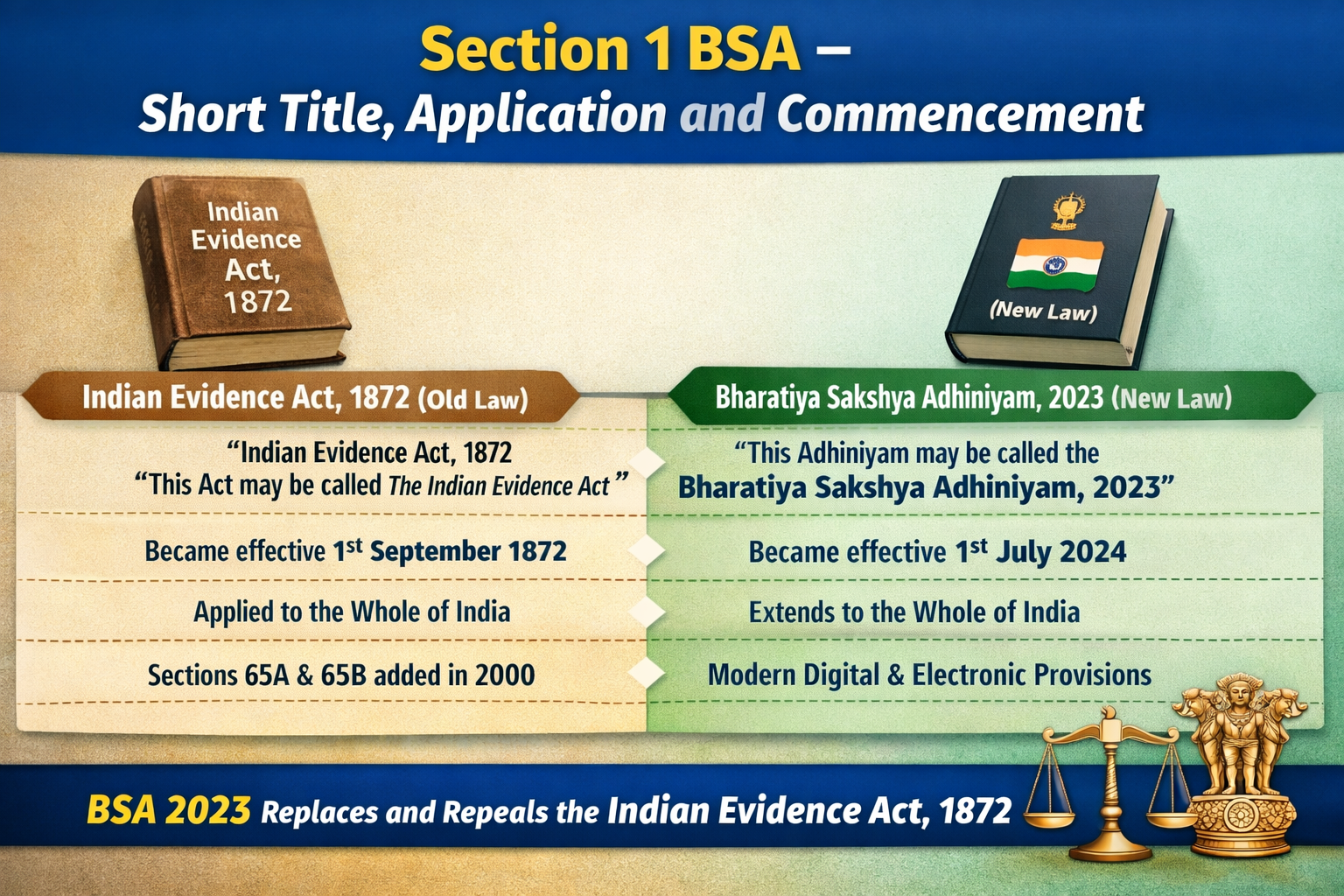
The Bharatiya Sakshya Adhiniyam 2023 serves as the primary evidence law in India which replaces the Indian Evidence Act 1872. The table below presents a clear and detailed comparison between the old law and the new law, focused specifically on the short title, application, and commencement clause.
| Parameter | Indian Evidence Act, 1872 (Old Law) | Bharatiya Sakshya Adhiniyam, 2023 – Section 1 BSA (New Law) |
| Name of Statute | Indian Evidence Act, 1872 | Bharatiya Sakshya Adhiniyam, 2023 (BSA) |
| Short Title Clause | Section 1 of IEA – “This Act may be called The Indian Evidence Act” | Section 1 BSA – “This Adhiniyam may be called the Bharatiya Sakshya Adhiniyam, 2023” |
| Language of Title | English – colonial and anglicised nomenclature | Sanskrit-rooted, indigenous naming aligned with decolonisation reforms |
| Year of Enactment | 1872 – enacted by British Indian Legislature | 2023 – enacted by Parliament of independent India |
| Effective / Commencement | Came into force on 1st September 1872 | Came into force on 1st July 2024 — commencement of new criminal laws 2023 |
| Application to Courts | Applied to all courts in India (except military courts) | Identical application — applies to all judicial proceedings before any court in India |
| Military Courts | Excluded proceedings under Army Act, Naval Discipline Act, Air Force Act | Same exclusion preserved under Section 1 BSA — no change |
| Civil Proceedings | Applied to civil courts and proceedings | Equally applies to civil proceedings — scope of BSA 2023 includes civil courts |
| Criminal Proceedings | Governed application of evidence law in criminal cases | Application of evidence law in criminal cases retained and modernised |
| Territorial Scope | Extended to the whole of India | Extends to the whole of India — identical territorial application |
| Total Sections | 167 sections | 170 sections — additional provisions for electronic and digital evidence |
| Electronic Evidence | Sections 65A and 65B (added in 2000 amendment) | Dedicated modernised provisions on electronic records integrated from inception |
| Colonial Legacy | Retained colonial terminology and structure | Indian criminal justice reforms 2023 — indigenised statutory framework |
| Repealing Provision | No repeal — remained in force for 152 years | Replaces and repeals the Indian Evidence Act, 1872 entirely |
| Key Reform Focus | Primarily paper-based evidence framework | Incorporates digital evidence, electronic records, and technology-neutral drafting |
The comparison shows that Section 1 BSA short title application and commencement match the existing structure of Section 1 Indian Evidence Act 1872 while the Bharatiya Sakshya Adhiniyam 2023 brings more than just a name change. The BSA introduces a modernized evidence law framework for India 2023 which replaces Indian Evidence Act 1872 and includes technology features and constitutional principles.
Key Takeaways from the Old-to-New Transition
- Section 1 BSA formally marks the end of the Indian Evidence Act 1872 — a 152-year-old colonial statute — and the beginning of a new chapter in Indian evidence law.
- The commencement of new criminal laws 2023 on July 1, 2024 creates a clear temporal divide — proceedings before this date are governed by IEA 1872; proceedings after this date are governed by Bharatiya Sakshya Adhiniyam 2023.
- The scope of BSA 2023 is identical to the IEA in its territorial application and court coverage — ensuring no gap or overlap in the transition.
- The Indian criminal justice reforms 2023 collectively signal a shift from colonial criminal law to an indigenised, rights-based, and technologically updated framework.
Conclusion
Section 1 BSA is the foundation upon which the entire Bharatiya Sakshya Adhiniyam 2023 rests. By providing the statute’s short title, defining the scope of BSA 2023, and fixing the date of commencement of new criminal laws 2023, it performs indispensable legal functions. The replacement of Indian Evidence Act 1872 by the BSA — anchored by Section 1 BSA — is not merely a legislative formality. It is a statement of intent: that India’s evidence law in India 2023 will be modern, indigenous, and fit for a 21st-century democracy.
For legal practitioners, Section 1 BSA determines which law applies to every proceeding they handle. For courts, it defines the governing framework for every question of evidence. For citizens, it represents the Indian criminal justice reforms 2023 promise of a more transparent, fair, and technology-ready justice system. Understanding Section 1 BSA in its full depth — including its relationship to the application of evidence law in criminal cases and the scope of BSA 2023 — is therefore not optional for any serious student or practitioner of Indian law. It is the starting point for everything that follows.