In 2023, India witnessed one of the biggest reforms in its criminal justice system when the old CrPC (Code of Criminal Procedure, 1973) was replaced by the Bharatiya Nagarik Suraksha Sanhita (BNSS) 2023.
The most significant impact of BNSS 2023 has been on India’s Bail System. This new law has reshaped not only the rules around bail but also the philosophy of arrest. It strengthens the long-standing principle:
“Bail is the rule, jail is the exception.”
This blog explains how BNSS 2023 changes the bail system, introduces stricter rules on arrest, adds the Notice of Appearance system, and makes Default Bail stronger than ever.
What is BNSS 2023 and Why is the New Bail System Important?
BNSS 2023 completely overhauls the 50-year-old CrPC. Earlier, policing and arrest procedures caused several issues such as:
- Unnecessary arrests
- Custodial harassment
- Delay in investigation
- Overcrowded prisons
- Slow access to justice
BNSS aims to fix these long-standing problems.
Objectives of BNSS 2023
- Reduce unnecessary arrests
- Strengthen personal liberty
- Speed up investigation
- Make bail procedures fair and clear
The new bail system under BNSS significantly improves the balance between individual rights and efficient justice.
Biggest Reform in BNSS 2023 — Arrest Becomes the Last Resort
Under CrPC, police often used arrest as the first response. BNSS reverses this approach.
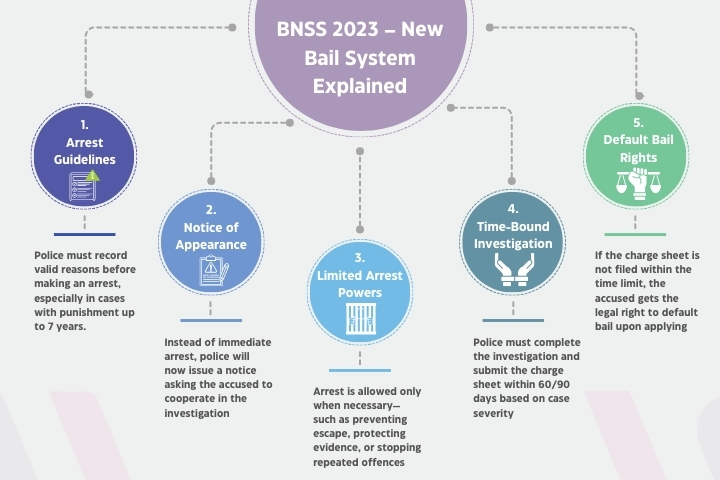
BNSS Section 35 mandates:
Police can arrest a person only if they record written reasons explaining why arrest is necessary.
When is arrest considered essential under BNSS?
Police may arrest only if:
- There is a risk of the accused destroying evidence
- The accused may abscond
- The accused may threaten or influence witnesses
- The offence is serious in nature
- The accused is not cooperating in the investigation
Written justification is now compulsory for every arrest — a revolutionary change that directly impacts bail.
Notice of Appearance — BNSS’s Most Powerful Replacement for Arrest
Instead of arrest, BNSS introduces Notice of Appearance for many offences.
This allows police to instruct the accused:
“Appear before the Police/Investigating Officer on the specified date and time. Arrest will not be made.”
Impact of the Notice System
- Drastically reduces the need for Regular Bail
- Removes fear and harassment associated with arrest
- Gives accused time to prepare
- Promotes transparency
This is one of the most citizen-friendly reforms introduced by BNSS.
Types of Bail Under BNSS (Updated Rules & Meaning)
BNSS retains the traditional categories of bail:
- Regular Bail
- Anticipatory Bail
- Interim Bail
- Default (Statutory) Bail
However, BNSS significantly modifies how each one works.
A. Regular Bail Under BNSS
Regular bail is granted after arrest. BNSS changes affect it in three key ways:
1. Reduced arrests = Fewer regular bail applications
- Since notice will be issued instead of arrest, courts will receive fewer regular bail cases.
2. Courts must impose reasonable conditions
- BNSS prohibits courts from imposing excessive or unrealistic bail conditions.
3. Faster bail hearings
- With strict time limits on investigation, hearings are expected to be quicker.
B. Anticipatory Bail Under BNSS
Although BNSS does not remove anticipatory bail, it changes the environment around it.
Impact of BNSS on Anticipatory Bail
- With arrests becoming rare, fewer anticipatory bail applications will be needed.
- Police must provide written reasons for arrest → courts will make more transparent decisions.
- Notice of Appearance reduces the immediate threat of arrest.
In many cases, anticipatory bail may no longer be necessary.
C. Interim Bail Under BNSS
Interim bail provides short-term protection.
BNSS Impact
- Interim bail will be granted for shorter periods.
- Investigation timelines are strict → long delays are eliminated.
- Interim bail becomes a temporary measure rather than a prolonged relief.
D. Default/Statutory Bail Under BNSS — Much Stronger Now
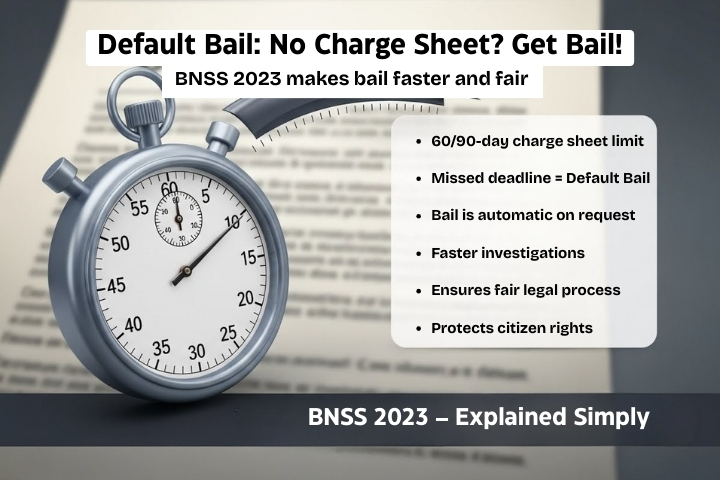
Default bail is one of the strongest rights introduced by BNSS.
Under CrPC, police often delayed filing of charge sheets, keeping the accused in jail for months.
BNSS fixes this by introducing:
- Strict time limits for investigation
- Court-supervised extensions
- Mandatory release if charge sheet is late
If the police fail to file the charge sheet on time, the accused immediately receives Default Bail.
This provision significantly strengthens citizens’ rights.
Bail Conditions Under BNSS — Fair, Reasonable, Transparent
While granting bail, courts must now consider:
- The behavior of the accused
- Nature of the offence
- Possibility of fleeing
- Safety of the victim
- Risk of obstructing investigation
BNSS clearly states that bail conditions cannot be unreasonable or excessive — a major improvement over previous practices.
Victim Rights Strengthened — Mandatory Role in Bail Hearings
BNSS makes victims an active participant in the bail process.
Victim Rights Under BNSS
- Mandatory notification before bail hearings in serious cases
- Right to object to bail
- Court must listen to the victim’s concerns
Earlier, victims were not informed and often excluded from the process.
Increased Police Accountability — Written Record of Every Arrest
BNSS imposes strict accountability on police.
Police must record:
- Why arrest was necessary
- Why notice was not sufficient
- What risks existed if arrest was not made
This prevents misuse of police power.
Benefits:
- Reduced harassment
- Decline in false arrests
- Fewer bail applications
- Less pressure on courts
Key Advantages of the BNSS Bail System (At a Glance)
✔ Arrests significantly reduced
✔ Personal liberty strengthened
✔ Bail system fairer and faster
✔ Strict investigation deadlines
✔ Higher police accountability
✔ Very strong Default Bail provisions
✔ Victim participation mandated
✔ Reduced unnecessary custody
BNSS brings a modern, balanced approach to bail and arrest procedures.
BNSS Bail System vs CrPC — Quick Comparison Table
| Old CrPC | BNSS 2023 |
| Arrest used extensively | Arrest is last option |
| No requirement for notice | Mandatory Notice of Appearance |
| Vague bail conditions | Clear and structured conditions |
| Frequent delays in investigation | Strict timelines |
| Weak default bail | Strong default bail |
| No victim involvement | Victim must be informed |
| Police authority unchecked | Written justification required |
Conclusion
BNSS 2023 brings historic changes to India’s bail system. It strengthens personal liberty, reduces arbitrary arrests, ensures faster investigation, and promotes fairness in judicial processes.
The new system aims to ensure:
“First notice, then investigation, and arrest only if absolutely necessary.”
BNSS aligns India’s bail philosophy with constitutional values —
“Bail is the rule, jail is the exception.”