
The Bharatiya Nagarik Suraksha Sanhita, 2023 (BNSS) is an epoch-making reform in the criminal procedural law of India that will totally replace the Criminal Procedure Code (CrPC). One of its major provisions is Section 14 BNSS, which is concerned with Executive Magistrates. This section of the law effectively establishes the premises for preventive justice, maintaining public order, and exercising administrative control in the criminal justice system.
Section 14 Bharatiya Nagarik Suraksha Sanhita is important for law students, legal practitioners, administration officials, and the general public to understand since Executive Magistrates are flexible in nurturing peace and order at the very bottom of the society.
Understanding Section 14 BNSS
Section 14 BNSS empowers the State Government to appoint Executive Magistrates in every district and metropolitan area. It also authorizes the State Government to appoint one of them as the District Magistrate (DM).
Unlike Judicial Magistrates, who deal primarily with trials and adjudication, Executive Magistrates under BNSS focus on administrative and preventive functions.
Who Are Executive Magistrates?
Executive Magistrates are government officials entrusted with magisterial powers to ensure public peace, safety, and order. Common Executive Magistrates include:
- District Magistrate (DM)
- Additional District Magistrate (ADM
- Sub-Divisional Magistrate (SDM)
- Tehsildar (when empowered)
Under BNSS Section 14 Executive Magistrates, these officers derive their authority directly from statutory provisions.
Appointment of Executive Magistrates Under BNSS
State Government’s Authority
Under Section 14 BNSS, the State Government has the power to:
- Appoint Executive Magistrates
- Define their territorial jurisdiction
- Assign specific powers
The appointment of Executive Magistrates BNSS ensures that every district has adequate administrative officers to handle law-and-order situations.
Role of District Magistrate Under BNSS
The District Magistrate under BNSS holds a central position among Executive Magistrates. The DM is responsible for:
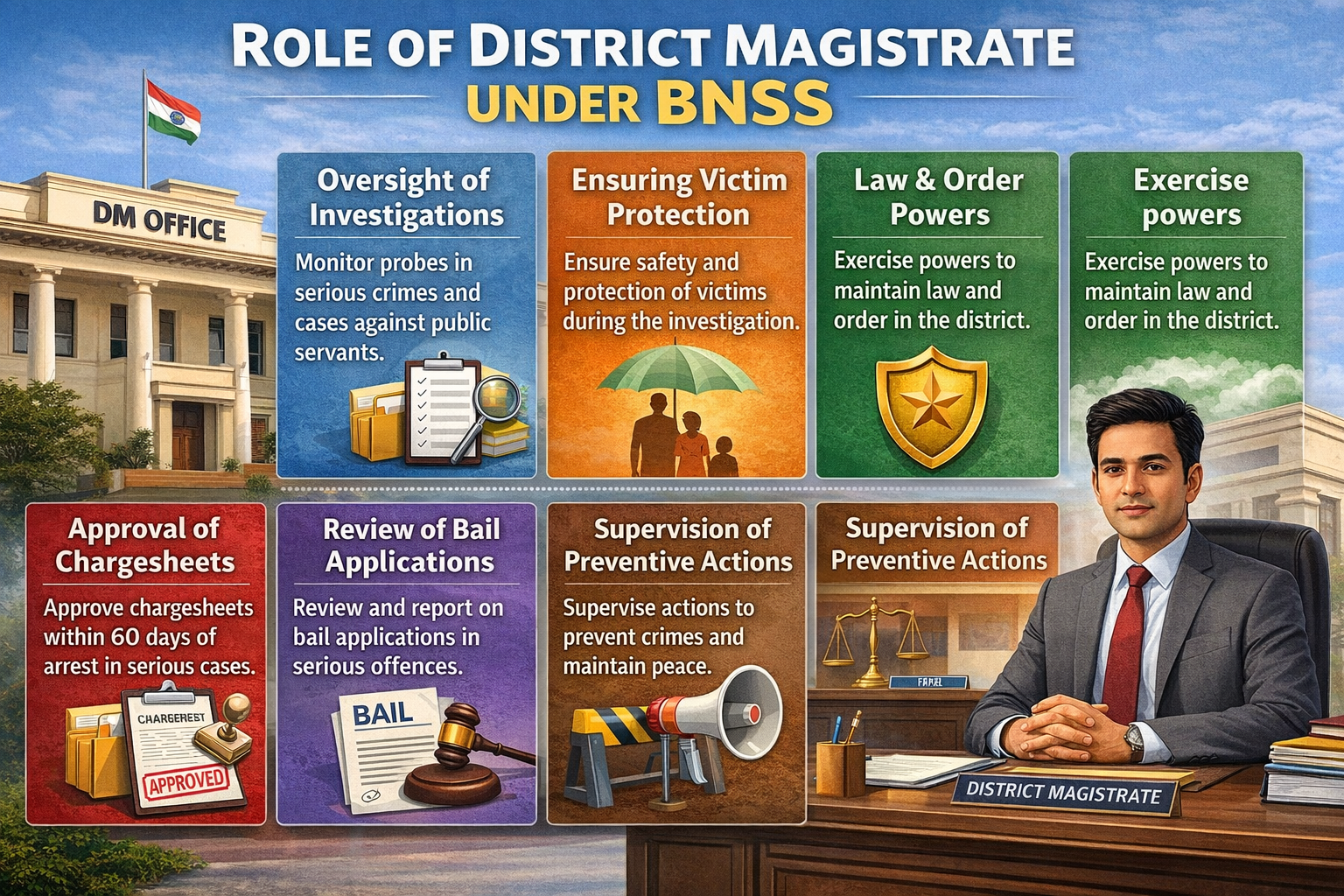
- Supervising other Executive Magistrates
- Maintaining public order
- Coordinating with police and civil administration
- Exercising preventive powers under BNSS
BNSS 2023 Executive Magistrates operate under the overall supervision of the District Magistrate.
Powers of Executive Magistrates Under BNSS
Preventive Justice
One of the most important aspects of the Executive Magistrate powers BNSS is preventive justice. Executive Magistrates can:
- Issue preventive orders
- Take action to prevent breach of peace
- Address urgent public safety concerns
These powers are exercised under various BNSS provisions, such as preventive sections dealing with public nuisance and unlawful assemblies.
Administrative Powers
Under Section 14 BNSS, Executive Magistrates also exercise administrative powers such as:
- Issuing prohibitory orders
- Managing emergency situations
- Supervising enforcement of government directives
These powers make Executive Magistrates under BNSS essential to day-to-day governance.
Executive Magistrates vs Judicial Magistrates
| Aspect | Executive Magistrates | Judicial Magistrates |
| Nature of Work | Administrative & Preventive | Judicial & Adjudicatory |
| Appointment | State Government | State Govt. + High Court |
| Primary Function | Public order | Criminal trials |
| Independence | Administrative | Judicial independence |
This distinction under BNSS Section 14 Executive Magistrates ensures separation of executive and judicial functions.
Importance of Section 14 BNSS
Strengthening Preventive Justice
- Section 14 BNSS explains the importance of proactive governance. Executive Magistrates act before disputes escalate into crimes.
Efficient Law and Order Management
- By empowering local administrative officers, Section 14 BNSS ensures swift decision-making during emergencies.
Reducing Burden on Courts
- Executive Magistrates handle preventive matters, allowing Judicial Magistrates to focus on trials.
Section 14 BNSS vs CrPC
While the CrPC also recognized Executive Magistrates, BNSS Section 14 Executive Magistrates improved clarity and structure.
| Feature | CrPC | BNSS |
| Terminology | Outdated | Modern |
| Administrative Clarity | Limited | Enhanced |
| Preventive Focus | Implicit | Explicit |
The BNSS framework is more aligned with modern governance needs.
Practical Example of Executive Magistrate’s Role
Suppose there is communal tension in a town. An Executive Magistrate under BNSS may issue prohibitory orders, coordinate with police, and take preventive measures to avoid violence. This immediate action helps maintain peace without waiting for judicial proceedings.
Impact on Citizens
For citizens, Executive Magistrates BNSS play a direct role in daily life by:
- Ensuring safety during public events
- Preventing unlawful assemblies
- Addressing urgent disputes
Understanding Section 14 BNSS helps citizens know which authority to approach during emergencies.
Judicial Oversight and Accountability
Although Executive Magistrates exercise wide powers, they remain accountable under law. Their actions can be reviewed by higher authorities and courts, ensuring checks and balances within the system.
Relationship With Other BNSS Provisions
Section 14 BNSS works alongside other provisions related to preventive justice, police powers, and public order. Together, they form a comprehensive framework aimed at maintaining societal stability.
Future Significance of Section 14 BNSS
As India fully transitions to BNSS, Executive Magistrates under BNSS will play an increasingly important role in:
- Disaster management
- Crowd control
- Preventive governance
The modernized structure under Bharatiya Nagarik Suraksha Sanhita 2023 enhances administrative responsiveness.
Conclusion
Section 14 – Bharatiya Nagarik Suraksha Sanhita (BNSS) – Executive Magistrates is an important clause which contributes to the improvement of preventive justice and administrative efficiency in the criminal justice system in India. This section, by explicitly stating the appointment, function, and authority of the Executive Magistrates under the BNSS, takes care of public safety, timely actions, and good governance.