The Bharatiya Nagarik Suraksha Sanhita, 2023 (BNSS) represents a transformative reform in India’s criminal procedural law. BNSS, one of three modern statutes replacing the old Criminal Procedure Code (CrPC), aims to make criminal justice more efficient, transparent, and aligned with contemporary administrative realities. A key provision in this new framework is Section 17 BNSS, titled Subordination of Executive Magistrates.
The significance of Section 17 BNSS cannot be understated as it establishes the order of importance among the executive magistracy – it shows clearly who is subordinate to whom, and the type of control that the District Magistrate has over the others in terms of supervision and administration. The entire system guarantees the accountability of the officials, the operational unity of the departments, and the provision of an effective way for sharing the administrative responsibilities at both the district and sub-divisional levels.
This article explains Section 17 in depth, exploring its meaning, legal foundation, practical implications, interaction with related provisions, and its significance in modern governance under BNSS.
1. What Is Section 17 BNSS?
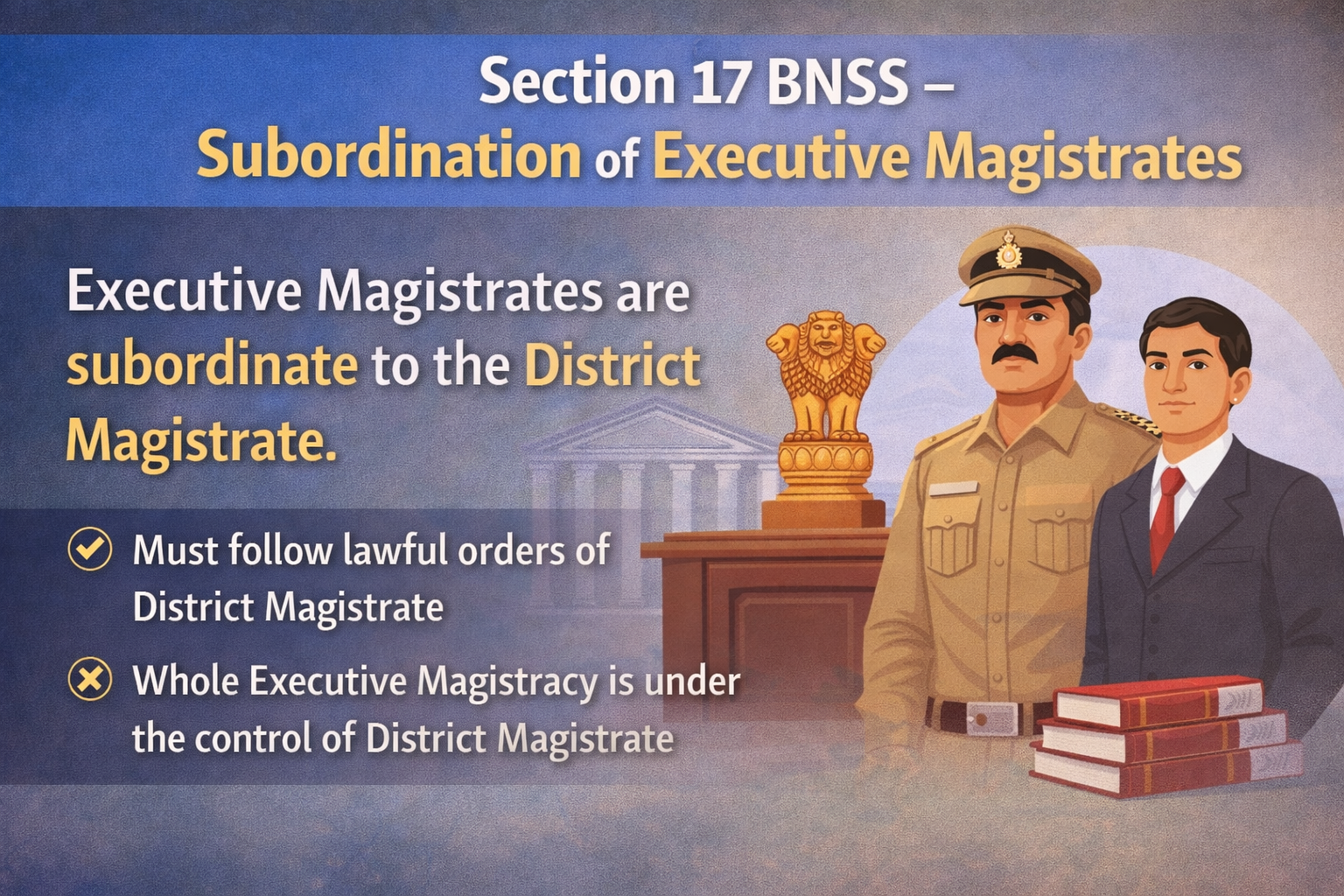
Section 17 of the Bharatiya Nagarik Suraksha Sanhita, 2023 is titled “Subordination of Executive Magistrates.” This section outlines the legal hierarchy and administrative control governing Executive Magistrates — a crucial role in India’s law‑and‑order framework.
In simple terms, Section 17 establishes that:
- All Executive Magistrates are subordinate to the District Magistrate (DM).
- Executive Magistrates working in a sub‑division (other than the Sub‑divisional Magistrate) are also subordinate to the Sub‑Divisional Magistrate (SDM), subject to the District Magistrate’s overall control.
- The District Magistrate may, from time to time, make rules or issue special orders governing the distribution of business among the Executive Magistrates under his or her supervision.
Thus, Section 17 defines both the vertical hierarchy and the distribution of administrative workload within the executive magistracy.
2. Background: Who Are Executive Magistrates?
Before analyzing Section 17, it’s important to understand Executive Magistrates under BNSS:
- Executive Magistrates are officers appointed by the State Government to perform administrative and law‑and‑order duties.
- In every district, a District Magistrate is appointed to oversee all Executive Magistrates.
- Sub‑divisions within a district may be placed under Sub‑Divisional Magistrates.
- Section 15 BNSS additionally allows the appointment of Special Executive Magistrates for specific areas or events.
While Executive Magistrates can perform a range of administrative functions — including preventive orders, crowd control, and public safety efforts — their authority and responsibilities must be exercised under a clearly defined hierarchy, which Section 17 protects.
3. Legal Text and Analysis of Section 17
The core legal text of Section 17 BNSS reads as follows:
- All Executive Magistrates shall be subordinate to the District Magistrate, and every Executive Magistrate (other than the Sub‑divisional Magistrate) exercising powers in a sub‑division shall also be subordinate to the Sub‑divisional Magistrate, subject to the general control of the District Magistrate.
- The District Magistrate may, from time to time, make rules or give special orders, consistent with this Sanhita, as to the distribution or allocation of business among the Executive Magistrates subordinate to him.
Subordination Explained
Subordination refers to the legal and administrative authority that one office holds over another. Under Section 17:
- The District Magistrate sits at the top of the executive magistracy structure in the district.
- Every Executive Magistrate — including those in specialized roles — reports to the District Magistrate in matters of administrative supervision and work allocation.
- In a sub‑division, the Sub‑Divisional Magistrate is the immediate supervisor for Executive Magistrates performing duties within that area, but always under the CMD’s control.
In essence, Section 17 ensures that no Executive Magistrate operates in isolation. Even if an officer holds specific administrative or preventive powers, their work aligns with the District Magistrate’s broader strategy and directives.
4. Why Subordination Matters
Subordination under Section 17 BNSS serves several vital objectives:
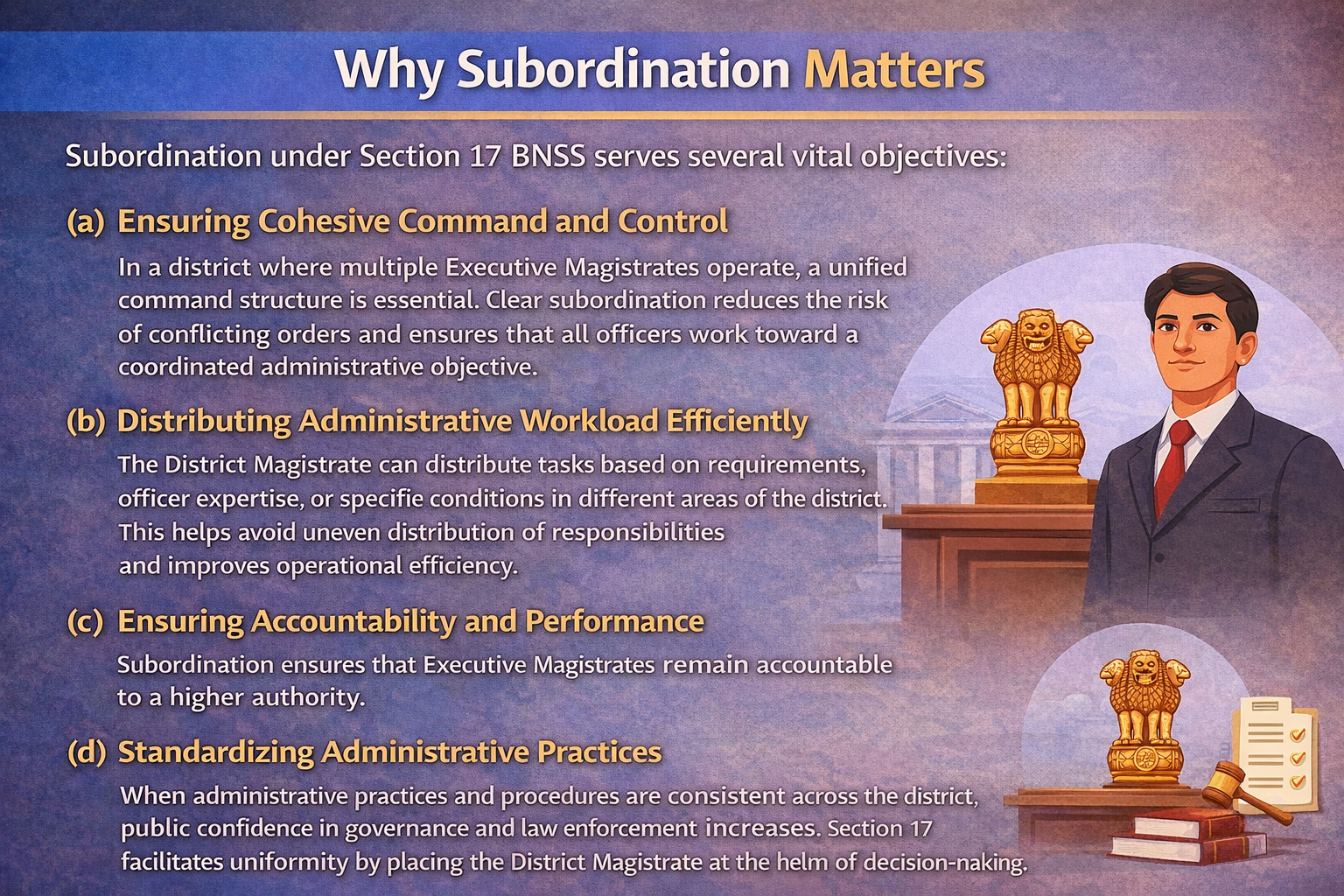
a) Ensuring Cohesive Command and Control
- In a district where multiple Executive Magistrates operate, a unified command structure is essential. Clear subordination reduces the risk of conflicting orders and ensures that all officers work toward a coordinated administrative objective.
b) Distributing Administrative Workload Efficiently
- The District Magistrate can distribute tasks based on requirements, officer expertise, or specific conditions in different areas of the district. This helps avoid uneven distribution of responsibilities and improves operational efficiency.
c) Ensuring Accountability and Performance
- Subordination ensures that Executive Magistrates remain accountable to a higher authority. The District Magistrate can monitor performance, issue corrective directives, and reassign duties as needed.
d) Standardizing Administrative Practices
- When administrative practices and procedures are consistent across the district, public confidence in governance and law enforcement increases. Section 17 facilitates uniformity by placing the District Magistrate at the helm of decision‑making.
5. Interaction with Sub‑Divisional Magistrates
Under Section 17, Sub‑Divisional Magistrates play an important intermediary role:
- In sub‑divisions, Executive Magistrates (other than the SDM themselves) are directly subordinate to the SDM for localized functions.
- However, the District Magistrate retains ultimate supervisory control of all Executive Magistrates, including those under SDMs.
This hierarchical framework ensures that local concerns can be addressed swiftly by the SDM while maintaining alignment with the district’s overall administrative strategy.
6. District Magistrate’s Power to Make Rules and Orders
Beyond simple supervision, Section 17 gives the District Magistrate the authority to:
- Make internal rules for work distribution among Executive Magistrates.
- Issue special orders to guide responses to specific challenges or events.
This means the DM can dynamically adjust administrative responsibility based on factors like emergencies, public events, or changes in crime patterns. Such flexibility is crucial for responsive governance in a diverse and populous democracy.
7. Practical Examples of Section 17 BNSS in Action
Example 1: Managing Law and Order During Festivals
- In districts with large public gatherings — such as religious festivals or cultural events — the District Magistrate may issue specific orders directing Executive Magistrates to prioritize crowd control and public safety. All subordinate magistrates are legally obligated to follow these directives.
Example 2: Disaster Response Coordination
- During natural disasters, effective coordination is crucial. The District Magistrate can issue orders allocating tasks such as evacuation management, relief distribution, and curfew enforcement among subordinate magistrates — ensuring all hands work in a unified direction.
Example 3: Work Reallocation to Address Districtwide Priorities
- If administrative workload is uneven — with some officers overburdened — the District Magistrate can reassign responsibilities across magistrates, optimizing resource use and ensuring that public needs are met uniformly.
8. Section 17 and Good Governance
Section 17 BNSS supports the broader goals of administrative reform and public accountability:
- Responsiveness: Executive Magistrates must act quickly in emergency situations, but within a framework that ensures their actions align with district policy.
- Transparency: Clear reporting lines facilitate oversight by higher authorities.
- Accountability: Performance evaluation and corrective orders flow through an established chain of command.
- Efficiency: Workload distribution helps minimize delays and overlaps.
9. Relationship with Other BNSS Provisions
Section 17 works together with preceding BNSS provisions:
- Section 14 deals with the appointment and powers of Executive Magistrates.
- Section 15 allows for the appointment of Special Executive Magistrates for specific roles or events.
- Section 16 defines local jurisdiction of Executive Magistrates.
- Section 18 onwards lay out other institutional frameworks like Public Prosecutors.
Together, these provisions shape the executive arm of BNSS, providing both the scope of authority and the framework of accountability necessary for balanced rule implementation.
10. Comparison with CrPC
Section 17 BNSS corresponds to Section 23 of the Code of Criminal Procedure (CrPC), which similarly provided subordination of magistrates under the old law. However, BNSS presents a more structured and modern narrative, emphasizing clarity and organizational hierarchy in executive functions.
Under both laws:
- The District Magistrate remains the top authority.
- Sub‑divisional Magistrates exercise localized control but under district supervision.
- Distribution of duties falls under the Magistrate’s administrative domain.
Thus, Section 17 BNSS continues the legacy of a hierarchical yet responsive administrative system, updated for contemporary governance needs.
Frequently Asked Questions (FAQs)
Q1. What is the main objective of Section 17 BNSS?
Section 17 BNSS establishes the hierarchy and administrative control of Executive Magistrates, ensuring they report to the District Magistrate and (in sub‑divisions) to the Sub‑Divisional Magistrate under the District Magistrate’s overall control.
Q2. Who has ultimate control over Executive Magistrates in a district?
All Executive Magistrates are subordinate to the District Magistrate, who has overarching authority over their administrative duties.
Q3. Can a District Magistrate issue rules or orders to Executive Magistrates?
Yes. Section 17 explicitly allows the District Magistrate to make rules or give special orders regarding the distribution of business among subordinates.
Q4. Does subordination under Section 17 BNSS affect judicial independence?
No. Subordination is administrative; Executive Magistrates’ law‑and‑order duties are coordinated without interfering with judicial independence, as they relate to executive functions.
Q5. Is the role of Sub‑Divisional Magistrates recognized under Section 17?
Yes. Executive Magistrates operating in a sub‑division are subordinate to the Sub‑Divisional Magistrate as well, with the District Magistrate retaining general control.
Conclusion
Section 17 – Subordination of Executive Magistrates is a foundational provision in the Bharatiya Nagarik Suraksha Sanhita, 2023 that reinforces the hierarchical and administrative structure of executive authority in India’s criminal procedural system. By codifying the subordination of Executive Magistrates to the District Magistrate and, where applicable, to Sub‑Divisional Magistrates, Section 17 enables cohesive administration, accountability, and operational efficiency.