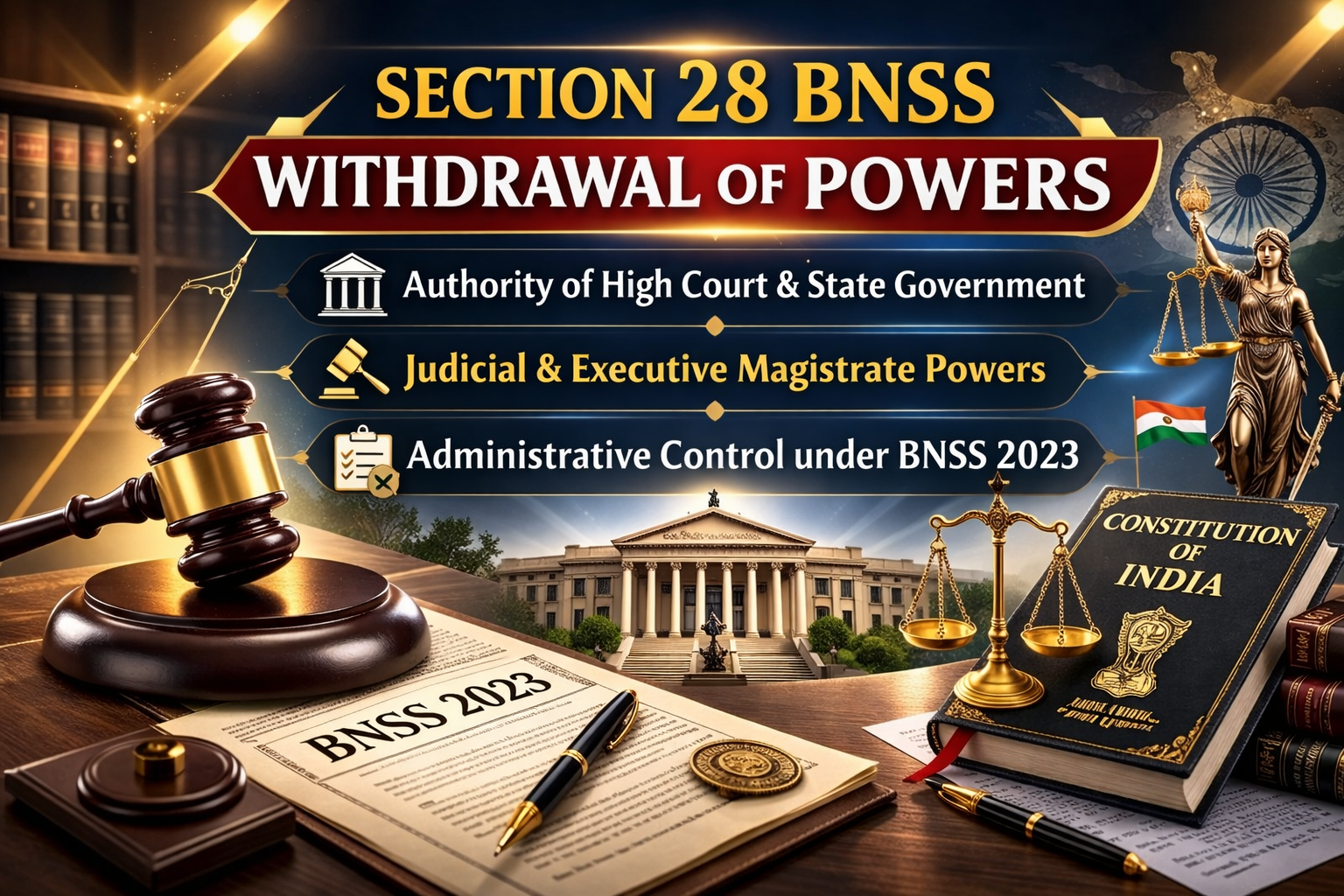
The enactment of the Bharatiya Nagarik Suraksha Sanhita marked a major transition in India’s procedural criminal law by replacing the Code of Criminal Procedure. Among its important administrative provisions is Section 28 BNSS Withdrawal of Powers, which deals with the Withdrawal Of Powers conferred upon Magistrates and judicial authorities.
The concept of Withdrawal Of Powers plays a crucial role in maintaining discipline, accountability, and structured hierarchy within the criminal justice system. This article provides a detailed Section 28 BNSS explanation, discusses the Withdrawal of Powers under BNSS, and compares the old and new provisions.
Meaning of Withdrawal Of Powers under Section 28 BNSS
Withdrawal Of Powers refers to the legal authority of a competent superior authority to withdraw powers that were earlier conferred upon a Magistrate or judicial officer. Under Section 28 BNSS Withdrawal of Powers, the High Court or the State Government may withdraw powers granted to a Magistrate if circumstances require.
This mechanism ensures proper Administrative control of Magistrates BNSS and maintains institutional discipline within the judiciary and executive framework.
Legal Framework under BNSS 2023 Procedural Law
The BNSS 2023 procedural law establishes a structured hierarchy of courts and Magistrates. Powers are conferred based on designation, jurisdiction, and administrative orders. However, these powers are not permanent or absolute.
Key Features of Withdrawal Of Powers:
- Powers may be withdrawn partially or fully
- Withdrawal must follow lawful authority
- The action must be within administrative jurisdiction
- It applies to judicial and executive Magistrates
The Authority to withdraw powers under BNSS is clearly defined to prevent arbitrary action.
Authority to Withdraw Powers under BNSS
Under Section 28 BNSS explanation, the power to withdraw authority lies with:
1. High Court
The High Court exercises Control of subordinate courts under BNSS and may withdraw powers from Judicial Magistrates if required.
2. State Government
The Power of State Government under BNSS extends to Executive Magistrates and certain administrative jurisdictions.
This dual structure ensures accountability while maintaining separation between judicial and executive functions.
Withdrawal of Powers of Magistrate under BNSS
The Withdrawal of powers of Magistrate under BNSS can occur in situations such as:
- Administrative reorganization
- Misconduct or inefficiency
- Reassignment of jurisdiction
- Public interest considerations
It is important to note that Withdrawal Of Powers does not necessarily imply punishment. It may simply be an administrative adjustment.
The Judicial powers withdrawal procedure BNSS ensures that such action is taken lawfully and within institutional guidelines.
Executive Magistrate Powers under BNSS
The Executive Magistrate powers under BNSS relate to preventive and administrative functions such as maintaining public order, issuing prohibitory orders, and handling urgent law-and-order situations.
If necessary, the State Government may initiate Withdrawal Of Powers for Executive Magistrates under administrative authority.
This ensures structured Revocation of judicial authority BNSS where required for public administration.
Judicial Powers Withdrawal Procedure BNSS
The Judicial powers withdrawal procedure BNSS follows a formal administrative route:
Step 1: Review of Conduct or Administrative Need
The superior authority assesses necessity for Withdrawal Of Powers.
Step 2: Competent Authority Decision
Only legally authorized authorities may initiate Withdrawal of Powers under BNSS.
Step 3: Official Notification
Withdrawal is generally formalized through an official order or notification.
This procedure ensures fairness and avoids arbitrary action.
Difference Between Withdrawal and Suspension
It is essential to distinguish between:
Withdrawal Of Powers
- Administrative in nature
- May be temporary or permanent
- Does not automatically imply misconduct
Suspension
- Usually disciplinary
- Linked with allegations or inquiry
- Service-related consequences
The Section 28 BNSS Withdrawal of Powers primarily deals with administrative withdrawal rather than disciplinary punishment.
Old Section vs New Section (CrPC vs BNSS)
Under the repealed Code of Criminal Procedure, similar provisions existed under Section 37 CrPC (regarding withdrawal of powers by High Court or State Government).
Old Provision (CrPC)
- Governed under Criminal Procedure Code
- Provided administrative withdrawal mechanism
- Applied to Magistrates and judicial officers
New Provision (BNSS)
- Incorporated as Section 28 BNSS Withdrawal of Powers
- Retains same administrative principle
- Structured within updated procedural framework
The Criminal Procedure Code replacement BNSS maintains continuity while modernizing the statutory structure.
Importance of Withdrawal Of Powers in Judicial Administration
The concept of Withdrawal Of Powers is vital for:
- Maintaining discipline in judiciary
- Ensuring efficient case management
- Preventing misuse of authority
- Strengthening hierarchical supervision
Without such provisions, Administrative control of Magistrates BNSS would be weakened.
The ability to implement Withdrawal of Powers under BNSS protects the institutional structure of courts and reinforces judicial accountability.
Safeguards Against Arbitrary Withdrawal
Although Authority to withdraw powers under BNSS exists, it is not unlimited. Safeguards include:
- Exercise within jurisdiction
- Administrative accountability
- Judicial oversight where applicable
- Constitutional framework
This ensures that Revocation of judicial authority BNSS is exercised responsibly.
Key Takeaways
- Withdrawal Of Powers is an administrative mechanism under Section 28 BNSS.
- It applies to both Judicial and Executive Magistrates.
- The High Court and State Government are competent authorities.
- It replaces similar provisions under CrPC.
- It ensures proper Control of subordinate courts under BNSS.
- It strengthens the procedural structure under BNSS 2023 procedural law.
The structured approach to Withdrawal Of Powers ensures balance between authority and accountability in India’s criminal justice framework.
FAQ
1. What is meant by Withdrawal Of Powers under BNSS?
It refers to the administrative authority to withdraw powers earlier conferred upon a Magistrate under Section 28 BNSS.
2. Who has authority to withdraw powers under BNSS?
The High Court and the State Government are competent authorities depending on the nature of the Magistrate’s appointment.
3. Does Withdrawal Of Powers mean punishment?
Not necessarily. It may be administrative or organizational in nature.
4. What is the old provision replaced by Section 28 BNSS?
Similar provisions existed under the Code of Criminal Procedure before the Criminal Procedure Code replacement BNSS.
5. Can a Magistrate challenge Withdrawal Of Powers?
If withdrawal violates legal or constitutional safeguards, appropriate legal remedies may be available.