The Bharatiya Nagarik Suraksha Sanhita (BNSS), 2023 — which replaced the Code of Criminal Procedure (CrPC), 1973 with effect from July 1, 2024 — is one of the three landmark statutes that form the backbone of India’s Indian criminal justice reforms 2023. Among its many important provisions, Section 30 Bharatiya Nagarik Suraksha Sanhita specifically deals with the Powers of Superior Officers of Police and the authority they hold within the police hierarchy and powers in India. The section is brief but its legal and practical implications are profound — it defines who can exercise police powers, over what area, and to what extent.
Understanding the Powers of Superior Officers of Police under Section 30 Bharatiya Nagarik Suraksha Sanhita is essential for legal practitioners, police officers, and citizens alike. It determines how criminal procedure law in India 2023 applies to the chain of command within the police force and ensures that BNSS police investigation powers flow correctly from senior officers down to ground-level field staff. This blog analyses Section 30 BNSS in depth — covering its text, elements, practical significance, comparison with the old Section 36 CrPC, and its role in shaping the new criminal laws 2023 police powers framework.
What Does Section 30 BNSS Provide? The Powers of Superior Officers of Police Explained
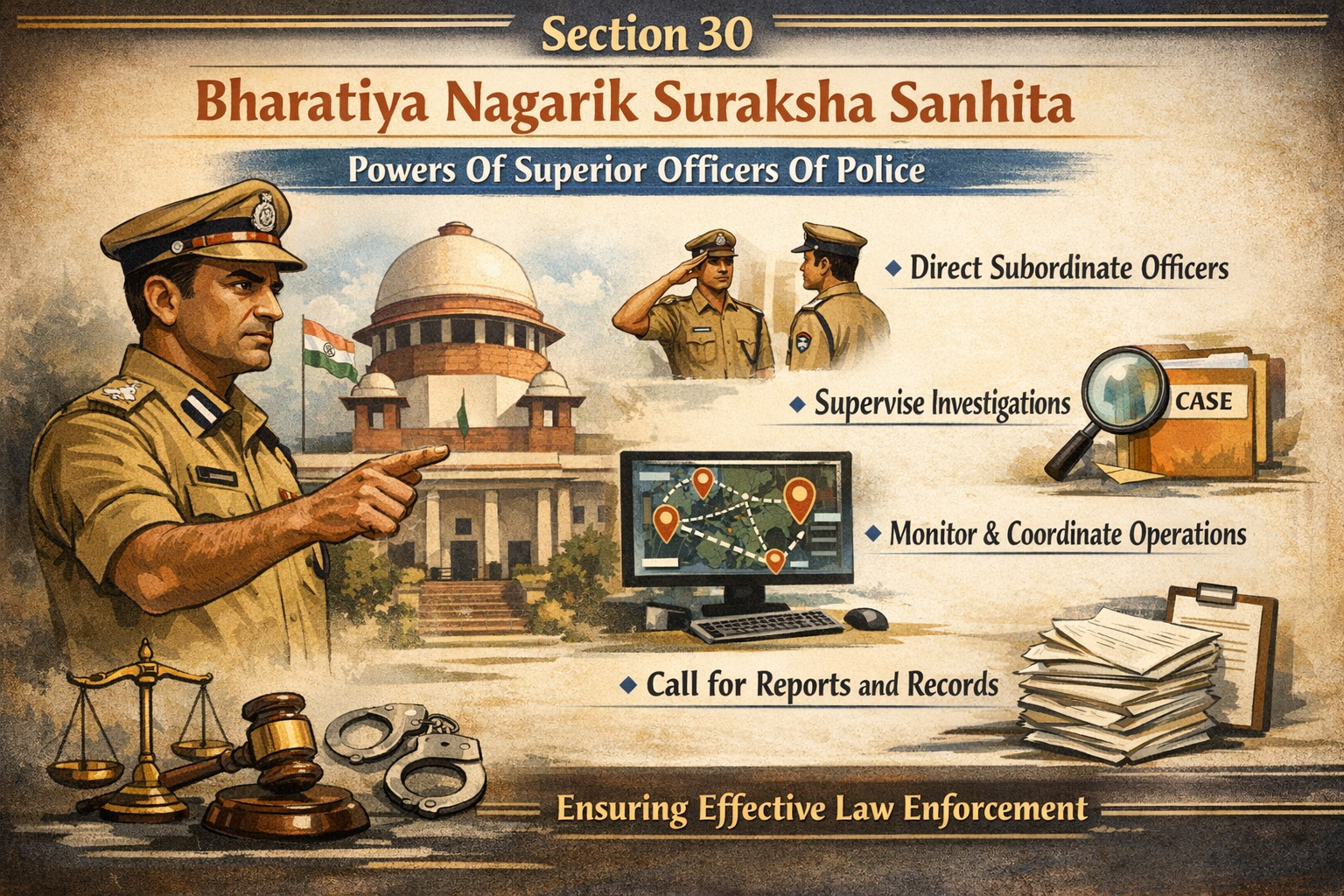
Section 30 Bharatiya Nagarik Suraksha Sanhita states, in essence, that every superior officer of police shall have all the powers of an officer-in-charge of a police station throughout the local area to which they are appointed, and shall be superior in rank to every officer-in-charge of a police station within that area. These Powers of Superior Officers of Police are exercisable anywhere within the geographical jurisdiction assigned to that superior officer.
This single provision achieves two critical objectives simultaneously. First, it ensures that police authority under Bharatiya Nagarik Suraksha Sanhita cascades clearly through the entire police hierarchy — from the Director General of Police at the apex down to the Circle Inspector at the field level. Second, it removes all ambiguity about whether a senior officer has the legal power to step in and exercise station-level powers in any situation within their area.
Core Elements of Section 30 BNSS
- Superior officer of police: The provision applies to all officers above the rank of officer-in-charge of a police station — including DSP, SP, DIG, IGP, ADGP, and DGP. Each of these ranks holds the Powers of Superior Officers of Police under Section 30 Bharatiya Nagarik Suraksha Sanhita.
- All powers of officer-in-charge: The superior officer can exercise every power that an officer-in-charge of a police station has — including powers to investigate, register FIRs, arrest, search, and take cognisance-related actions. These investigation powers under BNSS are not limited to a single station but extend across the entire area of jurisdiction.
- Throughout the local area: The territorial jurisdiction of police officers under Section 30 BNSS is defined by the area to which the superior officer is posted. A Superintendent of Police, for instance, holds Powers of Superior Officers of Police across the entire district — not just within one police station.
- Superiority in rank: Section 30 BNSS also establishes that the superior officer is, in all matters, senior in rank to every officer-in-charge within their area. This ensures a clear police chain of command and prevents jurisdictional conflicts.
Police Hierarchy and Powers in India Under Section 30 BNSS
The police hierarchy and powers in India as structured under Section 30 Bharatiya Nagarik Suraksha Sanhita follows a clear vertical chain of authority. The Powers of Superior Officers of Police at each level are co-extensive with the territorial jurisdiction assigned to that officer:
Director General of Police (DGP)
Powers of DGP under BNSS: The DGP is the highest-ranking police officer in the state. Under Section 30 Bharatiya Nagarik Suraksha Sanhita, the DGP holds the Powers of Superior Officers of Police across the entire state. The DGP can exercise all station-officer powers in any part of the state and has the highest supervisory powers of police officers within the state police establishment.
Inspector General of Police (IGP) and DIG
Inspector General of Police powers: The IGP exercises the Powers of Superior Officers of Police across the assigned range or zone — typically covering multiple districts. The supervisory powers of police officers at the IGP level allow direct intervention in investigations, arrests, and station proceedings across the entire range. The DIG similarly exercises these powers within their assigned division.
Superintendent of Police (SP) and DSP
Superintendent of Police authority: At the district level, the SP is the most practically relevant officer in the exercise of the Powers of Superior Officers of Police. The SP can intervene in any investigation, take over any case, and exercise all BNSS police investigation powers across the district. The authority of senior police officers in BNSS at the SP level is critical for district-level law enforcement. The DSP holds similar powers within the sub-division.
Practical Significance of Powers of Superior Officers of Police
The Powers of Superior Officers of Police under Section 30 Bharatiya Nagarik Suraksha Sanhita have enormous practical relevance in day-to-day law enforcement and the criminal justice system.
Role of Superior Police Officers in Criminal Investigation
The role of superior police officers in criminal investigation goes far beyond mere supervision. When a complex or sensitive case requires immediate intervention — such as a case involving organised crime, violence against vulnerable persons, or offences with political sensitivity — a superior officer can step in directly and exercise all investigation powers under BNSS. The Powers of Superior Officers of Police allow the SP or IGP to personally supervise arrests, conduct searches, and direct the course of investigation without needing to formally take over the case from the station officer.
Supervisory Powers of Police Officers
The supervisory powers of police officers under Section 30 BNSS ensure institutional accountability. When a station officer fails to act, acts with bias, or handles a case incorrectly, the Powers of Superior Officers of Police provide the immediate legal basis for a senior officer to intervene, correct the course of proceedings, and ensure police accountability under BNSS. This prevents the misuse of powers at the station level from going unchecked.
Police Powers Under BNSS 2023 — Concurrent Exercise
The police powers under BNSS 2023 are not exclusive. A superior officer’s exercise of the Powers of Superior Officers of Police does not divest the station officer of their own powers. Both can act concurrently — which is essential in large-scale operations, crowd management situations, or multi-jurisdictional investigations. This concurrent jurisdiction of police ensures maximum operational flexibility while maintaining a clear police chain of command.
Section 36 CrPC (Old Law) vs. Section 30 BNSS (New Law) – Detailed Comparison
The difference between CrPC and BNSS police powers is an important area of study for practitioners navigating the transition from the old to the new law. The table below provides a detailed side-by-side comparison of the old provision — Section 36 CrPC — and the new provision — Section 30 Bharatiya Nagarik Suraksha Sanhita — as part of the broader Indian criminal justice reforms 2023.
| Parameter | Section 36 CrPC (Old Law) | Section 30 BNSS (New Law) |
| Governing Code | Code of Criminal Procedure (CrPC), 1973 | Bharatiya Nagarik Suraksha Sanhita (BNSS), 2023 |
| Section Number | Section 36 CrPC | Section 30 BNSS |
| Chapter | Chapter IV – Powers of Police Officers | Chapter IV – Powers of Police Officers |
| Core Principle | Superior police officers hold all the powers of an officer-in-charge within their jurisdiction | Same principle retained – Powers of Superior Officers of Police continue under BNSS |
| DGP Powers | DGP can exercise all powers of officer-in-charge throughout the state | Powers of DGP under BNSS remain the same across the state |
| IGP / DIG Powers | IGP and DIG exercise powers across the assigned range or zone | Inspector General of Police powers remain identical under BNSS |
| SP Authority | Superintendent of Police can exercise powers throughout the district | Superintendent of Police authority continues unchanged under BNSS |
| DSP / Circle Inspector | DSP or Circle officers exercise powers in their respective subdivisions | Authority of senior police officers in BNSS at sub-district level remains the same |
| Concurrent Powers | Superior officers and station officers may exercise powers simultaneously | Concurrent jurisdiction of police retained under BNSS |
| Investigation Powers | Superior officer may investigate, arrest, or conduct searches within their jurisdiction | BNSS police investigation powers continue in the same manner |
| Supervisory Role | Senior officers supervise and intervene in investigations conducted by station officers | Supervisory powers of police officers preserved under BNSS |
| Territorial Jurisdiction | Powers can be exercised across the entire area assigned to the officer | Territorial jurisdiction of police officers remains unchanged |
| Police Chain of Command | Establishes rank superiority over officer-in-charge within the jurisdiction | Police chain of command retained under BNSS |
| Police Accountability | Accountability mainly governed by departmental rules and service laws | BNSS operates alongside new criminal laws 2023 framework |
| Drafting Language | Traditional legal drafting used in CrPC 1973 | Updated legislative language under BNSS 2023 |
| Effect of Repeal | Section 36 existed under CrPC until its repeal | Section 30 BNSS replaces Section 36 CrPC |
| Judicial Precedents | Numerous judicial precedents developed over decades | Courts may rely on precedents from Section 36 CrPC when interpreting Section 30 BNSS |
The comparison table makes clear that Section 30 Bharatiya Nagarik Suraksha Sanhita is the direct and substantively unchanged successor to Section 36 CrPC. The difference between CrPC and BNSS police powers at this section level is primarily one of language modernisation and renumbering — not a change in the substance of the Powers of Superior Officers of Police. All judicial precedents, High Court rulings, and Supreme Court decisions rendered under Section 36 CrPC remain fully applicable when interpreting Section 30 BNSS.
Key Takeaways from the Old-to-New Transition
- Powers of Superior Officers of Police are substantively identical under Section 36 CrPC and Section 30 BNSS — no rights or powers have been diminished.
- Police hierarchy and powers in India remain structured on the same vertical chain of command — from DGP to DSP to Circle Inspector.
- BNSS police investigation powers and supervisory powers of police officers are fully preserved with modernised language.
- Police authority under Bharatiya Nagarik Suraksha Sanhita is co-extensive in territorial scope with what existed under the CrPC.
- All judicial decisions under Section 36 CrPC serve as authoritative precedent for Section 30 Bharatiya Nagarik Suraksha Sanhita.
Conclusion
Section 30 Bharatiya Nagarik Suraksha Sanhita is a foundational provision that defines and preserves the Powers of Superior Officers of Police in India’s new criminal procedure framework. By vesting every senior police officer with the full police powers under BNSS 2023 of a station officer within their area, the section ensures operational flexibility, police chain of command, and effective criminal procedure law in India 2023
Whether it is the Inspector General of Police powers at the range level, the Superintendent of Police authority at the district level, or the Powers of DGP under BNSS across the entire state, Section 30 Bharatiya Nagarik Suraksha Sanhita provides the legal architecture for the entire police hierarchy and powers in India to function as a coherent, accountable, and legally grounded system. The role of superior police officers in criminal investigation, the supervisory powers of police officers, and the BNSS police investigation powers vested by this section are indispensable to the delivery of justice under the Indian criminal justice reforms 2023 framework.