
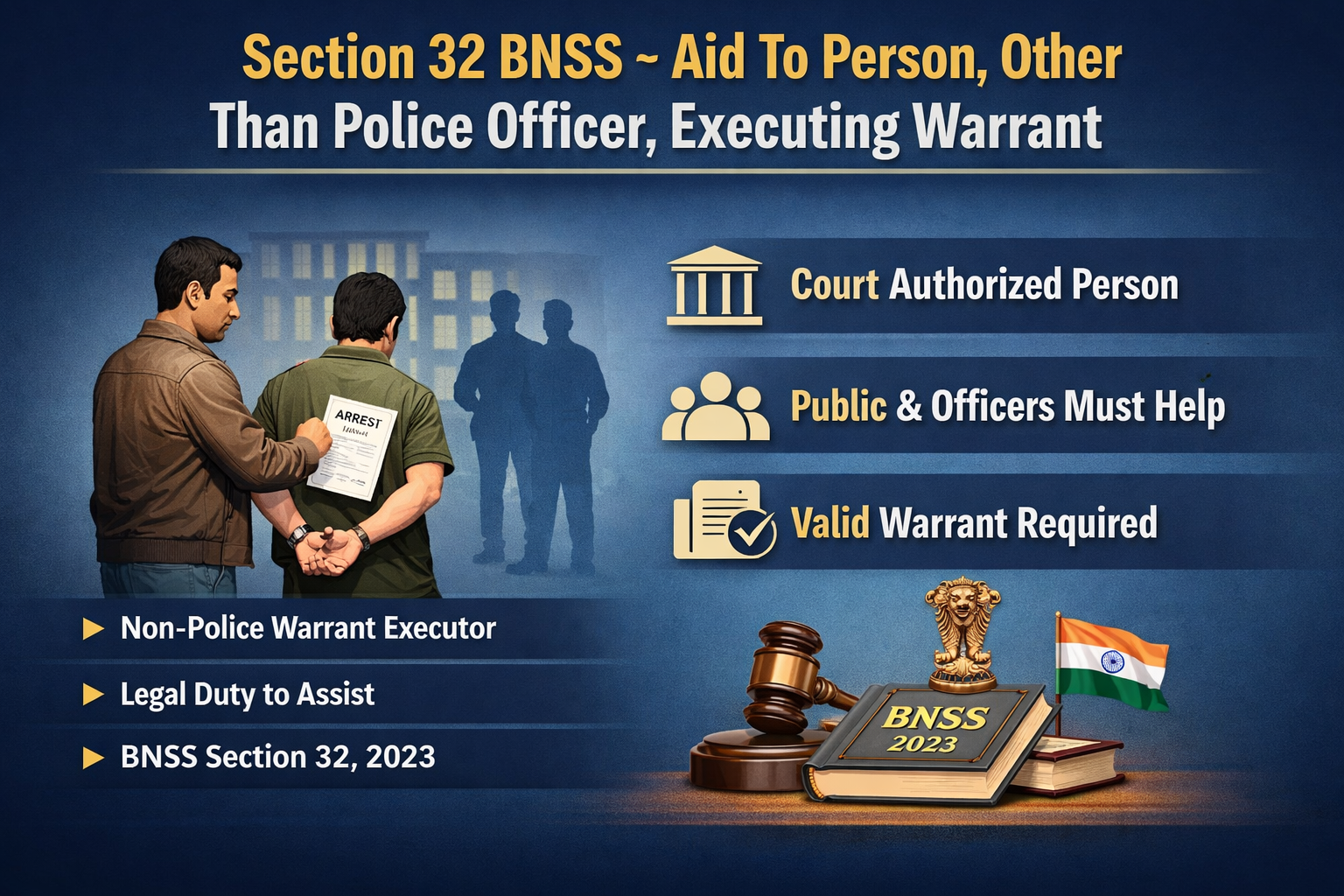
Section 32 BNSS Aid to Person Executing Warrant establishes one of the main legal requirements that underlie India’s modern criminal procedure system which is established in the Bharatiya Nagarik Suraksha Sanhita 2023 (BNSS). The section addresses an essential part of criminal law which requires all citizens and public officials and institutions to help any person who holds a valid warrant and tries to execute it.
The Bharatiya Nagarik Suraksha Sanhita Section 32 replaces the earlier provision under the Code of Criminal Procedure, 1973 (CrPC) and carries forward the same public obligation with certain refinements. Legal professionals and law students and government officers and ordinary citizens who might need to assist in warrant execution must understand Section 32 BNSS explanation.
In this article, we break down Section 32 BNSS Aid to Person Executing Warrant in detail — covering its text, meaning, scope, comparison with the old CrPC provision, and practical implications.
Old Provision Under CrPC — What Section 32 BNSS Replaces
You need to learn about the related provision which exists in the Code of Criminal Procedure 1973 before you can comprehend the new law. The BNSS warrant execution law which exists in Section 32 derives its main principles from Section 37 of the CrPC 1973 which had the title “Aid to Magistrate and Police.”
Section 37 CrPC, 1973 — The Old Provision
Section 37 of CrPC 1973 establishes legal obligations which require all individuals to support police officers and magistrates who make reasonable requests for assistance with their official duties which include (a) arresting individuals who magistrates and police officers have authority to detain and (b) maintaining peace through their law enforcement activities and (c) protecting railway and canal and telegraph and public facilities from damage.
Key Features of Section 37 CrPC (Old Law)
- Scope: Section 37 CrPC required every person to assist a Magistrate or police officer when reasonably demanded.
- Subjects: The duty to assist was tied only to Magistrates and police officers — not to private persons executing warrants.
- Purpose: The law covered four offenses which included arrest and escape prevention and breach of peace and protection of public property which included railways and canals and telegraphs.
- Limitation: Section 37 of the Criminal Procedure Code (CrPC) did not include provisions for non-police officers who required help from citizens to carry out their warrant execution duties.
- Penalty for Refusal: Refusing to provide assistance according to Section 37 CrPC results in legal consequences because the Indian Penal Code, 1860 prohibits the obstruction of public servants.
A strengthening of the BNSS Section 32, here, would be the right option due to this existing oversight._given a legal mandate of assistance to any person-aside from an executing officer-who is authorized to execute a search warrant-ranging the scope of the principles of public assistance in warrant execution.
Section 32 BNSS Aid to Person Executing Warrant
Section 32, Bharatiya Nagarik Suraksha Sanhita, 2023: When a warrant is directed to a person other than a police officer, all Court of Justice officers and public office employees and all individuals with territorial authority must assist the warrant recipient in warrant execution whenever there is a reasonable need for such assistance.
The core text of Section 32 BNSS Aid to Person Executing Warrant exists in this document. The short text explains BNSS warrant procedure in India through its complete legal and practical impact.
Section 32 BNSS Meaning — Breaking Down the Provision
The BNSS Section 32 meaning becomes clear when each key phrase is examined individually. Let us break down the text of Section 32 BNSS Aid to Person Executing Warrant :
1. When a Warrant is Directed to a Person Other Than a Police Officer
The Indian criminal law system allows courts to issue warrants that instruct non-police officers to arrest specific individuals who must be brought to court. The category of persons who can execute this task includes court officers, government officials, bailiffs, and designated personnel who possess special authorization. Section 32 BNSS specifically deals with this category of warrant-executor.
- Warrant Executor: A designation for bailiff, process server, court clerk, or any other person, as written by the court.
- Not a Police Officer: This provision pertains whenever the warrant is NOT issued to a police officer, filling a procedural gap created by the old CrPC framework.
- Legal Basis: It has to be a valid order given by a competent legal body or organ under the BNSS.
2. Every Officer of Every Court of Justice and of Every Public Office
The phrase identifies who is obligated to assist under Aid to Person Executing Warrant BNSS. This includes a wide range of public functionaries:
- Court Officers: Peshkars, reader-clerks, nazirs, process servers, and other judicial staff are included in this obligation.
- Public Office Officers: Officers working in government offices — revenue, municipal, district administration — are equally bound under this provision.
- Breadth of Coverage: The use of the phrase “every officer of every court” reflects the legislature’s intent to make assistance in warrant execution a universal public duty — not limited to any one department.
3. Every Person Having Jurisdiction in a Particular Area
This clause extends the obligation beyond formal court officers and public servants to include any person who has territorial or administrative jurisdiction over an area. This is a significant aspect of powers to assist warrant execution BNSS.
- Village Officers: Gram Pradhans, Panchayat officers, revenue patwaris, and other local administrative authorities are covered.
- Municipal Officers: Urban local body officials who have jurisdiction over a municipal area are also included.
- Police Station Officers: Station House Officers (SHOs) of a police station, when required by a non-police warrant executor, may also be obligated to render assistance.
4. If Reasonably Required
The phrase “if reasonably required” serves as a qualifying term which restricts the extent of the obligation> The statement establishes that the obligation to provide assistance exists only within particular situations.
- Not an Absolute Duty: Assistance must be sought by the warrant-executor in a reasonable manner, and the circumstances must justify the need for help.
- Proportionality: The level of assistance must be proportionate to the actual need — officers cannot be compelled to assist in a disproportionate manner.
- Practical Sense: For instance, if a warrant is directed to a court bailiff and the concerned person is resisting arrest, it would be ‘reasonably required’ for a nearby public officer to step in and help.
5. Render Assistance for Executing Such Warrant
The final operative phrase clarifies the purpose and scope of the assistance. Under Assistance in Executing Warrant BNSS, the duty is strictly connected to warrant execution — not any general law enforcement activity.
- Purpose-Limited Duty: The assistance must be specifically for executing the warrant which requires help to arrest the individual named in the warrant and stop him from escaping and to handle any physical resistance.
- No General Policing Power: The disposition does not confer on the public officer power to enforce any law in general; this duty arises only when a valid specific warrant is involved.
Comparison: Section 37 CrPC vs Section 32 BNSS — Key Differences
Understanding how BNSS Section 32 differs from the old Section 37 CrPC helps appreciate the evolution of BNSS warrant procedure India:
| Feature | Section 37 CrPC (Old Law) | Section 32 BNSS (New Law) |
| Heading | Aid to Magistrate and Police | Aid to Person Executing Warrant (Non-Police) |
| Focus | Assisting Magistrates and Police Officers in performing duties | Assisting a person who is executing a warrant but is not a police officer |
| Who Must Assist | Every person is legally bound to assist Magistrates and police when required | Court officers, public officers, and persons within the jurisdiction may assist the authorized person executing the warrant |
| Warrant Condition | Assistance was not specifically linked to a warrant | Assistance is directly connected to the execution of a valid warrant issued by a court |
| Scope of Assistance | Includes helping in arrest, preventing escape, controlling breach of peace, and protecting public property | Limited mainly to helping in the execution of the specific warrant issued by the court |
| Key Gap Addressed | Did not clearly mention help to a person who is not a police officer executing a warrant | Clearly fills the gap by recognizing non-police persons authorized to execute warrants |
| Law Replaced | Code of Criminal Procedure, 1973 (CrPC) | Bharatiya Nagarik Suraksha Sanhita, 2023 (BNSS) |
Why Section 32 BNSS Aid to Person Executing Warrant
The Section 32 BNSS explanation becomes fully meaningful when we understand the real-world situations it addresses. Below are the key reasons why this provision is critically important in India’s criminal justice system:
1. Addresses a Long-Standing Procedural Gap
Under the old CrPC, when a warrant was directed to a non-police person, there was no clear statutory obligation on public officers to assist. Section 32 BNSS Aid to Person Executing Warrant closes this gap decisively, making assistance a legal duty rather than a discretionary act.
2. Strengthens Effectiveness of Court Warrants
Court orders and warrants carry little practical value if the person directed to execute them cannot get cooperation. The legal provisions for warrant execution BNSS in Section 32 ensure that non-police warrant executors have legal backing to seek and obtain assistance when faced with resistance.
3. Creates Accountability Among Public Officers
By imposing a statutory obligation, public duty in warrant execution BNSS becomes enforceable. Public officers who refuse to assist without reasonable cause can face disciplinary action and legal consequences under the BNSS.
4. Supports Rule of Law
The democratic functioning of courts depends on their orders being executed promptly. Assistance in executing warrant BNSS ensures that the dignity of the court and the rule of law are upheld by all public functionaries, regardless of which department they belong to.
5. Reflects India’s Shift Towards Citizen-Centred Criminal Justice
The Bharatiya Nagarik Suraksha Sanhita Section 32 is part of India’s larger effort to modernise criminal procedure law and make it more responsive to real-world challenges. The new code was introduced in 2023 to replace the CrPC and reflects a more structured approach to BNSS warrant procedure India.
Who Is Bound to Assist Under Section 32 BNSS — Practical Guide
The powers to assist warrant execution BNSS apply to a specific category of persons. Here is a practical breakdown of who must provide assistance under Section 32 BNSS Aid to Person Executing Warrant :
Court Officers
- Peshkars and reader-clerks in civil and criminal courts
- Nazirs and deputy-nazirs of courts
- Court process servers and bailiffs
- Any other officer employed in the administration of justice
Public Office Officers
- Revenue department officers — tehsildars, patwaris, revenue inspectors
- Municipal corporation and panchayat officers
- District administration officers — SDMs, BDOs
- Magistrates of executive class
- Officers of Central and State government departments in the relevant area
Persons Having Jurisdiction in a Particular Area
- Station House Officers (SHOs) of police stations in the relevant area
- Village headmen (Gram Pradhans)
- Forest officers, excise officers, and other government field staff
- Customs and border protection officers in their jurisdictional areas
Legal Implications of Refusing to Assist Under Section 32 BNSS
Refusing to render assistance when reasonably required under Aid to Person Executing Warrant BNSS is not merely a professional lapse — it can have serious legal consequences:
- Obstruction of Legal Process: Refusal to assist could amount to obstruction of a lawful warrant execution process, which is an offence under the Bharatiya Nyaya Sanhita, 2023 (BNS) — the new penal code replacing the IPC.
- Contempt of Court: If the warrant is issued by a court and the refusal impedes its execution, the officer concerned could face contempt of court proceedings.
- Departmental Proceedings: Public officers who refuse to comply with the statutory obligation under BNSS Section 32 may face departmental enquiries and disciplinary action from their parent department.
- Civil Liability: In cases where refusal causes loss or damage to the person holding the warrant or to the administration of justice, civil liability may also arise.
Practical Scenarios — How Section 32 BNSS Applies in Real Life
To fully understand Section 32 BNSS Aid to Person Executing Warrant , it helps to look at real-world scenarios where this provision would be invoked:
Scenario 1: Court Bailiff Executing an Arrest Warrant
A civil court issues an arrest warrant against a judgment-debtor who has failed to appear. The warrant is directed to a court bailiff (not a police officer). When the bailiff reaches the debtor’s village, the debtor resists and the bailiff is outnumbered. Under Assistance in Executing Warrant BNSS, the Gram Pradhan and the nearest revenue officer are legally bound to assist the bailiff in executing the warrant.
Scenario 2: Revenue Officer Executing an Attachment Warrant
A court directs a revenue officer to attach certain property of a tax defaulter. A group of persons obstruct the process. Under Legal provisions for warrant execution BNSS, other government officers and local officials in the area are obligated under Section 32 BNSS to step in and render assistance.
Scenario 3: Non-Police Officer Facing Resistance During Warrant Execution
Any person other than a police officer — authorised by a competent court — who faces active resistance while executing a warrant can invoke Section 32 BNSS Aid to Person Executing Warrant to demand assistance from court officers and jurisdictional authorities. Refusal without reason makes the non-assisting officer legally liable.
Conclusion
Section 32 BNSS Aid to Person Executing Warrant is a carefully crafted provision that addresses a critical aspect of criminal procedure — ensuring that the execution of court warrants by non-police persons is not impeded for lack of cooperation.
The Bharatiya Nagarik Suraksha Sanhita Section 32 builds upon and expands the old Section 37 of the CrPC by creating a specific, enforceable duty for court officers, public office officials, and jurisdictional authorities to assist warrant executors. This strengthens the effectiveness of court orders, promotes the rule of law, and makes public duty in warrant execution BNSS a matter of legal obligation — not mere courtesy.
Understanding the Section 32 BNSS explanation is essential for legal practitioners, judicial officers, government administrators, and law enforcement officials. Whether you are a law student, advocate, or public servant, Section 32 BNSS Aid to Person Executing Warrant is a provision that directly impacts the practical administration of justice in India’s evolving criminal justice framework.