
The Bharatiya Nagarik Suraksha Sanhita (BNSS) 2023 implementation which starts on July 1 2024, has created a major police system change that affects police departments throughout India including the state of Gujarat. The new law which succeeds the long-standing Code of Criminal Procedure (CrPC) seeks to improve police investigation processes through enhanced efficiency and transparent and accountable methods. The blog post demonstrates how BNSS Changes Police Powers in Gujarat which leads to a new framework of law enforcement practices throughout the state.
The legal change of BNSS Changes Police Powers in Gujarat marks more than a simple law update because it establishes an entirely new period which combines modern technology with responsible oversight. The Gujarat Police organization which already maintains a strong reputation for technological adoption, will experience major operational changes because of this legislative development.
CrPC vs BNSS: A Fundamental Shift Shaping BNSS Changes Police Powers in Gujarat
The transition from BNSS vs CrPC police powers is not merely a reorganization of sections; it alters the entire philosophy of the criminal justice system. The BNSS establishes a modern legal system which differs from the British colonial legal system that influenced the development of the CrPC.
- Difference in Objective: The CrPC was mainly a legal framework yet the BNSS directs its procedures to achieve more efficient processes and better delivery of judicial services.
- Technological Integration: The BNSS officially accepts digital evidence together with video recordings and electronic communications as valid components of the criminal justice system which the CrPC did not acknowledge.
- Timelines: The BNSS establishes specific investigation and decision-making deadlines which will help to stop delays in handling cases.
Understanding how BNSS Changes Police Powers in Gujarat is crucial, as every police officer must now be well-versed in the new rules and their technical applications.
Specific Impact on Gujarat Police: How BNSS Changes Police Powers in Gujarat is Being Felt
The Gujarat Police department possesses advanced technical infrastructure which enables them to execute the requirements of the BNSS. The Gujarat police powers under BNSS have become more empowered and technologically sophisticated.
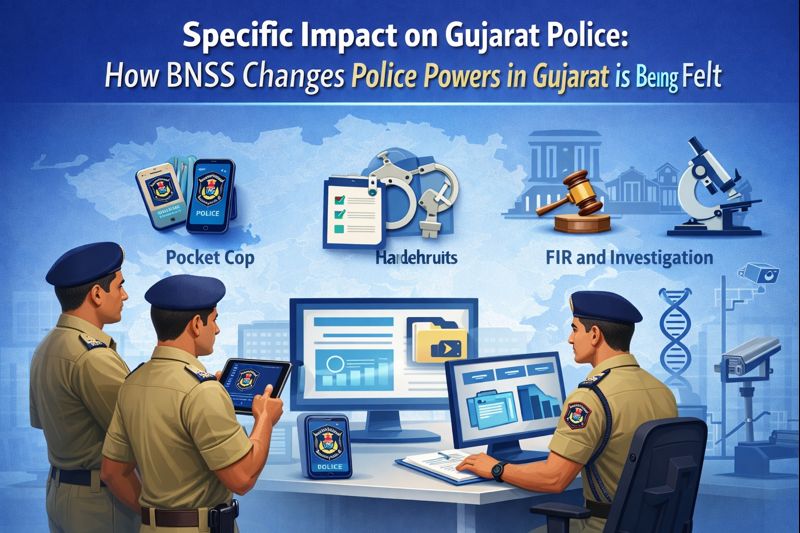
- Leveraging Technical Progress: The Gujarat Police demonstrate their capacity to execute digital requirements of the BNSS through their successful implementation of the ‘Pocket Cop’ project. The new system enables law enforcement agencies throughout the state to operate with greater efficiency.
- Accountability and Transparency: The new law establishes multiple measures that enhance police accountability through its requirement of mandatory videography, which was not present before. The Changes in police powers after BNSS 2023. The Changes in police powers after BNSS 2023.
- Fast-track Justice: The prescribed timelines and recognition of digital evidence under BNSS are expected to lead to faster case disposals in Gujarat, increasing trust in the judicial process.
BNSS Changes Police Powers in Gujarat will have the most direct impact on the daily functioning of the police.
Arrest Powers under BNSS in Gujarat
Arrest powers under BNSS in Gujarat have been significantly modified to increase transparency and reduce the arbitrary use of arrest, while still providing necessary authority to the police in serious cases.
- Prior Permission from DSP: In crimes with a sentence of less than 3 years, if the accused is over 60 years old or physically infirm, prior written permission from an officer of the DSP (Deputy Superintendent of Police) rank is mandatory for arrest. This strengthens the Rights of accused under BNSS 2023.
- Public Information: Every police station must now appoint a designated police officer to digitally display the names of arrested persons and information regarding their cases. This promotes transparency in the arrest process.
- Use of Handcuffs: The BNSS grants police the explicit right to use handcuffs in certain serious crimes, such as terrorism, organized crime, rape, and economic offenses. This is a significant change in Police powers under BNSS Gujarat, especially in dealing with heinous crimes.
Changes in FIR Registration and Investigation
FIR registration under BNSS Gujarat and investigation processes have undergone major changes to improve accessibility and investigation quality.
- Zero FIR (Section 173): Under the BNSS Changes Police Powers in Gujarat, any person can now file an FIR at any police station in Gujarat, even if the crime did not occur within that station’s jurisdiction. It will be recorded as a ‘Zero FIR’ and later transferred to the relevant police station.
- E-FIR (Electronic FIR): The BNSS now provides legal recognition for filing FIRs through electronic means. Gujarat Police already have citizen portals allowing online complaints, and the BNSS will further strengthen these systems.
- Mandatory Videography (Section 105): It is mandatory for investigating officers to video record the entire process of search and seizure. This makes the process more reliable and holds the police accountable. The BNSS 2023 impact on police investigation is most visible through this provision.
- Forensic Mandate (Section 176): In crimes punishable by 7 years or more, it is mandatory for forensic experts to visit the scene and collect evidence. The presence of the National Forensic Sciences University (NFSU) in Gujarat will provide significant support in implementing this, strengthening Gujarat police powers under BNSS.
Police Remand and Judicial Control
The BNSS 2023 introduces significant flexibility in remand procedures while maintaining Magistrate control over police under BNSS.
- Flexible Police Remand (Section 187): Under the CrPC, police remand could only be taken within the first 15 days of arrest. Under the BNSS, Gujarat police can now take 15 days of remand in parts within the first 40 or 60 days of arrest. This power is crucial for investigating complex and inter-state crimes.
- Judicial Oversight: Although the police have more flexibility in remand, the Magistrate’s final control remains. The duration and necessity of each remand will be carefully examined by the Magistrate, ensuring that the police do not misuse their powers.
This new approach reflects how BNSS Changes Police Powers in Gujarat, providing police more time for in-depth investigation of serious cases.
Gujarat Police: New Powers and Technical Changes under BNSS
It is worth understanding how the Gujarat Police have integrated their ‘Pocket Cop’ project and other digital initiatives under the umbrella of BNSS Changes Police Powers in Gujarat.
| Subject | Old System (CrPC) | New Power/Change (BNSS 2023) | Impact of ‘Pocket Cop’ (Gujarat Specific) |
| Search and Seizure | Only paper panchnama existed. | Mandatory Videography (Sec 105): Seizure is invalid without video evidence. | Police record video on-site via mobile app and upload it to a secure server, increasing transparency. |
| Police Remand (Custody) | Remand had to be taken within the first 15 days. | 60-Day Window (Sec 187): 15 days of remand can be taken anytime within the first 60 days. | Access to digital records of criminals in ‘Pocket Cop’ allows police to plan interrogations strategically. |
| Forensic Investigation | Depended on the will of the police. | Mandatory Forensic (Sec 176): Experts mandatory in cases with 7+ years of sentence. | Immediate availability of mobile forensic labs is ensured with the help of NFSU, Gandhinagar. |
| FIR Process | FIR only at the relevant station. | Zero FIR and E-FIR: Legal right to file FIR at any station or online. | Gujarat’s citizen portals now allow online complaints to be converted directly into FIRs per BNSS rules. |
| Use of Handcuffs | Almost prohibited as per Supreme Court orders. | Legal Permission: Can use handcuffs for terrorists, organized criminals, or rapists. | Police can decide on handcuffs after checking the suspect’s detailed criminal history on the ‘Pocket Cop’ database. |
| Citizen Information | Providing info was merely procedural. | Digital Display (Sec 37): Mandatory to display the arrested person’s name on a screen outside the station. | ‘Digital Boards’ in Gujarat stations are connected to HQ, updating data in real-time. |
| Investigation Progress | Victims had to run from pillar to post. | 90-Day Update: Police must update the victim on the status every 3 months. | Information is sent via automated SMS and WhatsApp, simplifying the process. |
| Property Attachment | Happened after long court procedures. | Immediate Attachment: Power to seize property earned from crime during the investigation itself. | Police can freeze suspicious bank accounts on-site by checking digital records. |
Rights of the Accused and Victims under BNSS 2023
The BNSS 2023 has not only reorganized police powers but also strengthened the Rights of accused under BNSS 2023 and the rights of victims.
Rights of the Accused:
- Right to Information of Arrest: The arrested person has the right to be informed immediately of the reasons for arrest and their rights.
- Right to Meet a Lawyer: The arrested person has the right to meet a lawyer of their choice.
- Right to Medical Examination: The arrested person is entitled to regular medical check-ups.
- Electronic Records: Videography conducted by the police can serve as a vital tool for the defense if proper procedures are not followed.
Rights of the Victim:
- Right to File FIR (Zero FIR): Victims can now lodge their complaints without any jurisdictional barriers.
- Information on Investigation Progress: The victim has the right to receive regular updates on the status of the investigation.
- Access to Justice: The BNSS aims for a victim-centric approach, giving them a more significant role in the justice system.
Official Legal Sources (Government Websites)
For authoritative reference, readers may consult:
- Ministry of Law and Justice – https://legislative.gov.in
- Gujarat Police Official Portal – https://police.gujarat.gov.in
- eCourts India – https://ecourts.gov.in
These government sources provide statutory texts and procedural guidance related to BNSS.
Conclusion
The Bharatiya Nagarik Suraksha Sanhita (BNSS) 2023 is bringing a significant and far-reaching change to police powers in Gujarat. The new legislation updates investigation methods and establishes digital evidence as valid proof while enhancing police oversight. The BNSS Changes Police Powers in Gujarat now extend beyond official documents because they have adopted both technological advancements and public service methods. The Gujarat Police have developed their operational capabilities through the ‘Pocket Cop’ technology which enables them to execute BNSS requirements effectively.