
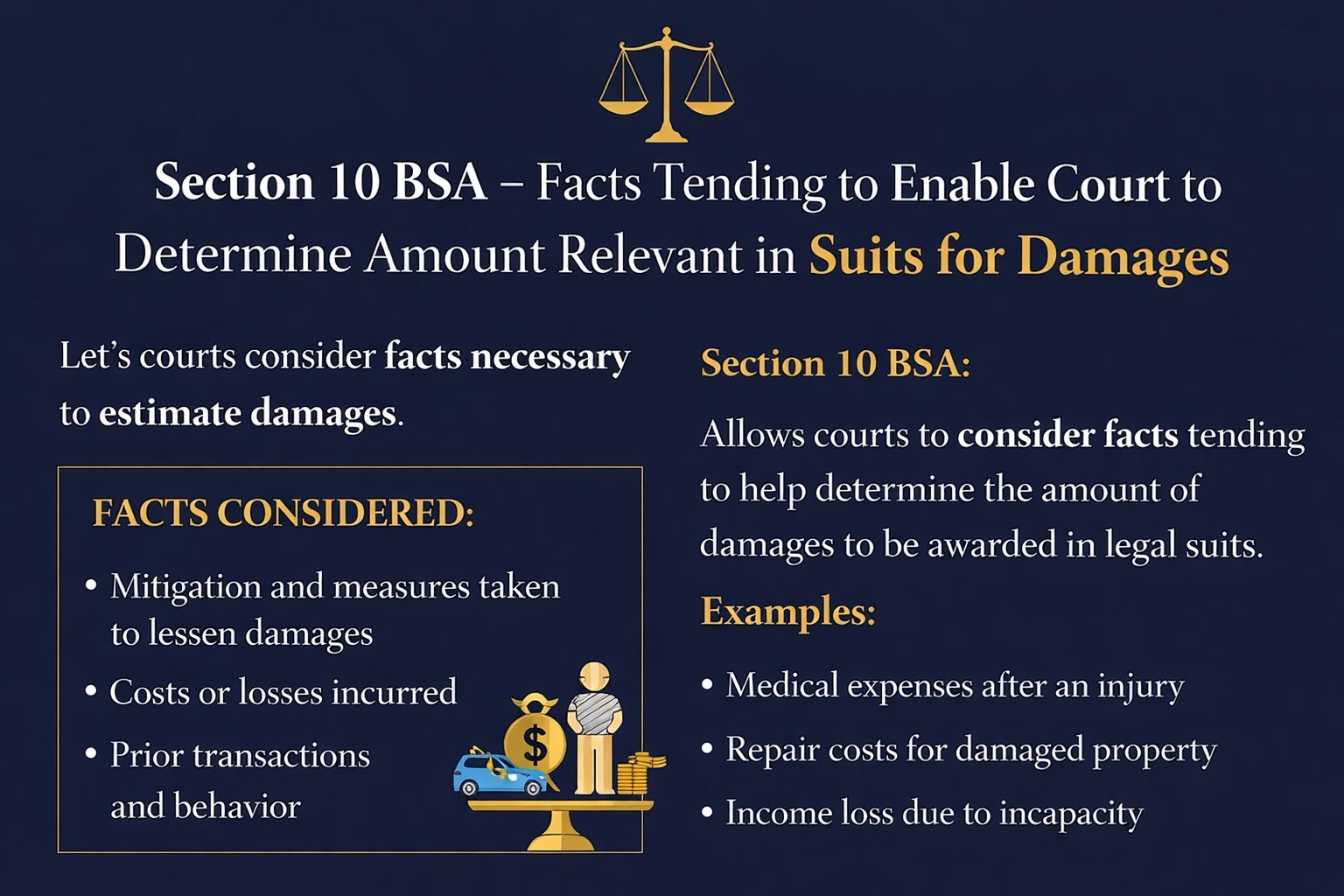
The legal process requires proof of responsibility to succeed in civil cases. The court must first establish a defendant’s fault before proceeding to assess the amount of damages which the plaintiff will receive. The Facts tending to enable Court to determine amount relevant in suits for damages constitute an essential element in this process. The Bharatiya Sakshya Adhiniyam 2023 establishes this provision to ensure that courts have access to all necessary information for awarding fair and reasonable compensation.
The Transition from Old Law: Section 12 IEA to Section 10 BSA
Before understanding the present framework, it is important to examine its origin. Section 10 of the Bharatiya Sakshya Adhiniyam, 2023 is the successor to Section 12 of the Indian Evidence Act, 1872. While the fundamental legal principle remains unchanged, the modern statute aligns better with current judicial practices.
The law recognizes that the Assessment of damages in Indian law requires flexibility. Courts must consider not only direct facts but also surrounding circumstances that influence the extent of loss. This shift ensures that facts which were earlier treated as secondary can now become central when determining compensation.
What are Facts Tending to Enable Court to Determine Amount Relevant in Suits for Damages?
Section 10 clearly provides that in suits where damages are claimed, any fact that helps the court determine the amount of damages is relevant. This expands the scope of admissibility of evidence after liability has been established.
Once the right to compensation is confirmed, the court allows Evidence for calculating compensation in civil cases. This ensures that compensation is not arbitrary but based on real and provable data.
Scope of Relevance in Damage Claims
The Relevance of facts in damage claims is much broader than the facts required to prove the wrongful act. Courts go beyond establishing liability and examine the financial and personal impact of the wrong.
Key Points:
- Facts relating to market conditions in contract disputes
- Financial position of the parties
- Circumstances that influenced the extent of loss
For example, in a breach of contract, proving the breach is only the first step. The court must then examine how the breach affected the plaintiff financially. This is where Facts tending to enable Court to determine amount relevant in suits for damages become crucial.
Nature of the Suit
Section 10 applies strictly to civil proceedings where the primary relief is monetary compensation. These include:
- Tort cases such as negligence and defamation
- Contract disputes
- Property damage claims
In all such cases, the Proof of damages in civil suits must rely on facts that help the court arrive at a specific monetary value.
Types of Facts Considered by Courts
Courts generally classify facts into two categories: aggravating and mitigating.
Aggravating Circumstances
These increase the amount of damages:
- Malice or Intent: In defamation cases, intentional harm to reputation increases liability
- Extent of Injury: Severe or permanent injuries justify higher compensation
Such factors directly influence Compensation determination under BSA.
Mitigating Circumstances
These reduce the amount of damages:
- Plaintiff’s Conduct: If the plaintiff contributed to the loss, damages may be reduced
- Prior Compensation: Insurance payouts or prior relief are considered
These are essential Facts relevant for determining damages and ensure fairness in awarding compensation.
Assessment of Damages in Indian Law
The Assessment of damages in Indian law follows established legal principles. The primary objective is to restore the injured party to their original position, as far as money can do so.
Steps Followed by Courts:
- Determining Pecuniary Loss:
Includes measurable financial losses such as medical expenses, repair costs, or loss of income - Evaluating Non-Pecuniary Loss:
Covers pain, suffering, emotional distress, and loss of reputation. Here, Facts tending to enable Court to determine amount relevant in suits for damages include expert opinions and medical reports - Applying Rule of Remoteness:
Courts exclude losses that are too indirect or not reasonably connected to the wrongful act
This structured approach ensures accurate Quantification of damages in court.
Importance in Tort Cases
In tort law, damages are often unliquidated, meaning no fixed amount is predefined. Therefore, Section 10 becomes highly significant.
Defamation Cases
- Reputation, social standing, and reach of defamatory content are crucial
- A statement published widely attracts higher damages
These are clear Facts tending to enable Court to determine amount relevant in suits for damages.
Negligence and Accident Cases
- Age and income of the victim
- Number of dependents
- Nature of injury
These elements form the backbone of Evidence for calculating compensation in civil cases and ensure proper financial support for victims.
Practical Evidence for Proof of Damages in Civil Suits
To succeed, parties must present concrete evidence. Mere claims are not sufficient under the Bharatiya Sakshya Adhiniyam, 2023.
Common Forms of Evidence:
- Expert Reports: Doctors, valuers, and financial experts assist in Loss assessment in tort and contract cases
- Financial Records: Tax returns, invoices, and bank statements prove economic loss
- Market Data: Used in property and contract disputes for fair valuation
All these serve as Facts tending to enable Court to determine amount relevant in suits for damages.
Civil Liability vs Damages Evidence
A clear distinction exists between liability and damages:
- Liability: Establishes that a wrongful act occurred
- Damages: Determines the monetary value of loss
For example, CCTV footage may prove an accident (liability), while repair bills establish compensation (damages). Section 10 ensures that such financial evidence is admissible.
Why Section 10 BSA is a Safeguard
Without this provision, courts might limit evidence only to the wrongful act. Section 10 ensures that the financial consequences are also considered.
By recognizing Facts tending to enable Court to determine amount relevant in suits for damages, the law prevents injustice and ensures that compensation reflects the actual loss suffered.
Conclusion
Understanding the Facts tending to enable Court to determine amount relevant in suits for damages is essential for effective litigation. This provision ensures that courts rely on factual and objective data when awarding compensation.
By presenting proper evidence, parties can strengthen their case and achieve fair outcomes. The transition from the old law to the Bharatiya Sakshya Adhiniyam, 2023 has reinforced the importance of detailed and relevant evidence in determining damages.
Ultimately, the Assessment of damages in Indian law remains a fact-driven process, and the success of any claim depends on how effectively these facts are presented before the court.