Bail serves as the fundamental element of Indian criminal law because it maintains a proper balance between right to personal liberty and the interest of a fair criminal justice process. However, bail once granted is not irrevocable. Indian criminal law recognises situations where the liberty granted to an accused may be withdrawn. This concept is legally known as Cancellation of Bail Under BNSS & CrPC.
The new bail system established by the Bharatiya Nagarik Suraksha Sanhita 2023 (BNSS) maintains its basic elements from the Code of Criminal Procedure 1973 (CrPC) while introducing new rules for bail. The process of when and how bail can be cancelled all parties involved in the case which includes accused individuals and their attorneys and law students.
The article provides a comprehensive legal explanation of bail cancellation under BNSS and CrPC which includes its statutory foundation and judicial requirements and constitutional effects.
Understanding Cancellation of Bail Under BNSS & CrPC
The process of Cancellation of Bail Under BNSS & CrPC enables judicial authorities to revoke previously granted bail rights from defendants who demonstrate lawful reasons to restrict their freedom.
It is important to note:
- Cancellation occurs after bail has been granted
- It is distinct from refusal or rejection of bail
- Courts exercise this power cautiously
The law recognises that bail is granted on trust. If that trust is abused, courts may intervene.
Statutory Framework Governing Cancellation of Bail
Cancellation of bail under CrPC
The CrPC provides explicit statutory authority for cancellation of bail:
- Section 437(5) CrPC
Empowers a Magistrate to direct that a person released on bail be arrested and committed to custody if circumstances justify such action. - Section 439(2) CrPC
Grants the High Court or Sessions Court the power to cancel bail granted by any court, including a Magistrate.
These provisions form the foundation of judicial control over misuse of bail.
Cancellation of bail under BNSS
The BNSS retains the same philosophy while reorganising procedural law. The BNSS bail cancellation provisions empower courts to:
- Revoke bail if liberty is misused
- Ensure accused compliance with judicial conditions
- Protect the integrity of investigation and trial
Although section numbers may differ, the substantive legal principles remain unchanged.
Cancellation of Bail Under BNSS & CrPC – Core Legal Principles
Courts have consistently held that Cancellation of Bail Under BNSS & CrPC must be based on supervening circumstances arising after bail is granted.
Key principles include:
- Bail once granted should not be cancelled mechanically
- Liberty under Article 21 must be respected
- Strong and cogent reasons are mandatory
Grounds for Cancellation of Bail
Grounds for cancellation of bail recognised by law include:
1. Misuse of bail
If the accused uses liberty to:
- Commit another offence
- Evade investigation
- Obstruct trial
courts may cancel bail.
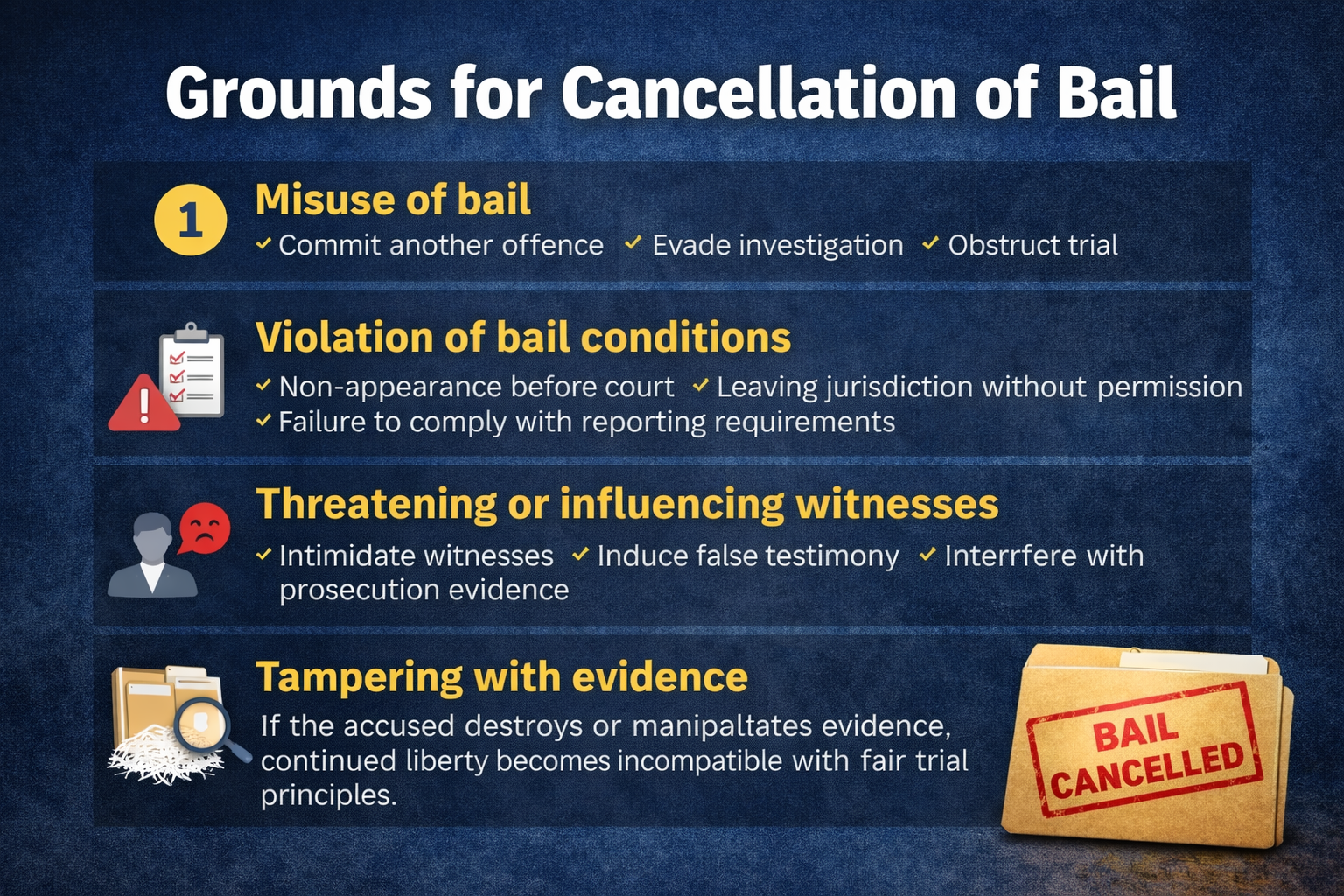
2. Violation of bail conditions
Common violations include:
- Non-appearance before court
- Leaving jurisdiction without permission
- Failure to comply with reporting requirements
Repeated or deliberate breaches justify cancellation.
3. Threatening or influencing witnesses
Any attempt to:
- Intimidate witnesses
- Induce false testimony
- Interfere with prosecution evidence
is treated seriously by courts.
4. Tampering with evidence
- If the accused destroys or manipulates evidence, continued liberty becomes incompatible with fair trial principles.
5. Absconding or likelihood of absconding
- Conduct indicating risk of fleeing from justice can justify withdrawal of bail.
When Can Bail Be Cancelled?
When can bail be cancelled is determined by post-bail conduct, not by reassessment of original merits.
Important points:
- Bail cannot be cancelled merely because charges are serious
- Filing of charge sheet alone is not sufficient
- Courts focus on events after grant of bail
This approach safeguards fairness and prevents arbitrary detention.
Difference Between Rejection and Cancellation of Bail
Understanding the Difference between rejection and cancellation of bail is essential:
| Aspect | Rejection of Bail | Cancellation of Bail |
| Stage | Before grant | After grant |
| Basis | Merits of case | Post-bail misconduct |
| Liberty | Not yet granted | Already granted |
| Standard | Judicial discretion | Higher threshold |
Courts apply stricter scrutiny in cancellation matters.
Power of Court to Cancel Bail
The Power of court to cancel bail depends on jurisdiction:
- Magistrate:
May cancel bail under Section 437(5) CrPC - Sessions Court / High Court:
Broader powers under Section 439(2) CrPC, including cancellation of anticipatory bail and regular bail
Under BNSS, courts retain similar hierarchical authority.
Supreme Court Judgments on Cancellation of Bail
Indian bail jurisprudence has been shaped by landmark rulings.
Key Supreme Court judgments on cancellation of bail include:
1. Dolat Ram v. State of Haryana (1995)
The Court held that cancellation of bail requires very cogent and overwhelming circumstances.
2. Puran v. Rambilas (2001)
It was clarified that bail can be cancelled if the order granting bail is perverse or liberty is misused.
3. X v. State of Telangana (2018)
Reiterated that personal liberty cannot be curtailed without compelling reasons.
These judgments continue to guide courts under BNSS.
Personal Liberty and Cancellation of Bail
The relationship between Personal liberty and cancellation of bail is governed by Article 21 of the Constitution.
Courts ensure that:
- Liberty is not curtailed arbitrarily
- Detention does not become punitive
- Cancellation serves legitimate judicial purpose
Bail jurisprudence reflects a balance between individual freedom and societal interest.
Bail Jurisprudence in India
Bail jurisprudence in India has evolved around the principle that:
“Bail is the rule, jail is the exception.”
However, this principle is conditional upon:
- Responsible use of liberty
- Respect for judicial conditions
- Cooperation with legal process
Cancellation of Bail Under BNSS & CrPC acts as a corrective mechanism when this balance is disturbed.
Can Default Bail or Anticipatory Bail Be Cancelled?
Yes. Both:
- Default bail
- Anticipatory bail
can be cancelled if grounds such as misuse of bail or violation of bail conditions are established.
However:
- Default bail is not cancelled merely because a charge sheet is filed later
- Courts require independent reasons
Conclusion
The court system uses Cancellation of Bail Under BNSS & CrPC process as an essential judicial function which protects judicial fairness against wrongful imprisonment. The legal system permits personal freedom through bail but it requires bail cancellation to maintain the judicial process and investigation methods and public trust in the legal system.
Indian courts exercise this power with restraint, which follows constitutional values and statutory safeguards and established judicial principles. The three elements which include Cancellation of bail under BNSS and Cancellation of bail under CrPC and grounds for cancellation of bail must be understood to navigate criminal cases effectively.