
The Bharatiya Nagarik Suraksha Sanhita 2023 BNSS established a fundamental transformation of India’s criminal justice system. The Code of Criminal Procedure 1973 CrPC served as the governinCrPC VS BNSSg law for all matters related to arrests and investigations and trials and citizen rights for more than 40 years. The CrPC vs BNSS comparison now examines three areas which include accountability practices and the speed of operations and the protection of citizens through safeguards that center their needs.
The common citizens experience this change as something beyond a technical matter. The changes directly impact police operations and the functioning of Magistrates and the methods used to protect rights during criminal cases. This article explains CrPC vs BNSS in a clear and practical manner, highlighting what has changed and why it matters to everyday people.
Understanding CrPC vs BNSS: A Structural Shift
The CrPC vs BNSS comparison begins with purpose. The CrPC originated as a colonial-era system which underwent amendments yet maintained its original governmental functions. The BNSS system replaces CrPC by establishing a new legal framework which upholds both constitutional principles and contemporary societal needs.
Key structural changes include:
- Clearer timelines for investigation and trial
- Increased judicial oversight
- Greater accountability of police authorities
- Better protection for both victims and accused
The transition from CrPC to BNSS marks a fundamental change in Indian criminal procedure law.
CrPC vs BNSS: What Changed for Common Citizens?
For ordinary citizens, CrPC vs BNSS is most visible at the ground level—police stations, Magistrate courts, and investigation stages.
Major citizen-focused changes:
- Reduced scope for arbitrary police action
- Stronger role of Magistrates in investigations
- Faster handling of complaints
- Improved transparency in criminal procedures
The BNSS impact on citizens lies in making the system more accountable and rights-oriented.
BNSS Replaces CrPC: What Changed After CrPC?
The moment BNSS replaces CrPC, several procedural shifts come into effect. These are not cosmetic changes but affect daily interactions between citizens and law enforcement.
Key changes include:
- Mandatory documentation of investigative steps
- Judicial supervision at early stages
- Defined responsibilities for police officers
- Clear remedies for police inaction
This answers the crucial question of what changed after CrPC—citizens now have stronger legal remedies against delay and abuse.
Criminal Procedure Under BNSS: A Citizen-Friendly Approach
The criminal procedure under BNSS emphasizes fairness, speed, and legality. Unlike CrPC, where procedural delays were common, BNSS introduces accountability at each stage.
Important features:
- Time-bound investigation process
- Digital documentation where applicable
- Enhanced Magistrate oversight
- Clearer separation between investigation and adjudication
This reform is part of broader criminal justice reforms India has long awaited.
Police Powers Under BNSS: Stronger Checks and Balances
One of the most debated aspects of CrPC vs BNSS concerns police authority. While police retain investigative powers, police powers under BNSS are now subject to stricter judicial supervision.
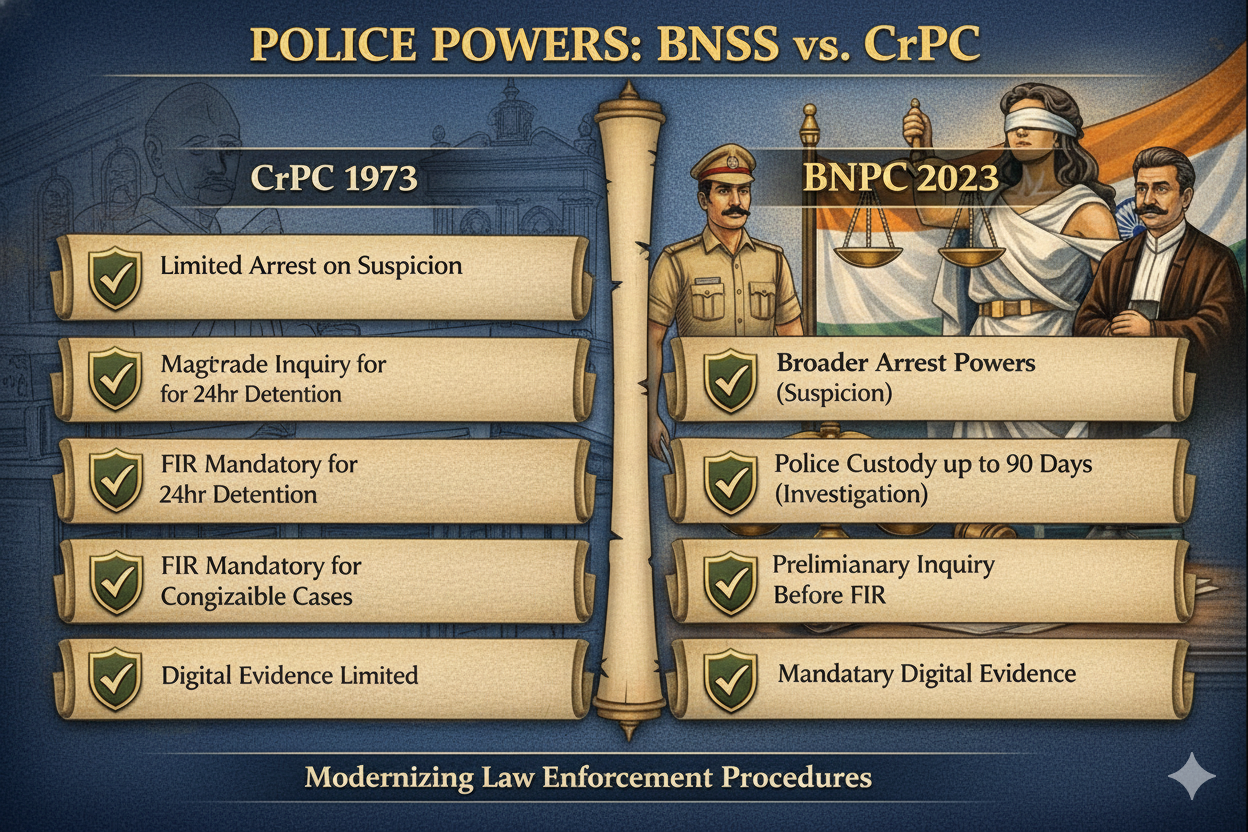
Key limitations on police:
- Investigations cannot be arbitrarily delayed
- Magistrates can intervene in cases of inaction
- Accountability mechanisms are clearer
- Rights of individuals during investigation are better protected
For citizens, this reduces harassment and misuse of authority.
Magistrate Powers BNSS: Strengthened Judicial Oversight
Under CrPC vs BNSS, the role of the Magistrate has evolved significantly. Magistrate powers BNSS are broader and more clearly defined, especially during investigation stages.
Magistrate powers include:
- Directing proper investigation
- Seeking status reports from police
- Preventing arbitrary closure of cases
- Ensuring compliance with procedural safeguards
This judicial supervision is a key safeguard for both victims and accused persons.
BNSS Rights of Accused: Greater Procedural Protection
A critical aspect of CrPC vs BNSS is the treatment of accused persons. BNSS rights of accused emphasize constitutional protections under Articles 14 and 21.
Safeguards for accused include:
- Protection against illegal detention
- Judicial oversight during investigation
- Transparency in procedural steps
- Protection from malicious prosecution
These changes ensure that the criminal process does not become punitive before conviction.
Impact on Victims and Complainants
While accused rights are protected, BNSS also strengthens remedies for victims. Under CrPC vs BNSS, complainants now have clearer pathways to judicial intervention.
Benefits for complainants:
- Remedies against police refusal to act
- Judicial supervision of investigations
- Timely progress of cases
- Increased accountability
This balances the system by ensuring access to justice for all parties.
New Criminal Law BNSS and Public Trust
The new criminal law BNSS aims to rebuild public confidence in the justice system. Delays, arbitrary action, and lack of accountability were major criticisms of the CrPC framework.
Through CrPC vs BNSS, the system now promotes:
- Transparency
- Fairness
- Speed
- Accountability
These reforms strengthen trust in institutions and align procedural law with constitutional principles.
Practical Difference Between CrPC and BNSS for Daily Life
For common citizens, CrPC vs BNSS affects:
- How FIRs are handled
- How investigations proceed
- How quickly courts intervene
- How rights are protected
The BNSS framework ensures that citizens are not left helpless against procedural delays or misuse of power.
Conclusion: Why CrPC vs BNSS Matters for Common Citizens
The shift from CrPC to BNSS is one of the most important legal reforms in independent India. The legal system comparison between CrPC vs BNSS demonstrates a fundamental judicial transformation which affects every aspect of life including personal freedoms and judicial access.
By strengthening police powers under BNSS with judicial checks, expanding Magistrate powers BNSS, and safeguarding BNSS rights of accused, the law creates a balanced and rights-oriented criminal procedure.