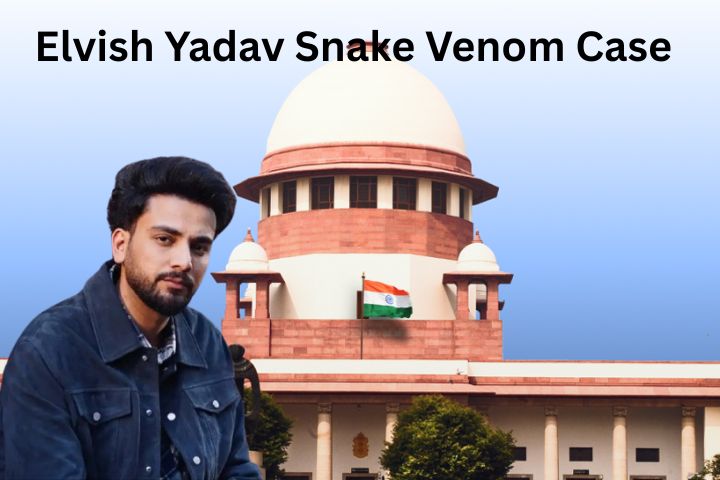
The Indian legal system reached an important decision when it ended a highly publicized legal dispute between famous people. The Elvish Yadav Snake Venom Case reached its final resolution when the Supreme Court judgment on FIR quashing on March 19 2026. The bench which included Justices M.M. Sundresh and N. Kotiswar Singh declared that the criminal case against the popular YouTuber and Bigg Boss OTT 2 winner lacked legal foundation.
The case which combined wildlife conservation elements with drug abuse allegations and celebrity impact has been hotly disputed since its discovery in late 2023. The Elvish Yadav Snake Venom Case needs complete examination of Indian legal procedures and all specific laws which the Uttar Pradesh police used for their police operation.
The Genesis: Timeline of the Elvish Yadav Snake Venom Case
To understand the court reasoning in Elvish Yadav case, we need to examine the events that led to the dispute. The Supreme Court analyzed the case because the timeline established which elements of Indian law enforcement and legal processes needed to be examined.
- November 3, 2023: The Noida Police registered an FIR at Sector-49 Police Station following a sting operation by the NGO People for Animals (PFA). The complaint alleged that Elvish Yadav was involved in organizing rave parties where snake venom was used as a recreational intoxicant.
- November 22, 2023: A case of a serious nature under the Wildlife Protection Act and the Indian Penal Code (IPC) existed.
- March 17, 2024: After months of questions and investigations, Noida police was able to arrest the”so-called” Elvish Yadav and booked him under relevant sections of the IT Act. He was sent to 14-day judicial custody and got bail on the very next day.
- April 5, 2024: A 1,200-page chargesheet was filed, adding stringent sections under the NDPS Act.
- May 12, 2025: Plea moved by Yadav to quash the FIR was dismissed by the Allahabad High Court stating that the allegations were of a serious nature and required a full trial.
- August 6, 2025: The Supreme Court has suspended the trial court proceedings, as it has the matter of principle regarding the charges.
- March 19, 2026: The Supreme Court has officially quashed the FIR in the case and all other subsequent proceedings with regard to the Elvish Yadav Snake Venom Case.
Key Legal Issues: Why the Case Crumbled
The Elvish Yadav Snake Venom Case was built on three main pillars: the Wildlife (Protection) Act, the NDPS Act, and the IPC. However, the Supreme Court identified fundamental flaws in how each of these was applied.
1. Procedural Lapses in the Wildlife Protection Act Case India
The power to quash the FIR in this case was conferred under, inter alia, Section 55 of the Wildlife (Protection) Act, 1972.
- The Authorized Signatory Rule: The powers of confiscation and penalty may be exercised by a bench magistrate authorized by a court that issues the license or permission to such toys.
- The Informant’s Status: The FIR in Elvish Yadav snake venom case was lodged on the basis of a complaint by a person who, while filing, did not possess a recognised stake in animal welfare.
- Court Finding: The courtroom justified that the lawsuit was competent, but since there was no notification from a competent authority, conversation begets fact into a modest argument.
2. NDPS Act Applicability Snake Venom Case
The most sensational bit about this case is the application of the Narcotic Drugs and Psychotropic Substances Act.
- Missing Scheduled Substances: The defense had contended that the recovered liquids from co-accused individuals was an anti-venom or a substance listed separately from the NDPS Schedule.
- Lack of Direct Recovery: Elvish Yadav faced charges because of “disclosure statements” provided by his co-accused, which did not present enough evidence to support the case without physical evidence to back it up.
- The Ruling: The Supreme Court ruling confirmed that the NDPS Act applicability for the snake venom case had been incorrectly applied because the substance did not meet the definition of a “prescribed psychotropic substance” specified in the law.
Supreme Court Judgment on FIR Quashing: A Deep Dive
In its final order, the apex court emphasized that “criminal law cannot be expanded by investigative imagination.” The Elvish Yadav Snake Venom Case serves as a cautionary tale regarding the sensationalism of legal proceedings against public figures.
Understanding the Court Reasoning in Elvish Yadav Case
The bench focused on the FIR validity and legal procedure India mandates. The court noted that the IPC offences (Sections 284 and 289) were linked to a previous complaint in Gurugram where a closure report had already been filed. Legally, a person cannot be prosecuted twice for the same set of facts if the original investigation found no merit.
Snake Venom Case Legal Issues India: The Question of Evidence
The prosecution’s reliance on call detail records (CDR) and virtual numbers was deemed insufficient to bridge the gap left by the lack of physical recovery. In the Elvish Yadav Snake Venom Case, the court found that the “causal link” between Yadav and the alleged rave parties was too tenuous to sustain a criminal trial.
Impact on Future Wildlife Protection Act Case India
The judgment establishes mandatory environmental and wildlife law requirements which must be followed through strict procedural methods. The court established that only authorized officials possess the power to start such legal proceedings which protects the Wildlife Protection Act case India from being used improperly by private people and NGOs who want personal gain or publicity.
Final Takeaway on Criminal Proceedings Quashed by Supreme Court
The decision to have the criminal proceedings quashed by Supreme Court does not necessarily mean the court endorsed the actions shown in viral videos. In fact, earlier in 2026, the bench remarked that influencers must be mindful of the message they send to society. However, the court’s duty is to uphold the law, and in the Elvish Yadav Snake Venom Case, the law was not followed correctly by the investigating agencies.