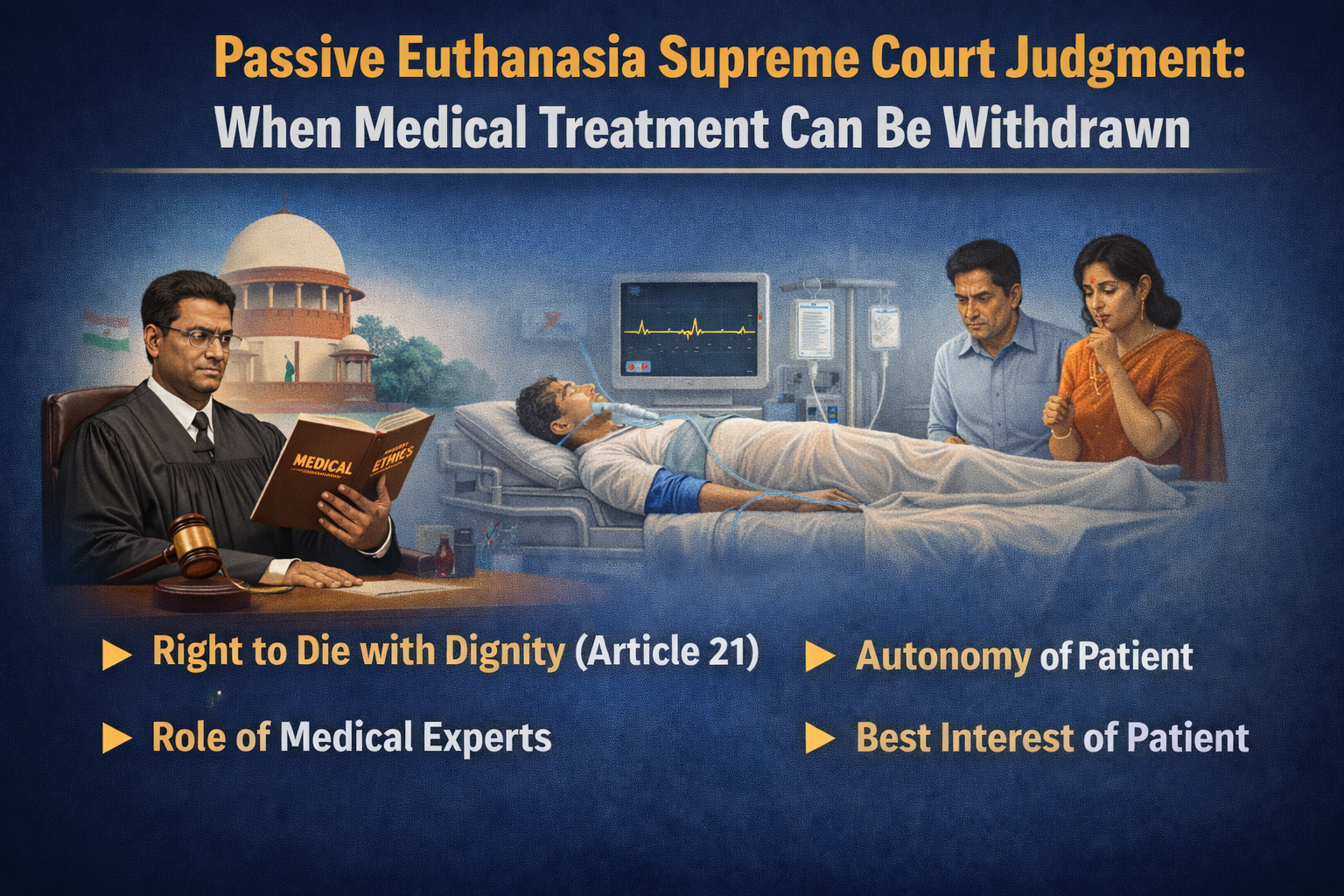
The Supreme Court of India recently clarified an important legal issue regarding passive euthanasia and the withdrawal of life-sustaining medical treatment. The Court established through its ruling that medical treatment should be discontinued when it no longer serves the best interests of the patient and to treat patients who cannot recover the medical staff should provide comfort care.
The Passive Euthanasia Supreme Court Judgment creates a significant legal development for India’s medical and constitutional framework. The ruling establishes that Article 21 of the Constitution of India protects the right to live with dignity also includes the right to die with dignity.
The judgment enhances the previous rulings from the Supreme Court that permitted euthanasia to be legally done in specific conditions.
Understanding Passive Euthanasia in India
In order to discuss the Passive Euthanasia Supreme Court Judgement, the passive euthanasia concept has to be fully grasped.
Passive euthanasia takes place when medical personnel decide to stop all treatment procedures which keep a patient alive through life-support systems including ventilators and feeding tubes. The objective is not to cause death but to allow the natural course of the illness when recovery is impossible.
The Supreme Court of India established passive euthanasia as a legal medical practice through its ruling in Aruna Shanbaug v. Union of India in 2011 and its subsequent confirmation in Common Cause v. Union of India in 2018.
The Passive Euthanasia Supreme Court Judgment was established through these cases which proved that patients possess the right to reject medical treatments which would extend their lives.
Background of the Recent Supreme Court Case
The recent Passive Euthanasia Supreme Court Judgment arose from a case involving a patient who was in a permanent vegetative state and dependent on artificial life support. The Court needed to decide if doctors and family members had the authority to stop medical treatment under these specific conditions.
The petition raised an important legal question:
When can medical treatment be withdrawn in the best interests of a patient?
The Supreme Court examined medical evidence, ethical principles, and constitutional rights before delivering its decision.
Supreme Court’s Observations on Patient’s Best Interest
It ensured the appropriate care for the patient and, therefore, also underlined the need for an understanding of the legislative provisions that are constitutionally upheld.
Key Observations of the Court
- Medical treatment should benefit the patient
The Court stated that treatment must have a reasonable chance of improving the patient’s condition. If treatment only prolongs suffering without any hope of recovery, withdrawal may be justified. - Patient dignity must be respected
Under Article 21, the right to life includes dignity and autonomy. Keeping a patient alive through artificial means despite irreversible medical conditions may violate this principle. - Decision must involve medical experts
Doctors must carefully assess the medical condition before recommending withdrawal of treatment. - Family members may be consulted
The Court recognized that family members play an important role in deciding what is in the patient’s best interests.
These principles form the core reasoning behind the Passive Euthanasia Supreme Court Judgment.
Legal Principles Applied by the Supreme Court
The Passive Euthanasia Supreme Court Judgment relies on several important legal principles.
1. Right to Die with Dignity
The Supreme Court has repeatedly held that the right to life includes the right to live with dignity. This interpretation flows from Article 21 of the Constitution of India.
If a patient is kept alive through invasive treatment with no possibility of recovery, it may amount to unnecessary suffering.
The Passive Euthanasia Supreme Court Judgment reinforces that allowing a natural death can sometimes be consistent with constitutional values.
2. Autonomy of the Patient
Another key principle recognized in the Passive Euthanasia Supreme Court Judgment is patient autonomy.
Patients have the right to decide whether they wish to continue or refuse medical treatment. This principle also supports the concept of a living will, where individuals can state their medical wishes in advance.
The Supreme Court had earlier recognized living wills in the Common Cause case, and the recent judgment follows the same approach.
3. Role of Medical Professionals
Doctors play a central role in implementing the principles established in the Passive Euthanasia Supreme Court Judgment.
Before withdrawing life-support treatment, medical professionals must evaluate:
- The patient’s medical condition
- Possibility of recovery
- Level of suffering
- Effectiveness of treatment
Only after proper medical evaluation can the withdrawal of treatment be considered lawful.
Importance of the Judgment
The Passive Euthanasia Supreme Court Judgment is significant for several reasons.
1. Clarifies Legal Position
The recent judgment establishes more precise rules for determining when medical treatment should be terminated despite earlier recognition of passive euthanasia in previous legal decisions.
2. Protects Patient Dignity
Dignity should come first in medical care, not lifelong drugs to prolong life.
3. Provides Guidance to Doctors and Hospitals
Hospitals encounter ethical problems when they treat patients who are in the final stage of their life. The Passive Euthanasia Supreme Court Judgment provides guidance on how such situations should be handled.
4. Strengthens Constitutional Rights
By holding that passive euthanasia is part of the essentials of the dignified way of life and thus Art. 21, the Supreme Court reaffirms their rights because dignity is essential to every individuals.
Ethical Considerations in Passive Euthanasia
The Passive Euthanasia Supreme Court Judgment also highlights the ethical challenges associated with end-of-life decisions.
Doctors must balance multiple considerations, including:
- Medical ethics
- Patient dignity
- Family wishes
- Legal obligations
The Court emphasized that decisions should always be taken carefully and responsibly.
Future Impact of the Judgment
The Passive Euthanasia Supreme Court Judgment will create an impact on future medical and legal developments throughout India.
Hospitals will develop better procedures to handle patients who have reached their final stages of life. Public understanding of living wills and patient rights will experience an increase.
Legal experts believe that this ruling strengthens the framework governing end-of-life decisions while ensuring that patient dignity remains the central focus.
Conclusion
The Supreme Court of India delivered a recent judgment about passive euthanasia which establishes clear guidelines for medical professionals to follow when they need to stop treatment to protect their patients’ best interests.
The Court established through its decision that Article 21 of the Constitution of India protects the right to die with dignity because it combines medical ethics and patient dignity with constitutional principles.
The ruling builds upon earlier landmark cases such as Aruna Shanbaug and Common Cause which establish an ongoing process to develop passive euthanasia legislation through humane and balanced methods across India’s legal system.