Indian society and legal systems through time have recognized cruelty toward married women as a major social and legal problem. The legislature established Section 498A IPC to create a criminal offense for husbands and their family members who commit acts of cruelty toward their wives. The Bharatiya Nyaya Sanhita 2023 BNS introduction has established new legal provisions to handle this particular criminal offense.
This article provides details when and how a Section 498A IPC case is registered with the operational functions of IPC and BNS laws and the established penalties and bail procedures and the urban definition of cruelty offences through Sections 85 and 86 BNS.
Section 498A IPC Meaning: Legal Background
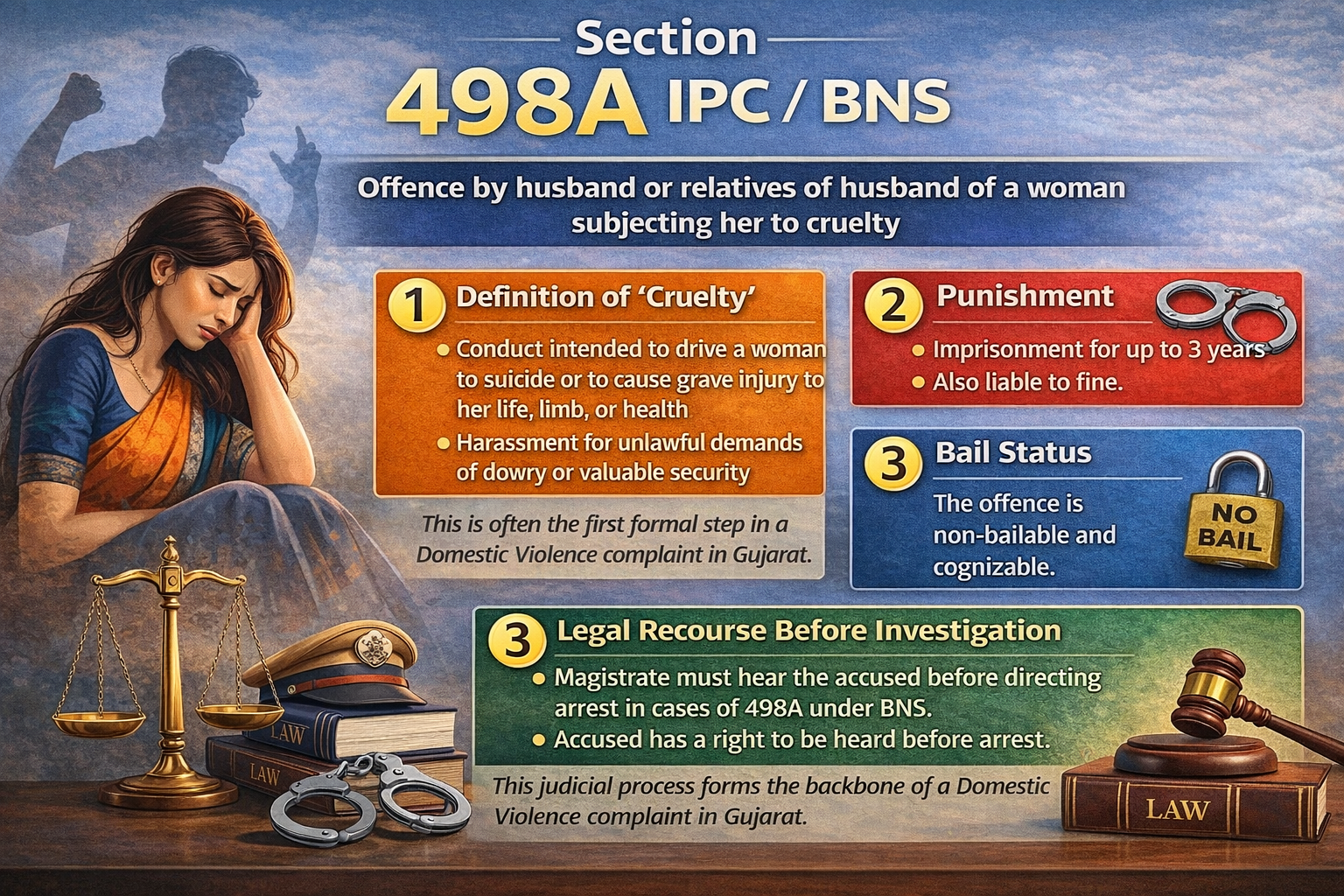
The legal meaning of Section 498A IPC protects married women from their husbands and their husbands’ relatives who commit abusive acts against them. The term cruelty encompasses both physical violence and psychological torment which includes the continuous pursuit of unlawful financial or material demands.
The old IPC system based Section 498A IPC as the most frequently used legal tool for resolving matrimonial disputes which involved dangerous conduct and abusive treatment and dowry-related offenses.
The 2023 BNS implementation has replaced 498A IPC replaced by BNS which now defines the crime under Section 85 BNS cruelty offence, while Section 86 BNS addresses specific extreme cases of this offense.
Section 498A IPC Case: When and How Is It Registered?
When Is a Section 498A Case Filed?
A Section 498A IPC case is filed when a married woman alleges cruelty by her husband or his relatives. The legal system permits people to proceed without showing their physical injuries in all situations.
A case can be registered when:
- The woman is subjected to physical violence
- There is mental harassment or emotional abuse
- She is harassed for dowry or unlawful demands
- She is threatened, humiliated, or forced into harmful conduct
- There is continuous abusive behavior affecting her dignity or safety
This answers the core question: When 498A case is filed — it is filed whenever cruelty, as defined by law, is alleged during marriage.
How Is 498A Case Registered? Step-by-Step Legal Process
The 498A case registration process follows a structured legal path:
1. Filing of Complaint
The aggrieved woman approaches:
- Local police station, or
- Women’s police station, or
- Magistrate directly
2. Preliminary Inquiry
- Following Supreme Court guidelines, police may conduct a brief inquiry before arrest to prevent misuse.
3. Registration of FIR
If prima facie cruelty is found, an FIR is registered under:
- Cruelty case under IPC 498A (for acts before BNS enforcement), or
- 498A IPC under BNS (now Section 85 BNS)
This explains how 498A case is registered in practical terms.
498A IPC Legal Procedure After FIR
Once the FIR is registered, the 498A IPC legal procedure includes:
- Police investigation
- Recording of statements
- Medical examination (if applicable)
- Filing of charge sheet
- Trial before Magistrate
A Section 498A IPC case is triable by a Magistrate of First Class.
Is Arrest Automatic in a Section 498A IPC Case?
No. Arrest is not automatic.
Courts have clarified that:
- Police must follow due process
- Arrest depends on necessity, severity, and evidence
- Notice of appearance under law may be issued
This clarification is crucial in understanding 498A IPC offence explained in its practical application.
Punishment Under Section 498A IPC and BNS
Punishment Under IPC
Under IPC:
- Imprisonment up to 3 years
- Fine
Punishment Under BNS (Section 85)
Under Section 85 BNS cruelty offence:
- Imprisonment up to 3 years
- Fine
- Or both
Thus, punishment remains substantively similar, though the structure is modernized.
Bail in Section 498A IPC Case
A Section 498A IPC case is:
- Cognizable
- Non-compoundable
- Bailable (as per judicial interpretation)
Bail depends on:
- Nature of allegations
- Medical evidence
- Past conduct
- Possibility of settlement
Courts increasingly favor personal liberty while balancing victim protection.
Section 498A IPC Replaced by BNS: New Legal Position
With the enactment of BNS:
- 498A IPC replaced by BNS
- Primary cruelty offence now lies under Section 85 BNS
- Certain aggravated forms fall under Section 86 BNS
This transition ensures continuity while updating legislative language.
Section 85 BNS: Meaning of Cruelty Against Wife
What Is “Cruelty” Under Section 85 BNS?
Under Cruelty against wife BNS, cruelty includes:
- Any willful conduct likely to cause grave injury
- Mental or physical harm
- Harassment for unlawful demands
- Conduct forcing suicide or serious harm
The definition mirrors judicial interpretations developed under IPC, ensuring consistency.
Section 86 BNS: Aggravated Cruelty
When Does Section 86 BNS Apply?
Section 86 BNS applies when cruelty:
- Results in serious injury
- Is continuous and severe
- Has grave consequences on life or health
This answers:
- When does Section 85, 86 BNS case apply?
- How is Section 85, 86 BNS case registered?
The process remains FIR-based with police investigation.
Difference Between IPC 498A and BNS Sections 85–86
| Aspect | IPC 498A | BNS Sections 85–86 |
| Law framework | IPC | BNS |
| Nature of offence | Cruelty | Cruelty & aggravated cruelty |
| Punishment | Up to 3 years | Up to 3 years (may vary) |
| Focus | Dowry & cruelty | Physical & mental cruelty |
Judicial Approach to Section 498A and BNS Cruelty Cases
Courts emphasize:
- Protection of women
- Prevention of misuse
- Fair investigation
- Scope for reconciliation in appropriate cases
A Section 498A IPC case is treated seriously, but judicial caution ensures balanced justice.
Conclusion
The Section 498A IPC case functions as a crucial mechanism which safeguards married women from domestic violence and abusive treatment. The IPC framework established the basic structure of the offence which the Bharatiya Nyaya Sanhita now redefined through its Section 85 and Section 86 BNS provisions without compromising their protective function.
Understanding when and how a Section 498A IPC case is registered, how punishment and bail operate, and how cruelty is defined under BNS is essential for both legal awareness and justice delivery. The law maintains its fundamental purpose which protects women’s dignity and safety and rights throughout marriage although it continues to develop.