
India’s Constitution isn’t merely a legal document; rather, it is the very foundation of Indian democracy. In its essence, it secures that all Indian citizens are granted some rights, which safeguard their freedom, equality, and dignity. These rights, referred to as Fundamental Rights, are preserved in Part III of the Constitution and serve as a protective barrier against any arbitrary measures taken by the government or other power structures. It is of utmost importance for every citizen to understand these rights, as the preservation of the values of justice, liberty, equality, and fraternity in everyday life depends on it.
What Are Fundamental Rights?
The Constitution of India grants all Indian citizens certain rights known as Fundamental Rights which are the basic rights that cannot be denied to them. These rights are very important for the complete development of a person and they are the legal means to contest any violation of rights. All rights are protected by the courts which imply that the citizens can come to the judiciary if their rights are violated.
Fundamental Rights are characterized by some important features:
- The rights are enforceable through the law.
- The rights safeguard individuals from wrongful or harsh government actions.
- The rights are assurances for all persons regardless of their religion, caste or gender.
- The rights constitute the basis for a just society.
Types of Fundamental Rights in India
Fundamental Rights of India are divided into six principal categories. The different rights serve the same purposes, providing protection to people’s liberty and dignity.
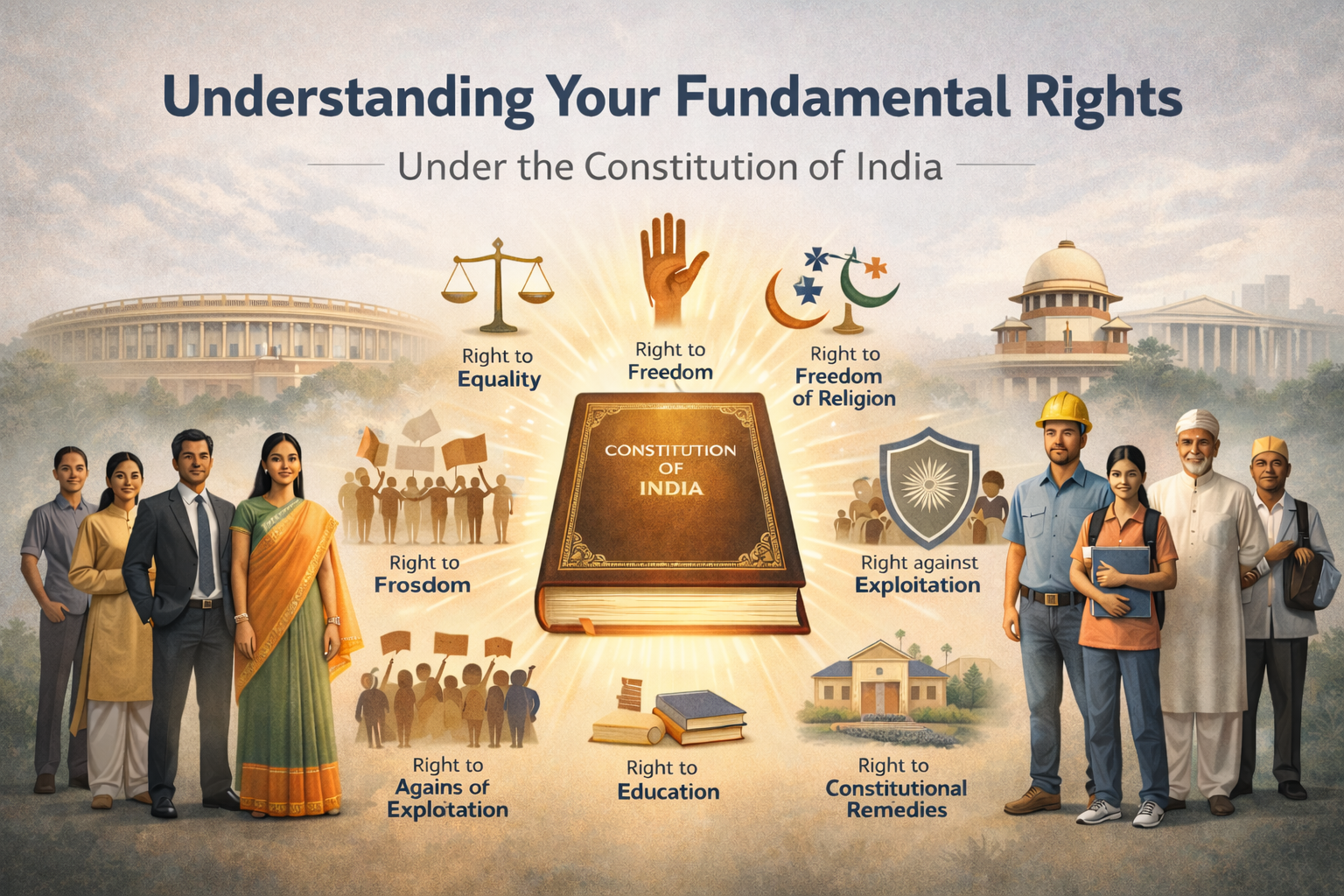
1. Right to Equality
The Right to Equality guarantees that every single person is equally considered in the eyes of the law. It stops any discrimination made based on religion, caste, gender, or birth place. Some main points are:
- Equality before law: All people are equals in front of the law.
- Prohibition of discrimination: Nobody will be discriminated against in respect of the job, education, or public services.
- Equality of opportunity: All the people are given equal chances in the competition for government services.
- Abolition of untouchability: It is not allowed to have social customs that lower people on the basis of their caste.
- Abolition of titles: No one is allowed to receive a title that will suggest their social status.
2. Right to Freedom
The Right to Freedom is considered to be one of the premier rights that the Constitution provides, as it secures personal liberty and independence. It encompasses among others:
- Freedom of speech and expression: The individuals are allowed to communicate their ideas without restrictions.
- Freedom to assemble peacefully: The public can get together even for protests or meetings without being anxious about being punished.
- Freedom of association: The people can create and join groups, trade unions, or political parties.
- Freedom of movement: The citizens are entitled to go anywhere within the borders of the country and not be restricted to any particular area.
- Freedom to reside and settle: The people have the right to choose where they want to live or settle in India.
- Freedom to practice any profession: The people can take the profession or business of their choice.
3. Right Against Exploitation
The Right against Exploitation, among other things, safeguards people from exploitation in the labor market as well as trafficking for sexual or other purposes. It outlaws such practices and more:
- Pouring of youngsters into labor: No adult can be forced to work through kidnapping or any other means.
- Child labor: Children are not allowed to work in risky sectors under any circumstances.
4. Right to Religion
The Right to Religion secures the freedom of religion and shields the individuals from any kind of religious discrimination. It encompasses the following:
- Conscientious objection: Everyone is free to practice any faith or hold any belief.
- The right of the community to handle its religious matters: The religious group has the right to conduct its own worship and run its institutions.
- The right of the individual to communicate religion: People have the right to express their religious beliefs without fear.
- The state is secular: The authorities cannot support or inhibit any religion.
5. Cultural and Educational Rights
Cultural and Educational Rights act as a shield for minorities and allow Indian society’s variety to flourish. They comprise:
- Languages and cultures’ conservation: The minorities can keep their cultural assets alive.
- Mother tongue education right: The little ones can be taught in their language and script.
- Opening of Schools and Colleges: The minorities are allowed to create and run their educational institutions.
6. Right to Constitutional Remedies
The Right to Constitutional Remedies serves as a tool for the citizens to request the court’s involvement if any of their rights guaranteed by the constitution are infringed. The right provides the following:
- The citizens have the option of going to the Supreme Court and High Courts for the enforcement of Fundamental Rights.
- A shield against the government’s random acts.
- The right to make appeals like writs, including habeas corpus, mandamus, prohibition, quo warranto, and certiorari.
Importance of Fundamental Rights
The Fundamental Rights are not just the legal shields, but also the instruments of power for the social and political spheres. They:
- Social justice and equality are being promoted.
- Power is being given to the people thus strengthening the democratic process.
- The rights of minorities and the weakest parts of society are being safeguarded.
- People are being encouraged to act responsibly when using their rights.
- Governmental powers are being checked and authority is being balanced.
Fundamental Rights and the Constitution of India
The rights specified by the Indian Constitution have been carefully framed for the government to respect individual freedoms. From Article 12 to Article 35, the Constitution defines the rights in detail, setting at the same time the limits needed to secure public order, morality, and national security. The original intent of these rights has been kept intact through various amendments that have gradually brought about these rights addressed to modern-day issues.
The Supreme Court of India has been a decisive force in the interpretation of Indian Fundamental Rights. The landmark decisions have not only defined the range and application of these rights but also made sure these rights get the needed changes with the changing society.
For example:
- The right to education has been identified as a Fundamental Right.
- Judicial review serves as a protection for the citizens against any illegal imposition of restrictions on personal liberty.
- Affirmative action policies have been supported to keep up equality in cultural and academic opportunities.
Exercising Your Rights
Grasping the Fundamental Rights is merely the initial step; their application is of equal relevance. It is necessary for citizens to:
- Be aware of their rights under the law.
- Inform the appropriate authorities about the infractions or take legal action.
- Engage in civic activities and make rights known within the community.
- Teach others, particularly the underprivileged groups, about the rights provided by the Constitution.
Conclusion
In a free and democratic society, the Fundamental Rights provided by the Constitution of India are the very foundation. They give power to the individuals, safeguard their rights, and contribute to the peace among different social groups. The rights that span from the Right to Equality up to the Right to Constitutional Remedies guarantee that no citizen will live without respect, protection, and liberty. A clear comprehension and effective asserting of these rights will reinforce democracy and carry among us the ideals anticipated by the Constitution’s makers.