
The criminal justice system of India has changed significantly with the welcome of the new laws namely Bharatiya Nagarik Suraksha Sanhita (BNSS) 2023, Bharatiya Nyaya Sanhita (BNS) 2023, and Bharatiya Sakshya Adhiniyam (BSA) 2023. The enactment of these three laws, replacing the British-era IPC, CrPC, and Evidence Act, has been the biggest Criminal Law Reform 2023 in the history of India.
Out of the three, the Bharatiya Nagarik Suraksha Sanhita (BNSS) 2023 is the most impactful because it fully replaces the CrPC, 1973 (often referred to as CrPC 1973 replaced), changing how investigation, arrest, custody, FIR, trial, and judgment will take place in India.
Out of the three, the Bharatiya Nagarik Suraksha Sanhita (BNSS) 2023 is the most impactful as it fully replaces the CrPC, 1973, changing how investigation, arrest, custody, FIR, trial, and judgment work in India. Under BNSS, Section 193 sets investigation timelines, Section 173 covers FIR and e-FIR, Section 176 mandates forensic and video recording, and Sections 35–60 update arrest and custody rules. These provisions together reshape the country’s entire criminal procedure system.
In this blog, we will understand what Bharatiya Nagarik Suraksha Sanhita (BNSS) 2023 means, how it works, and how it is different from the old IPC and CrPC procedures. We will also examine the most important changes in the Bharatiya Nagarik Suraksha Sanhita, or the BNSS, with regard to citizens’ rights and police responsibilities regarding newly created digital technology as part of the New Criminal Laws of India.
Understanding the Bharatiya Nagarik Suraksha Sanhita (BNSS) 2023
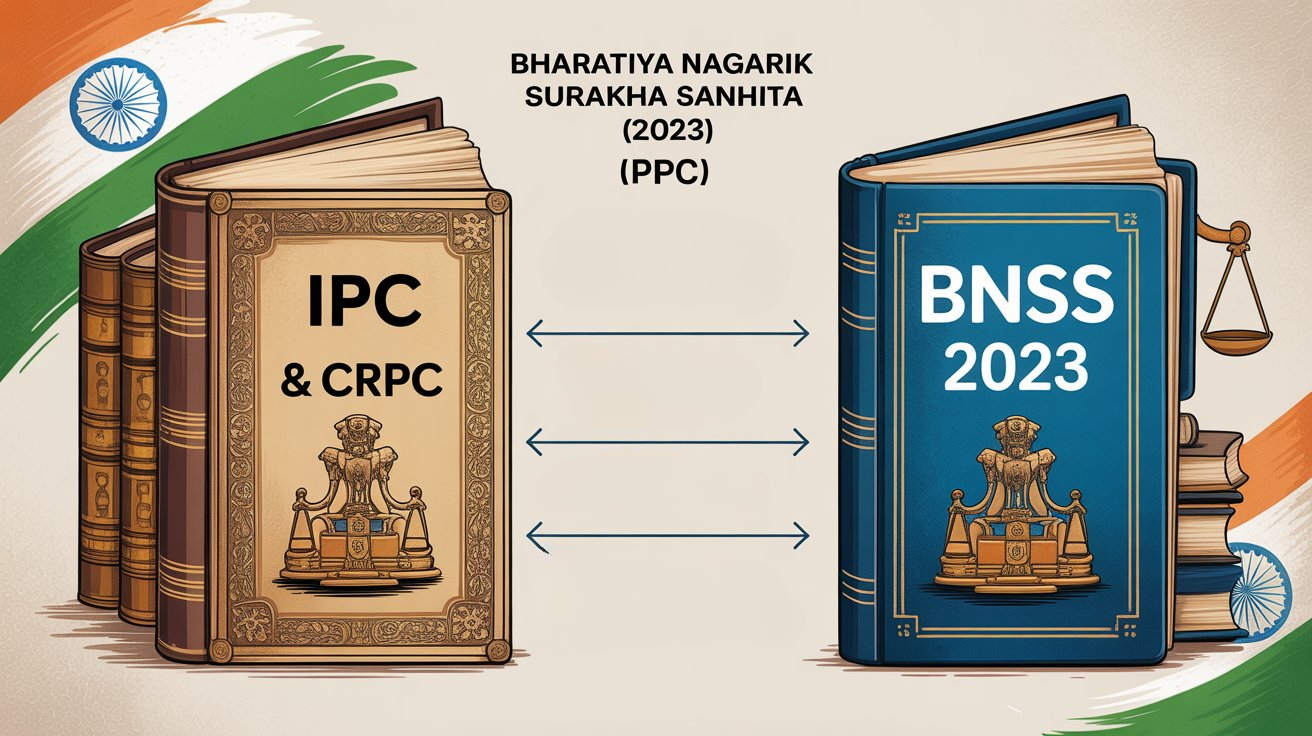
The BNSS 2023 will create a new procedural framework for criminal law, replacing the Code of Criminal Procedure (1973) in its entirety. In contrast, the old IPC defined crimes and penalties, whereas the old CrPC defined the process for prosecuting said crimes. The new framework will completely reorganise this entire framework.
Under the new system:
- The old IPC is now replaced by BNS 2023
- The old CrPC is now replaced by BNSS 2023
- The old Evidence Act is now replaced by BSA 2023
So, when we talk about BNSS vs CrPC or BNSS vs IPC, we are comparing the procedural shifts that impact how cases will progress in police stations and courts.
Major Changes Introduced Under Bharatiya Nagarik Suraksha Sanhita (BNSS) 2023
To understand Difference Between BNSS and CrPC, here are the major reforms that citizens, police, and courts must know.
1. Time-Bound Investigation and Court Proceedings
Bharatiya Nagarik Suraksha Sanhita (BNSS) 2023 sets strict timelines for speedy criminal procedures:
- Investigation must be completed in 90 days, extendable to 180 days for serious offences.
- Charges must be framed within 60 days.
- Judgments should be delivered within 45 days after conclusion of trial.
Why this change matters
- Faster case disposal
- Shorter pending cases
- Reduced delays in criminal justice system
Under CrPC, such deadlines did not exist, causing long pending trials.
2. Mandatory Digital Procedures in Investigation
A major highlight of the New Criminal Laws of India is compulsory technological usage.
Key digital changes
- E-FIR for faster complaint registration
- Electronic summons with digital acknowledgment
- Video-conferencing for recording statements
- CCTV-recorded search and seizure
- Digital evidence safeguards under Bharatiya Sakshya Adhiniyam
Impact
- Better transparency
- Lower chances of tampering
- More accuracy in evidence collection
This is one of the biggest BNSS key changes.
3. Zero FIR Becomes a Legal Right
Under Bharatiya Nagarik Suraksha Sanhita (BNSS) 2023, Zero FIR is now a statutory rule.
What this means
- Any police station must register an FIR
- No jurisdiction excuse
- Immediate action in serious offences like rape, cyber fraud, assault, accidents
Earlier, Zero FIR existed only through administrative practice, not law.
4. New Rules for Police Custody
The old CrPC allowed police custody only up to 15 days at once.
Under BNSS 2023, custody rules have changed.
Updated custody rules
- 15 days police custody can now be taken in phases
- Custody can be granted anytime within the first 60 days of arrest
- Helps deeper investigation in complex crimes
Why important
- Powerful tool for solving organised crime and cybercrime
- Reduces procedural loopholes
This change marks an important debate point in BNSS vs CrPC discussions.
5. Mandatory Forensic Investigation for Serious Crimes
Under the Bharatiya Nagarik Suraksha Sanhita (BNSS) 2023):
- Crimes with punishment of 7 years or more must involve forensic teams
- Mandatory video recording of crime scenes
- Scientific evidence must support investigations
Benefits
- More reliable trials
- Stronger prosecution
- Reduced wrongful arrests
This change is a huge upgrade from the old procedural system.
6. Victim-Centric Reforms
BNSS includes several victim-friendly provisions:
Key changes
- Victims must receive regular updates on progress
- Statements recorded through audio-video support
- In sexual offences, statements must be recorded by women officers
- Witness protection measures improved
Significance
- Strengthens victim participation
- Prevents intimidation
- Ensures fairness for survivors
7. Community Service Introduced for Minor Offences
One new innovation under Bharatiya Nagarik Suraksha Sanhita (BNSS) 2023) is community service.
Why introduced
- Reduces burden on courts
- Quick resolution for petty offences
- Encourages social responsibility
India has adopted this method for the first time in criminal justice.
8. Strict Action Against Proclaimed Offenders
BNSS contains tougher provisions for absconders:
BNSS key changes include
- Property attachment
- Auction and property confiscation
- Faster declaration of absconding accused
This helps police act firmly in cases involving hardened criminals.
9. Digital Warrants and Paperless Summons
BNSS brings a shift to digital court processes.
Changes
- Summons via SMS, email, portal
- GPS-based delivery tracking
- Digital signatures valid for all police and court documents
Impact
- Faster communication
- Reduced manual errors
- Time-saving process for courts and police
Difference Between BNSS and CrPC: Table
| Topic | CrPC (Old Law) | BNSS 2023 (New Law) | BNSS Section |
| 1. Investigation Time | No fixed timeline | Investigation must be completed within prescribed time | Sec 193 |
| 2. Zero FIR / FIR at Any Police Station | Not clearly codified | Zero FIR fully codified and applicable | Sec 173 |
| 3. e-FIR (Online FIR) | No provision for online FIR | e-FIR allowed | Sec 173 |
| 4. Forensic Investigation | Optional | Mandatory for serious offences | Sec 176 |
| 5. Police Custody (Remand) | Only 15 days once | 15 days allowed in different phases | Custody Chapter |
| 6. Digital Evidence | Limited rules | Digital recording made mandatory | Evidence Chapter |
| 7. Search & Seizure Recording | Video recording not mandatory | On-site video recording compulsory | Sec 176 |
| 8. Summons / Warrant | Paper-based | e-Summons and digital warrants introduced | Digital Process |
| 9. Community Service | No provision | Introduced for minor offences | Sentencing Chapter |
| 10. Victim Rights | Limited provisions | Stronger rights for victims | Victim Rights Chapter |
How BNSS Connects With BNS (IPC Replaced by BNS)
| Old Law | New Law (2023) | What changed overall |
|---|---|---|
| IPC, 1860 | BNS, 2023 | Substantive criminal law (offences, punishments) replaced. Number of sections reduced (from 511 to ~358), new offences added (organized crime, hate crimes, mob-lynching, etc.). |
| CrPC, 1973 | BNSS, 2023 | Procedural law (arrest, custody, investigation, trials, police powers, bail, evidence procedure) replaced. New procedures for arrests, custody, forensic exams, digital summonses, zero FIR, etc. |
| Indian Evidence Act, 1872 | Bharatiya Sakshya Adhiniyam (BSA), 2023 | Rules around admissibility of evidence, including digital records, forensic standards, statements, etc. |
Why Bharatiya Nagarik Suraksha Sanhita (BNSS) 2023 Matters
Key reasons
- Faster trials
- Better police accountability
- Stronger victims’ rights
- Modern digital system
- Clear timelines for justice
- Advanced scientific investigation
In many ways, it makes the Indian criminal justice process more structured, transparent, and citizen-friendly.
Final Thoughts
The setting up of the 2023 BNSS is a noteworthy transformation of India’s present criminal justice system, and at the same time, it introduces new methods that take over a lot of the old and makes its functioning routine with tech and modern public demands for citizens’ rights.
With tight timelines, more powerful forensic backing, digital progress, and open processes regarding accountability, the New Criminal Laws of India team up the nation with a more responsible judicial system. The alterations distinctly demonstrate the path India is stepping upon—quickness, scientific approaches, and justice.
.