Skip to content
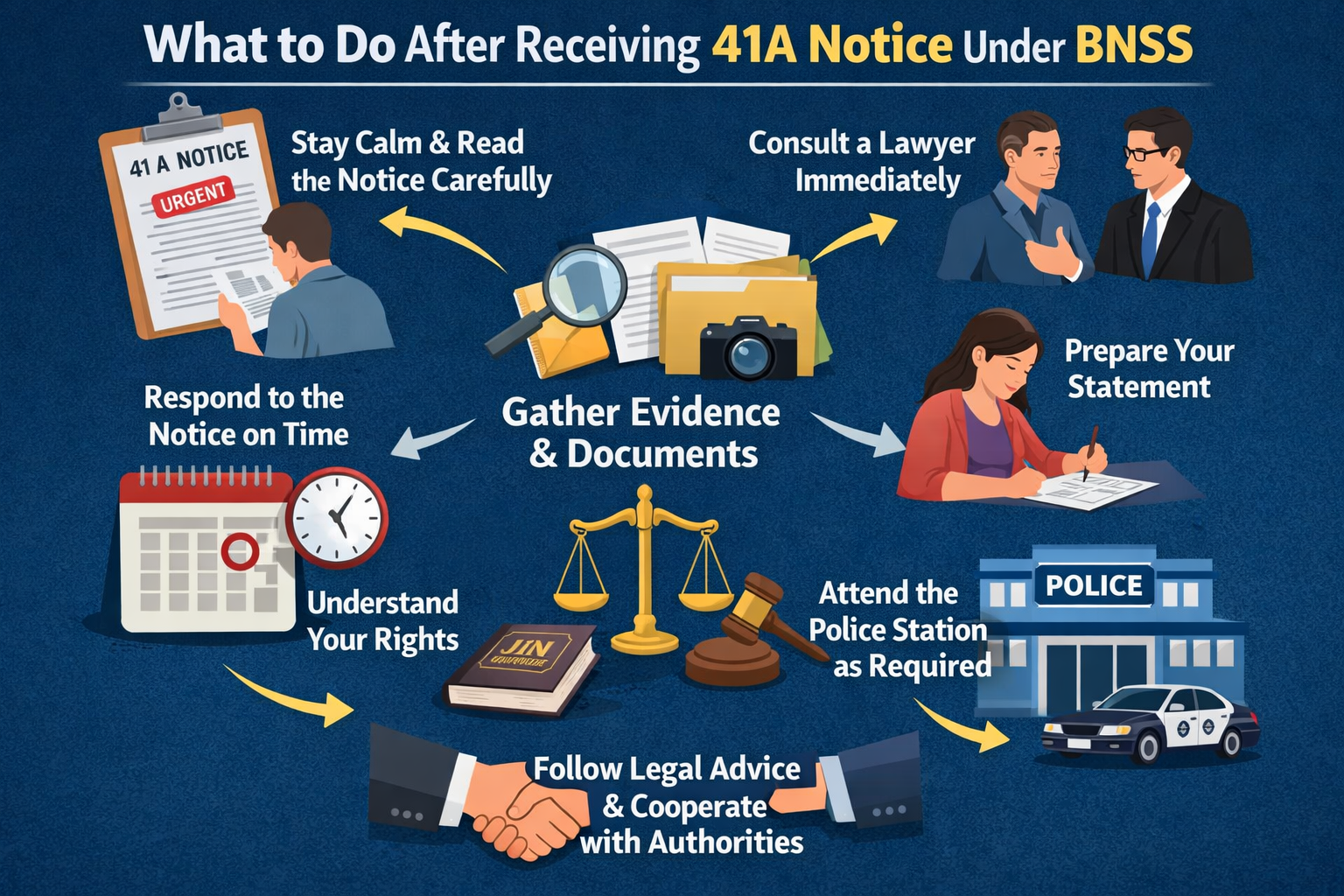
The police send you a Section 41A notice which comes from the original Code of Criminal Procedure but now exists as Section 35(3) of the Bharatiya Nagarik Suraksha Sanhita 2023. The notice functions as a pre-arrest summons which demands your presence at the investigation officer’s location.If handled incorrectly, it could lead to arrest or adverse legal consequences.
In this article, we explain What to Do After Receiving 41A Notice Under BNSS, including your rights, legal steps, common pitfalls, and practical tips with authoritative references.
What Is a 41A Notice Under BNSS?
A 41A notice under BNSS procedure refers to a notice of appearance that police issue when they have:
- Reasonable complaint, credible information, or reasonable suspicion that someone has committed a cognizable offence, but an immediate arrest is not necessary.
Under Section 35(3) of BNSS, the police must issue this notice instead of automatic arrest in many cases, especially where the offence is punishable with less than seven years imprisonment.
The notice requires the person to:
- Appear before the police at a specified time and place.
- Cooperate in investigation.
- Not tamper with evidence or threaten witnesses.
If you comply with the notice, the police cannot arrest you automatically unless fresh justification emerges.
Step-by-Step: What to Do After Receiving 41A Notice Under BNSS
1. Read the Notice Carefully
Check for:
- Your name, address, and details of the offence
- FIR or crime number
- Date, time, and place where you must appear
- Whether your personal appearance is mandatory
A BNSS notice must contain these details to be valid. If it doesn’t, it may be legally challengeable.
Why it matters: Notice that is defective or lacks elementary information may be legally void.
2. Confirm How the Notice Was Served
Important legal development The Supreme Court has determined that Section 41A and Section 35 BNSS notices must be served through traditional methods because WhatsApp and SMS and email and all electronic methods do not provide valid service. Notices must be served through prescribed statutory modes.
This means:
- The court will consider a WhatsApp message and SMS text without official service as an invalid proof of delivery.
- People should handle the situation through legal consultation because it offers better protection than total avoidance.
3. Consult an Advocate Immediately
The most important step after receiving a 41A notice under BNSS is to consult a criminal lawyer.
A lawyer will:
- Analyze the notice and legal validity
- Advise you on whether you need to appear in person
- Help draft a formal written reply
- Represent you before the police if necessary
Lawyer involvement protects your rights and reduces the risk of preventable missteps.
4. Prepare a Written Response
You should respond in writing even if you decide not to appear physically immediately.
Your written reply should:
- You must acknowledge receipt of the notice document.
- You need to explain your stance on the charges which have been brought against you.
- You should show your readiness to work together with others.
- You need to explain all limitations which you experience such as distance restrictions and health issues.
Submitting a reply helps establish a record of cooperation, which courts often consider favourably later.
Tip: Always send this reply through registered post or through your lawyer.
5. Decide Whether to Appear in Person
Depending on the nature of the offence and the seriousness of the allegations:
- Appear personally if the investigation requires it
- Send a lawyer to appear on your behalf if personal presence isn’t strictly mandatory
- Request a different date or location if the current schedule is unreasonable
Remember that ignoring the notice may provide police justification for arrest at a later stage.
6. Ensure You Don’t Tamper With Evidence
While cooperating:
- Do not delete or destroy evidence
- Do not threaten witnesses
- Do not attempt to influence the investigation improperly
Failing to comply with these conditions may give police fresh grounds to arrest you under BNSS.
7. Understand the Consequences of Ignoring the Notice
Ignoring a 41A notice under BNSS can lead to:
- Police arresting you later if they decide arrest is necessary.
- Courts treating your non-appearance as non-cooperation.
- Stronger discretionary justification for arrest later.
In summary, ignoring such a notice is rarely advisable.
Statistical Context (India Arrests)
While specific national data on Section 41A Section 35 BNSS notices is limited, arrest data shows that:
- A significant share of arrests occurs during investigation phases where pre-arrest notices are relevant.
- In 2023, India reported over 2 million arrests in cognizable offences — many of which involved pre-arrest procedures. (Exact statistical figures vary across crime categories)
This reflects the widespread use of investigative tools such as 41A notices, especially in minor or intermediate offences.
Key Legal Rights After Receiving the Notice
When you get a 41A notice under BNSS, you have these fundamental rights:
Right to Legal Representation
- You can be accompanied by a lawyer at all meetings.
This helps prevent coercion or misinterpretation of facts.
Right to Send Written Reply
- You don’t always need to appear physically. A reply through your advocate helps safeguard your interests.
Protection From Immediate Arrest
- If you comply with the conditions of the notice, you cannot be arrested immediately without valid grounds.
Right to Challenge Service of Notice
- If the notice was served electronically (e.g. WhatsApp), it may be challenged as invalid.
What Police Can and Cannot Do
Police Can:
- Call you for questioning
- Seek your cooperation
- Require you to attend investigation
Police Cannot:
- Arrest you solely for failing to answer questions
- Use WhatsApp or SMS as the only valid method of notice service (per Supreme Court).
When to Consider Higher Legal Remedies
If you believe the notice violates your rights — for example:
- It was served invalidly
- It contains errors or lacks statutory requirements
You may consider:
- Filing a habeas corpus petition
- Challenging the notice in the High Court
- Seeking anticipatory bail under BNSS
These are advanced legal options best pursued with experienced counsel.