

This blog explains the meaning of FIR, its purpose, importance, types, procedure, and rights of a complainant, all in simple language.
1. What Is an FIR?
The term FIR stands for First Information Report. It is the first piece of information given to the police about the commission of a cognizable offence—a crime for which the police can arrest the accused without a warrant.
Legal Definition
An FIR is a written document prepared by the police based on information about a cognizable offence under Section 154 of the Criminal Procedure Code (CrPC).
Simple Meaning
An FIR is the official record of the first complaint made to the police regarding a serious crime.
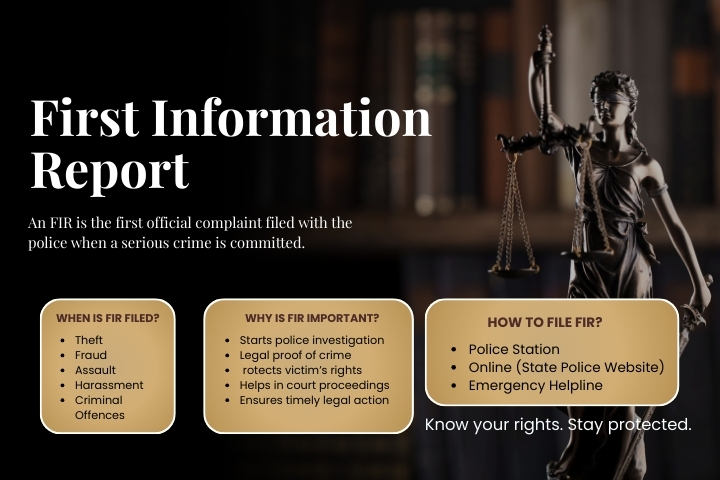
Once the FIR is registered, the police are legally bound to:
- Start an investigation
- Visit the crime scene
- Collect evidence
- Question witnesses
- Arrest the accused
- File a chargesheet
Thus, an FIR sets the criminal law into motion.
2. FIR Full Form and Key Features
FIR Full Form:
Key Features of an FIR
- First Information Report
- It relates only to cognizable offences.
- It is the first report made to the police.
- It must be reduced to writing.
- It must be signed by the complainant.
- A copy must be given for free to the complainant.
- It becomes the basis of police investigation.
3. Importance of an FIR
An FIR plays a crucial role in the criminal justice system. Here’s why it is so important:
1. Triggers the Investigation
Without an FIR, police cannot begin a formal investigation. Filing the FIR is what legally compels them to start action.
2. Legal Proof of Complaint
It works as the first official record that a crime has been reported. This helps prevent manipulation or denial later.
3. Establishes the Timeline of Crime
The FIR records the date, time, and place of complaint, which becomes important evidence in court.
4. Protects the Complainant’s Rights
Once the FIR is filed, the police must keep the complainant informed about:
- Progress in investigation
- Arrests
- Case updates
- Final report
5. Prevents Delays
An FIR acts as evidence that the complainant approached the authorities quickly, strengthening the case.
6. Provides Transparency in Police Action
Since an FIR is recorded in writing and signed, it reduces the chances of police ignoring or altering complaints.
4. Ingredients of a Valid FIR
For an FIR to hold legal value, it must contain:
- Name and details of the complainant
- Date and time of receiving information
- Description of the offence
- Details of accused (if known)
- Place where the incident occurred
- Names of victims and witnesses (if any)
- Brief facts of the incident
- Signature or thumb impression of the complainant
- Signature of the police officer filing the FIR
There is no need for proof at the FIR stage. It is only information, not evidence.
5. Who Can File an FIR?
An FIR can be filed by:
- The victim
- Any person who witnessed the crime
- Any person with knowledge of the crime
- A police officer (on their own information)
- A minor or illiterate person (with thumb impression)
The law does not require only the victim to file an FIR.
6. Where Can an FIR Be Filed?
An FIR can be filed at:
- The police station within whose jurisdiction the incident occurred
- Any police station in India (Zero FIR)
- Online (in states that provide online FIR facilities)
In emergencies, verbal information can also be given, which the police must convert into a written FIR.
7. Types of FIR in India
1. Regular FIR
Filed in the police station where the crime occurred. This allows the police to start the investigation immediately.
2. Zero FIR
A Zero FIR can be filed at any police station, irrespective of location. The FIR is later transferred to the appropriate jurisdictional police station.
Zero FIR is extremely important in cases involving:
- Rape
- Sexual harassment
- Kidnapping
- Road accidents
- Serious crimes requiring immediate action
3. Non-Cognizable Report (NCR)
This is not an FIR.
In non-cognizable crimes, the police cannot arrest or investigate without a court order.
Examples include:
- Defamation
- Minor hurt
- Public nuisance
8. How to File an FIR (Step-by-Step Process)
Step 1: Visit the Police Station
- Go to the local police station or the station nearest to the crime location.
Step 2: Explain the Incident
- Tell the police officer what happened—clearly and truthfully.
Step 3: Police Reduces the Information to Writing
- The police record your words in writing exactly as spoken.
Step 4: Read the FIR Carefully
- The complainant must read the report before signing.
If unable to read, the officer must read it aloud.
Step 5: Sign the FIR
- The FIR becomes valid only after being signed or thumb-marked by the complainant.
Step 6: Receive a Free Copy
- The police must give a free copy of the FIR to the complainant.
- Once these steps are completed, the FIR is officially registered.
9. What Happens After an FIR Is Filed?
After the FIR is registered, the police must:
- Investigate the case
- Inspect the crime scene
- Record witness statements
- Collect evidence (CCTV, weapons, documents, etc.)
- Arrest the accused if necessary
- Send the evidence for forensic analysis
- File a chargesheet in court
The investigation cannot be ignored once an FIR is filed.
10. Rights of a Complainant After Filing an FIR
A complainant has the legal right to:
1. Get a free copy of the FIR
- This cannot be denied.
2. Receive updates
- The police must inform the complainant about the investigation progress.
3. Protect their identity
- In cases like rape and POCSO offences, identity must be kept confidential.
4. Seek police protection
- If threatened, the complainant can request protection.
5. Approach court if police do not take action
- Under Section 156(3) CrPC, the complainant can approach a magistrate.
6. File online complaints
- Most states now offer online portals for filing complaints.
11. Difference Between FIR and Police Complaint
Many people confuse a normal police complaint with an FIR.
| Police Complaint | FIR |
| Can be for any offence | Only for cognizable offences |
| Does not start investigation automatically | Starts investigation immediately |
| No legal requirement to register | Mandatory to register if cognizable offence |
| Can be written or verbal | Must be recorded in writing |
| No strict format | Recorded under CrPC with formal process |
Understanding this helps citizens approach the correct remedy.
12. When Can Police Refuse to Register an FIR?
Police can refuse FIR only when:
- The crime is non-cognizable
- The information is vague or unclear
- No offence has actually been committed
However, refusal in a cognizable offence is illegal.
If police refuse, the complainant can:
- Approach senior police officers
- File an online complaint
- Approach the Magistrate under Section 156(3) CrPC
- Use helpline numbers like 100 or 112
13. Importance of FIR in India’s Criminal Justice System
The FIR ensures:
Accountability
- Police must act once an FIR is filed.
Transparency
- The details of the crime are formally recorded.
Fair Investigation
- Courts treat FIRs as important documents.
Protection of Rights
- FIR protects victims and helps them pursue justice.
Prevention of Manipulation
- It preserves the original version of events.
- Without an FIR, the entire investigation process collapses.
Final Thoughts
An FIR is not just a document—it is the foundation of justice in criminal matters. Every citizen should know what an FIR is, when it should be filed, how to file it, and what rights they have after filing it. The FIR ensures that the police take immediate and lawful action. It creates transparency, secures the rights of victims, and strengthens the overall criminal justice system.