Problems like defective products, delayed services, false advertisements, or unfair business practices are frequently encountered by the consumers. The majority of the public do not know that Indian law provides them with a powerful legal remedy via consumer courts. Consumer Court Complaint filing is a legally structured process for consumers seeking their rights, such as a refund, a replacement, or even compensation, without going through complicated court rules. A very simple and pragmatic way of explaining the Consumer Court Complaint process is what this blog does.
What Is a Consumer Court Complaint?
A Consumer Court Complaint is a formal complaint filed by a consumer with the court against a seller, manufacturer, or service provider that was the cause of bad service or defective goods. The Consumer Protection Act, 2019 is the governing law for consumer courts in India, and their primary purpose is to provide quick and low-cost justice.
After every purchase of goods or the hiring of services for private use, consumers can file a Consumer Court Complaint. The mechanism is made keeping the consumer in mind, and in many cases, it’s not necessary to engage a lawyer.
Who Can File a Consumer Court Complaint?
A Consumer Court Complaint can be filed by:
- An individual consumer
- A group of consumers with the same issue
- A registered consumer association
- Legal heirs of a deceased consumer
However, goods or services purchased for resale or commercial use are usually excluded, except when used for self-employment to earn livelihood.
Grounds for Filing a Consumer Court Complaint
A Consumer Court Complaint can be filed on several grounds, including:
- Defective or damaged products
- Delay or deficiency in services
- Overcharging or hidden charges
- False or misleading advertisements
- Unfair or restrictive trade practices
- Sale of hazardous goods
These issues form the basis of the consumer dispute complaint process and are commonly seen in banking, insurance, real estate, e-commerce, healthcare, and telecom sectors.
Consumer Court Complaint – Full Process (Step-by-Step)
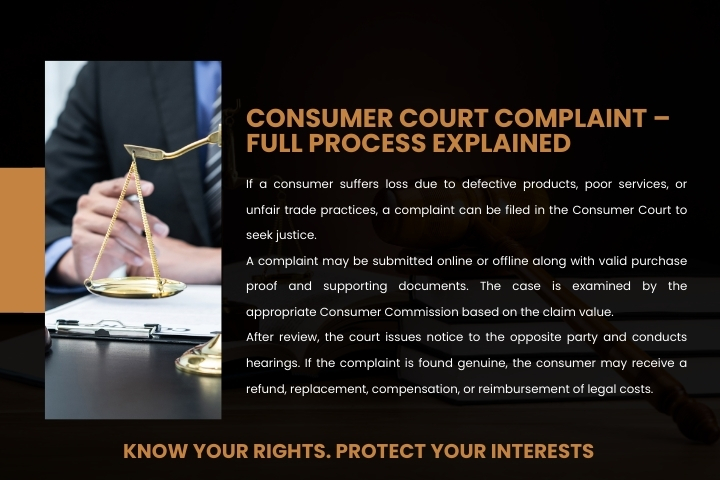
Consumer Court Complaint Process Explained
Understanding the Consumer court complaint process helps consumers take timely and correct action. Below is the complete procedure.
1. Identify the Correct Consumer Court
Before filing a Consumer Court Complaint, it is important to select the appropriate forum:
- District Commission – claims up to ₹50 lakh
- State Commission – claims above ₹50 lakh and up to ₹2 crore
- National Commission – claims above ₹2 crore
This stage is part of the consumer court case process and determines jurisdiction.
2. Send a Legal Notice (Optional but Helpful)
Although not compulsory, sending a legal notice is advisable before you file complaint in consumer court. The notice should explain:
- Details of the issue
- Relief demanded (refund, replacement, compensation)
- Time given to resolve the issue
Many disputes are resolved at this stage, reducing the need for a full Consumer Court Complaint.
3. Drafting the Consumer Court Complaint
Drafting is a crucial step in the consumer complaint filing procedure. The complaint must include:
- Details of the complainant and opposite party
- Facts of the case in sequence
- Proof of deficiency or defect
- Relief claimed
- Signature and verification
A clearly written Consumer Court Complaint improves the chances of faster disposal.
4. File Consumer Court Complaint Online or Offline
Today, consumers can choose between:
- Physical filing at the consumer commission
- Consumer court complaint online through the e-Daakhil portal
Online filing has simplified the consumer forum complaint process and allows tracking of case status from home.
5. Payment of Court Fees
A nominal fee is paid depending on the claim amount. The fee structure is affordable, making the Consumer Court Complaint system accessible to all sections of society.
Hearing and Evidence in Consumer Court Case Process
After admission, notice is sent to the opposite party. Both sides are given an opportunity to present evidence. During the consumer court case process, the court may:
- Examine documents
- Hear arguments
- Order product testing if required
The process is informal compared to civil courts, ensuring quicker outcomes.
Reliefs Granted in Consumer Court Complaint
If the Consumer Court Complaint is proved, the court may grant:
- Refund of amount paid
- Replacement of goods
- Removal of defects
- Compensation for mental harassment
- Litigation costs
These remedies strengthen consumer rights under consumer court complaint India framework.
Time Limit for Filing Consumer Court Complaint
A complaint to the Consumer Court has to be lodged within a period of two years starting from the day when the cause of action arises. It is possible to get the delay condoned if a reasonable justification is presented, however, it is always advisable to file within the specified time limit.
Appeal Procedure in Consumer Dispute Complaint Process
If a party is dissatisfied with the order:
- District Commission order → Appeal to State Commission
- State Commission order → Appeal to National Commission
- National Commission order → Appeal to Supreme Court
This hierarchy ensures fairness in the consumer dispute complaint process.
Advantages of Filing Consumer Court Complaint
Filing a Consumer Court Complaint offers multiple benefits:
- Simple procedure
- Low cost
- Faster resolution
- No mandatory legal representation
- Strong protection against unfair practices
These features make it easier for consumers to file complaints in consumer court without fear or confusion.
Conclusion
A Consumer Court Complaint is an effective and potent legal remedy that empowers consumers to fight against unfair trade practices, faulty products, and inadequate services. Knowing the procedure for a consumer court complaint and taking the right steps in the consumer court complaint process allows the consumers to guard their rights powerfully and efficiently.
The Consumer Court Complaint system in India is a great success because of the availability of online filing, well-defined procedures, and courts that are friendly to consumers, as it guarantees accountability and fairness in the market. Being informed and prompt in taking actions are the main things that lead to successful consumer justice.