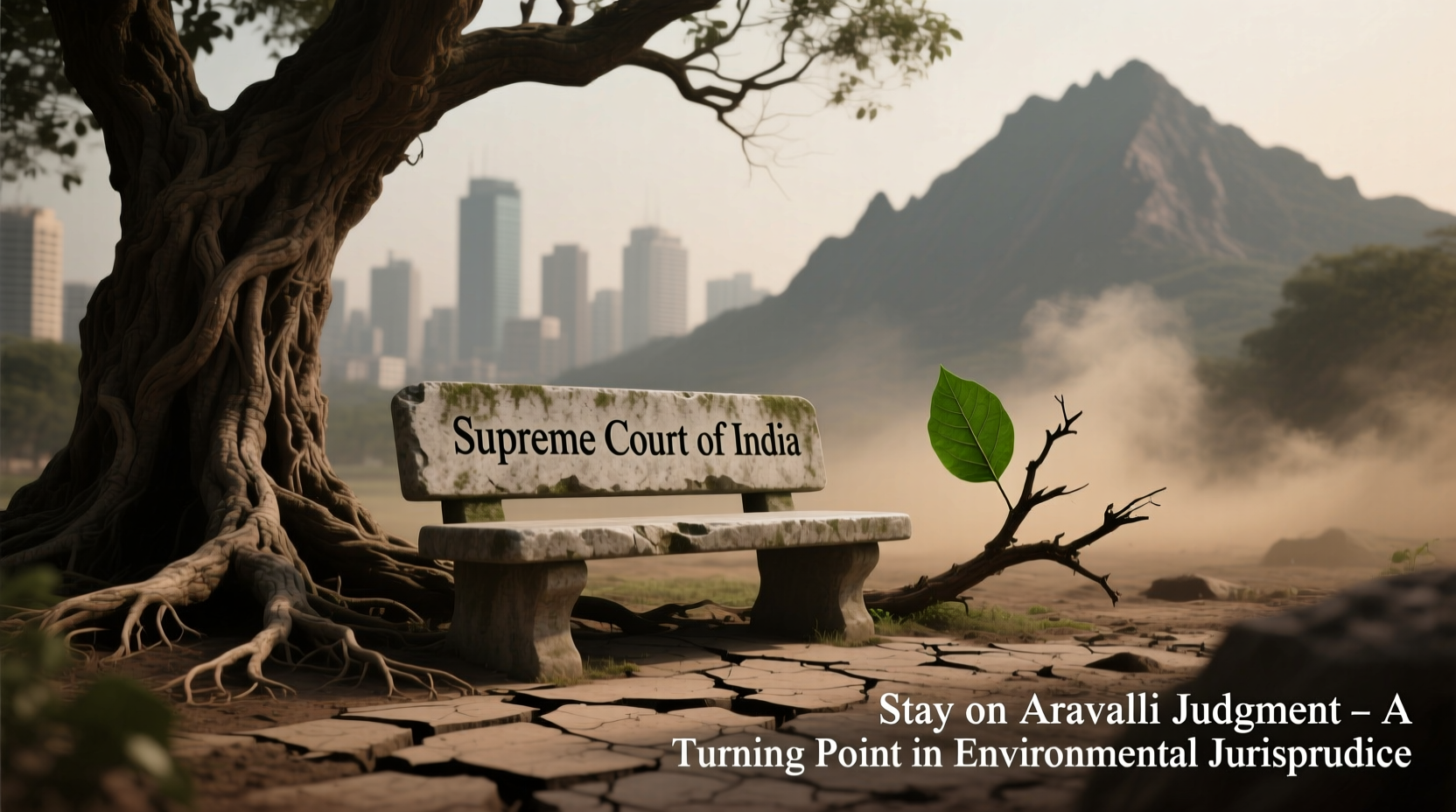
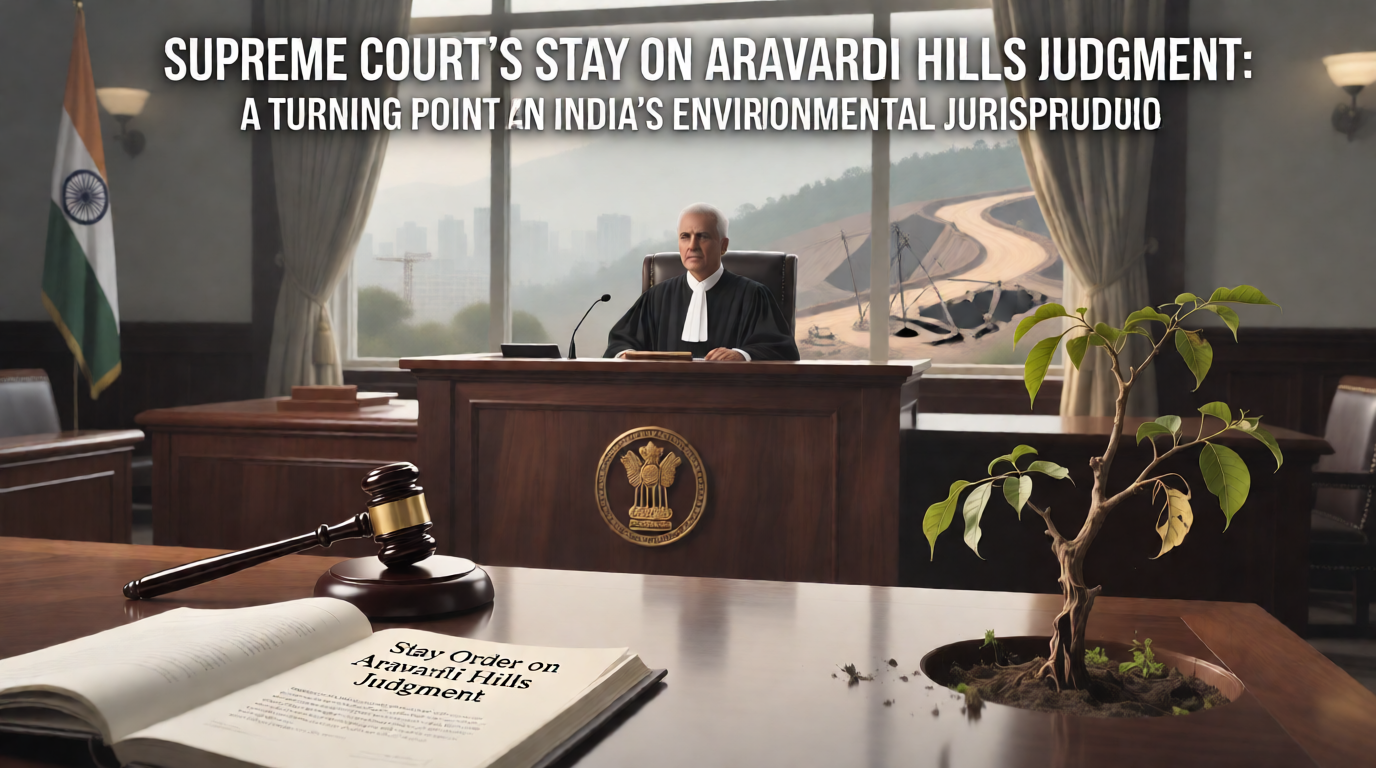
On December 29, 2025, the Supreme Court of India issued a significant order staying its previous ruling concerning the Aravalli Hills and Aravalli Ranges, which are among the most significant ecological resources in India. This stay is not just a matter of procedure; it implies a comprehensive reassessment of the interconnections between environmental protection, scientific proof, legal definitions, and sustainable development in modern India.
The Court’s latest action requires the constitution of a fresh expert committee to reassess its earlier findings and refine parameters for protecting the fragile Aravalli ecosystem. This decision has far-reaching implications for environmental law, mining regulation, public policy, and grassroots activism across four states — Rajasthan, Haryana, Gujarat and the National Capital Region (Delhi).
1. Aravalli Hills: Ecology, History, and Importance
1. The World’s Ancient Highlands
The Aravalli Hills are a mountain system of the oldest ones on the planet, and they extend from the state of Gujarat to Rajasthan, and then to Haryana and Delhi. The unique rock formation has a vital role in:
- One of the main functions of forests is to stop the spread of the desert by serving as a natural barrier to the Thar Desert.
- Besides, they are recharging aquifers and enabling the coexistence of nature and human beings in the arid and semi-arid regions.
- Climate regulation, air purification, and species variety maintenance are some of the forest’s benefits.
The well-being of the Aravallis is directly connected to the lives of millions of people, and it also affects the practices of agriculture, the patterns of weather and the resilience of the environment in the wider north-western Indian area.
2. Background: The Supreme Court’s 2025 Judgment
1. Defining the Aravallis
In November 2025, a significant Supreme Court bench accepted a uniform definition for “Aravalli Hills” and “Aravalli Range” — definitions that were previously inconsistent across states. The ruling, influenced by a committee report submitted to the Court, defined:
- Aravalli Hill: Any landform in designated districts with a minimum elevation of 100 metres above local relief, including slopes and associated landforms.
- Aravalli Range: A formation of two or more such hills situated within 500 metres of one another.
The judgment also directed the government to prepare a Comprehensive Management Plan to enable sustainable mining and conservation in the region.
3. Controversy Begins: Public, Scientific and Legal Pushback
1. Ecological Critique
Just right after the verdict, a group comprising environmentalists, scientists, and civil society organisations raised the issue that the height-based definition might leave out great areas of land, which have great ecological importance; these include the low ridges, scrublands, groundwater recharge areas, and also the habitats of various species that are not taller than the arbitrary limit of 100 meters. The critics cautioned that this situation could result in mining and industrial activities being carried on in millions of hectares.
Some of the activists even went as far as to say that nearly all of the Aravalli ecosystem, around 90%, might not fall under the new height-based definition of protection, which in turn would be a legal and emotionally charged public attention scenario.
2. Government Clarifications
The Ministry of Environment, Forest and Climate Change (MoEFCC) of the Union Government later stated that the definition was not a license for unrestricted mining and reiterated that only a minuscule part (approximately 0.19%) was earmarked for mining, which was subject to stringent conditions and scientific research before the issuance of further mining leases.
Nevertheless, these explanations did not completely silence the public’s concern over the possible impact on the environment.
4. The Supreme Court’s December 29, 2025 Stay Order
1. Why the Stay Was Ordered
The Supreme Court took a suo motu (on its own motion) view in revisiting the case after seeing evidence of widespread misunderstanding and concern about its previous order. The Court concluded that:
- The definition and its implementation were being misinterpreted or misapplied in ways that might undermine environmental protections.
- Fundamental questions remained about the scientific basis of the 100-metre rule and the broader definition of the Aravalli Range.
- There were potential structural inconsistencies in the earlier committee’s report that needed independent verification.
As a result, the Court stayed its own earlier order and directed that nothing should be implemented until further expert review. Responses from the Centre and state governments are to be considered in a forthcoming hearing on January 21, 2026.
2. Mandate for a New Expert Committee
A fresh high-powered expert committee was ordered to re-examine the ecological, geological, hydrological, and legal aspects of the earlier definition. This committee will have free will, not be biased and use a scientific way of working, and its review is likely to be checked against international ecological standards as well as local environmental conditions.
The Supreme Court chose to put clarity, scientific rigour, and ecological integrity above the speed of the procedural process. It also paused any new mining activities until the fresh committee’s recommendations were received and considered.
5. Legal and Policy Implications
1. Judicial Sensitivity to Science
The latest move of the Court has emphasised an evolving science-sensitive attitude in the courts’ decisions, mainly in cases concerning the environment. The need for expert proofs and subtle comprehension of the ecosystems indicates that the judges are getting ready to accept the ecological science being introduced into the judicial processes more and more.
This is a reflection of international patterns where the judiciary is relying on interdisciplinary evidence and not only the legal arguments.
2. Redefining Environmental Governance
The Aravalli case is probably going to set a legal standard for environmental governance, mainly in the way the courts settle disputes between economic activities like mining and environmental protection measures. Changing definition, committee referral, and continuous lawsuits will not only determine the future environmental policy of the Aravallis but also other areas with similar ecological conditions, such as the Western Ghats and the Himalayan foothills.
6. Public and Academic Reactions
1. Environmental Campaigns
The period when the # TheSaveAravallis campaign was trending as a rallying cry over social media and civil society platforms was quite remarkable. The discussion on Reddit and other platforms was an illustration of the public’s apprehension regarding the role of even the smallest hills, less than 100 metres in height, as pivotal in the processes of groundwater recharge, biodiversity, dust and heat-regulation.
2. Expert Debate
It is, however, a matter of how one interprets the situation: some consider it a disappointment for the transparency of the law regarding environmental issues, while others see it as a sign that the court is wise and has taken the future of the environment into account. Those who were against the previous definition said that it is impossible to use a simple mechanical measure (like height) to represent very complicated ecological processes, which need to be studied by scientists from more than one angle all at once.
7. Practical Legal Insight: What This Means for Stakeholders
The legal viewpoint of firms such as Go Legal Consultancy that offer legal interpretation, environmental compliance advice, and assistance in litigation situations provides a larger perspective that is necessary for the conversion of judicial actions into legal strategies.
1. For Governments and Regulators
Authorities must await the new expert panel’s guidance before issuing any new mining leases, zoning changes, or infrastructure clearances in the Aravalli ecosystem.
2. For Industry and Mining Firms
Although interim environmental protections may allow the current leases to persist, it is expected that the new leases will be postponed until the scientific recommendations are officially recognised and made into law.
3. For Environmental Lawyers and NGOs
The issuance of this stay order highlights the dominant role of legal tussles and public interest litigations in deciding the environmental policy. It calls for thorough scientific evidence to be presented in environmental cases.
4. For Local Communities
The communities that rely on groundwater and the climate resilience sector are expected to gain from more rigorous judicial reviews, which might lead to the establishment of more solid safeguarding systems.
FAQ — Aravalli Hills Supreme Court Stay Order
1. What exactly did the Supreme Court put a stay on?
The Supreme Court put a stay on its November 20, 2025, judgement on defining the Aravalli Hills and Ranges, pending a new expert committee review.
2. Why is the new expert committee needed?
The Court believes the earlier definition and guidelines were being misinterpreted and may lack a sufficient scientific basis, potentially harming ecological protection.
3. Does this stop all mining in the Aravalli region?
The Court has indicated that no new mining activities should be undertaken until the fresh committee provides clear guidance.
4. When is the next court hearing?
The matter is scheduled to be heard on January 21, 2026.
5. How will this affect local environmental protection?
The stay order preserves the status quo and aims to ensure that environmental protections are strengthened and scientifically informed, not weakened.
Conclusion
The Supreme Court’s decision to stay its own Aravalli judgment is a turning point in Indian environmental law, an event that gives precedence to scientific clarity and ecological integrity over stringent measures. The Court’s insistence on a new expert committee and the temporary stoppage of implementation has once again established its position as a protector of environmental justice and democratic accountability.
While India keeps on trying to juggle economic growth with ecological conservatism, the Aravalli case will stay as a reference point for environmental governance, legal interpretation, and public discourse in democracy.