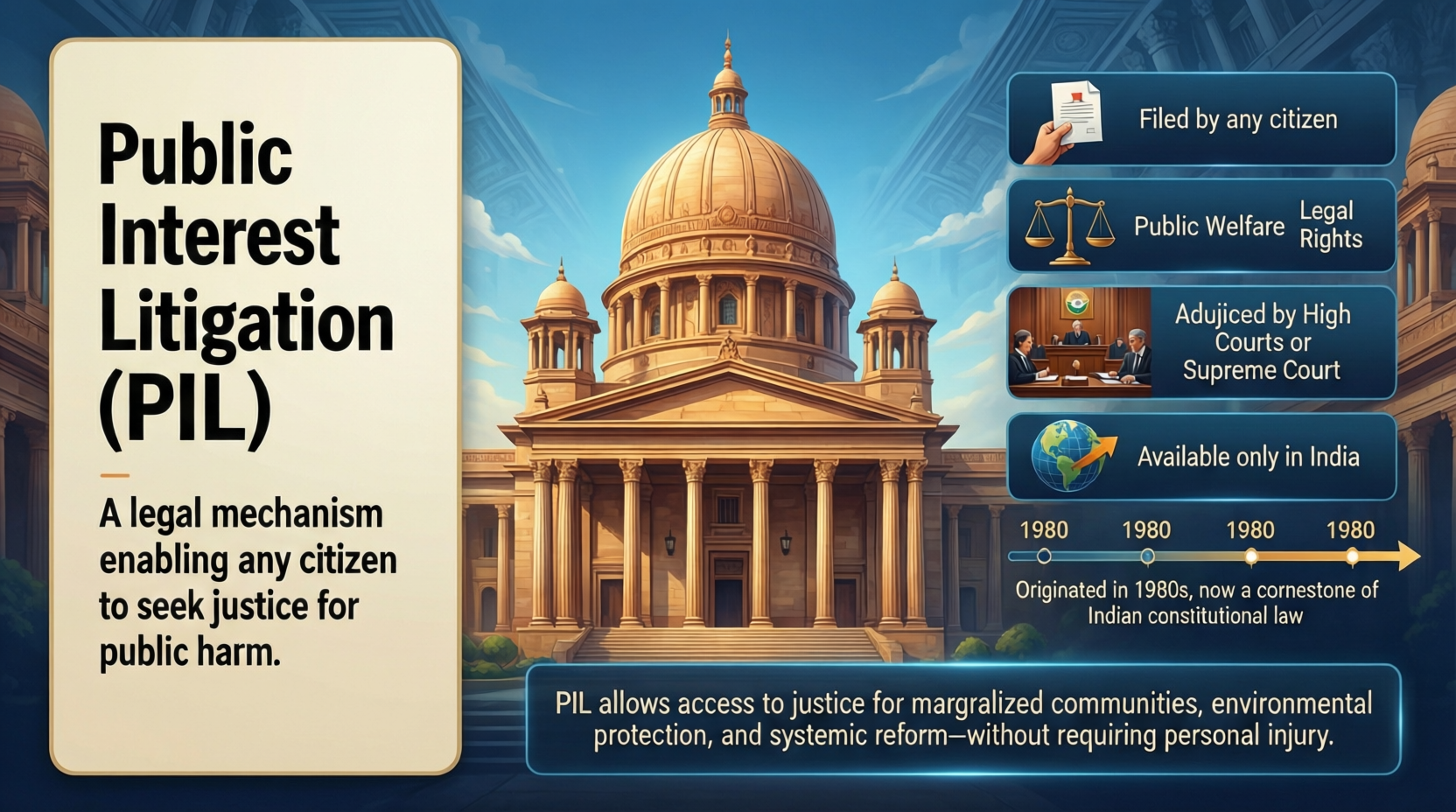
Public Interest Litigation (PIL) is an extremely important legal innovation by courts in the Indian legal system. It has completely changed the classical notion of litigation by making it possible for courts to intervene in cases of public interest, especially where the rights of the poor or the marginalized are involved. Courts will not only hear the case of the individual but also the case of society, thus reaching the constitutional values and protecting collective rights, which is the main PIL goal.
PIL has been a significant force in the strengthening of democracy, the opening of new avenues for lawyers, and the wiping out of the conservation of court power in India. The courts, through PILs, have tackled a variety of issues, e.g. protecting the environment, human rights abuses, cases of corruption, malfunctioning of government, health and education, among others. In this paper, a detailed study of PIL from all angles, i.e., its definition, legal foundation, historical development, procedural matters, extent, drawbacks, and present situation, is given.
What is Public Interest Litigation (PIL)?
Public Interest Litigation is the term used for a legal battle that is instigated in a court for the sake of public interest rather than private interest. Public interest is an issue that impacts the whole society or a large part of the public.
In PIL:
- The person who files the case might not be affected by the issue at all.
- The purpose behind the case is not a personal benefit but social justice.
- The rights of the public are being enforced constitutionally and legally, those in particular who are unable to go to courts by themselves are the major beneficiaries.
PIL is a landmark rule that has overruled the traditionally strict principle of locus standi, which had previously required a person who was directly aggrieved to seek the court’s intervention. In PIL, any person or institution with a public spirit can apply for judicial intervention.
Constitutional Basis of PIL in India
The Indian Constitution does not explicitly mention the term “Public Interest Litigation,” yet its basis can be found in the constitutional provisions concerning fundamental rights and judicial remedies.
Article 32 – Supreme Court
Article 32 allows people to approach the highest court for the enforcement of Basic Human Rights. According to Dr. B.R. Ambedkar, it was the “heart and soul” of the Constitution. PILs can be filed directly before the Supreme Court under this Article when fundamental rights of the public are violated.
Article 226 – High Courts
Writs might be issued by the High Courts under Article 226 for purposes beyond the enforcement of fundamental rights, as it particularly states that the High Courts are empowered to issue writs for “any other purpose” besides the enforcement of fundamental rights. This broad scope makes High Courts a preferred forum for PILs at the state level.
Together, Articles 32 and 226 form the constitutional backbone of PIL in India.
Evolution of Public Interest Litigation in India
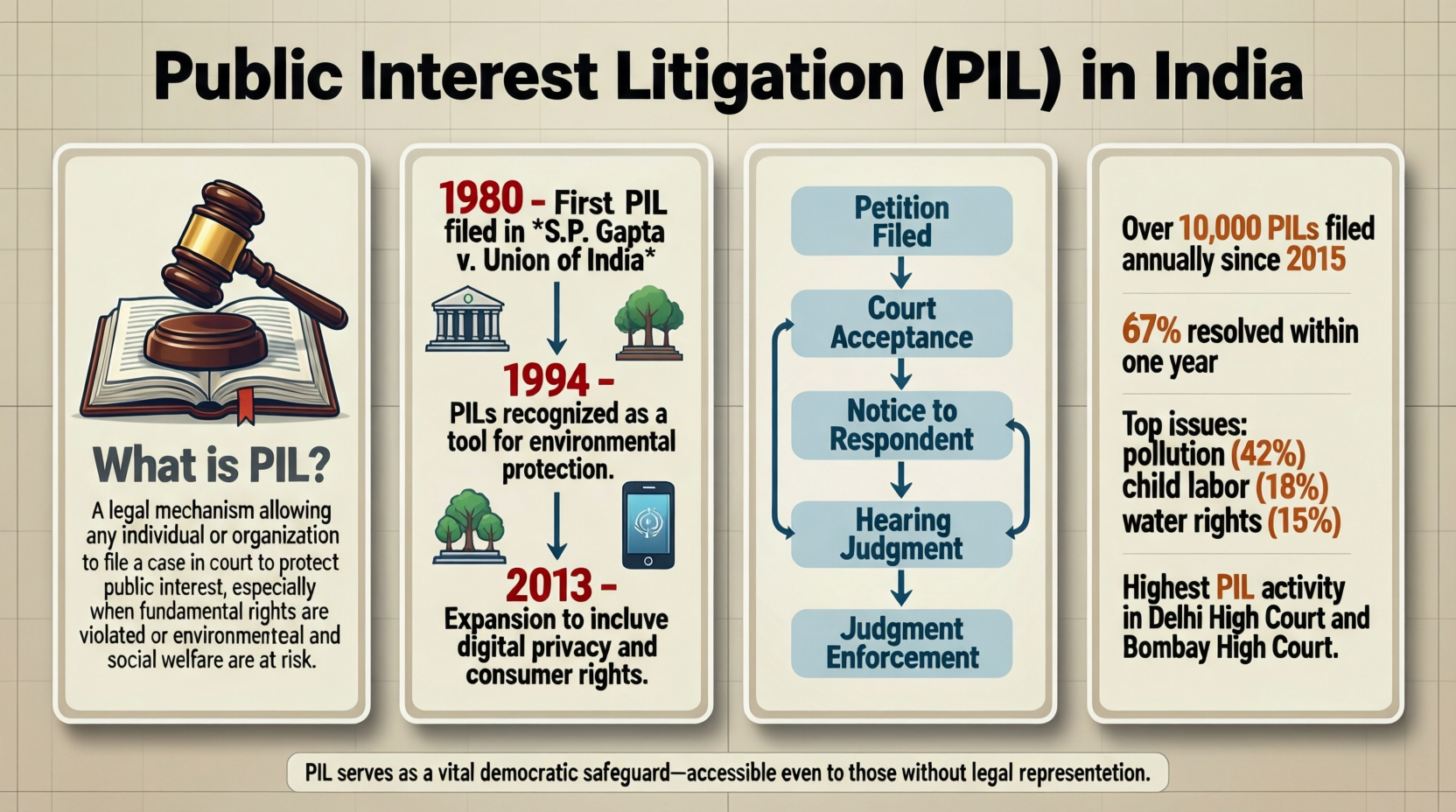
In India, the idea of PIL came into being during the late 1970s and the early 1980s as a reaction against the prevailing conditions of extreme poverty, illiteracy, and social injustice.
Judicial Innovation
P.N. Bhagwati and V.R. Krishna Iyer were the judges who pioneered the development of Public Interest Litigation (PIL) jurisprudence. They were aware of the fact that the strict rules of procedure served as a barrier to the poor and marginalized people to get justice.
Landmark Early Cases
- Hussainara Khatoon v. State of Bihar (1979): The case has put the issue of undertrial prisoners—mainly their suffering—into the limelight and at the same time has opened the door to the right of having a speedy trial being recognized.
- S.P. Gupta v. Union of India (1981): Allowed more access to the courts for the litigants and established the Public Interest Litigation (PIL) formally.
- People’s Union for Democratic Rights v. Union of India (1982): The case has increased the area of fundamental rights in relation to the welfare of the working class.
Through these cases, PIL evolved as a powerful tool for social transformation.
Who Can File a PIL?
A Public Interest Litigation can be submitted by:
- A citizen with public interests
- Social workers
- Non-profit organizations
- Attorneys representing the public’s interest
The applicant needs to be genuine and not for his/her own benefit, advertising, or political reasons. The courts pay close attention to the purpose of the applicant.
Issues That Can Be Raised Through PIL
Public Interest Litigation is a vast area of public issues and among them are the following:
- Environmental matters with a highly positive ability to impact the surrounding environment and noise pollution control
- Human Rights abuses
- Rights of Convicts, Women, Children, and Workers
- Bribery in Government Departments
- Unlawful Mining, Cutting of Trees, and Seizing of Land
- Health care, Sanitation, and Safety in Public Places
- Schooling and Welfare Programmes
- Abuse of administrative power
PIL has played a crucial role in enforcing socio-economic rights that are otherwise difficult to litigate individually.
Procedure for Filing a PIL
The procedure for filing a PIL is relatively flexible compared to ordinary litigation.
- Jurisdiction: PIL can be filed in the Supreme Court or the appropriate High Court.
- Form: It may be filed as a writ petition. In exceptional cases, courts have even accepted letters and emails as PILs.
- Contents: The petition must clearly state the public issue, legal violations, and relief sought.
- Evidence: Supporting documents, reports, and affidavits must be attached.
- Court Fees: Nominal court fees are charged.
Courts may appoint commissions, seek expert opinions, or issue continuing mandamus to monitor implementation.
Role of Judiciary in PIL
The judiciary plays an active and dynamic role in PIL cases. Courts often:
- Expand the interpretation of fundamental rights
- Issue detailed guidelines where laws are inadequate
- Monitor executive action
- Ensure accountability of public authorities
This proactive approach has led to judicial activism, which has both supporters and critics.
Misuse of Public Interest Litigation
While PIL has achieved remarkable success, its misuse has become a growing concern.
Frivolous and Motivated PILs
Some PILs are filed for:
- Personal or political gain
- Publicity
- Settling private disputes
Judicial Response
Courts have adopted a stricter approach to curb misuse. They may:
- Dismiss frivolous PILs at the threshold
- Impose heavy costs or penalties
- Question the credentials and motives of petitioners
The Supreme Court has repeatedly emphasized that PIL is a weapon for justice, not a tool for harassment.
PIL and Governance
PIL has significantly influenced governance and public administration in India. It has:
- Improved transparency and accountability
- Compelled governments to implement welfare scheme
- Strengthened environmental and regulatory frameworks
- Enhanced citizen participation in democracy
However, excessive judicial intervention may sometimes blur the separation of powers, making judicial restraint equally important.
Contemporary Relevance of PIL
In the modern era, PIL continues to address emerging challenges such as:
- Climate change and environmental sustainability
Digital rights and data protection - Public health emergencies
- Urban development and infrastructure issues
With increasing awareness and access to information, PIL remains a vital instrument for protecting constitutional values.
Frequently Asked Questions (FAQs)
1. What is the main objective of PIL?
To protect public interest and ensure enforcement of constitutional and legal rights.
2. Can anyone file a PIL in India?
Yes, any public-spirited individual or organization can file a PIL.
3. Where can a PIL be filed?
In the Supreme Court under Article 32 or High Courts under Article 226.
4. Is PIL meant for private disputes?
No, PIL cannot be filed for personal or private grievances.
5. Can courts reject a PIL?
Yes, courts can dismiss PILs that are frivolous, motivated, or lack public interest.
6. Is there a penalty for filing a false PIL?
Yes, courts may impose fines or costs for misuse of PIL.
Conclusion
Public interest litigation (PIL) is an important judicial mechanism that has changed the Indian legal landscape. It has made the justice system more accessible and has relaxed the rules of procedure, thereby empowering the citizens and, in turn, strengthening the governance of the constitution. It has made the powerless heard and has made sure that even the most disadvantaged groups in society enjoy the protection of the law.
But the real power of PIL is in its judicious use. It is, however, the case that during the time when it was still a cornerstone of social justice and democratic accountability, preventing its misuse was the only way to retain its credibility and effectiveness. Under purity and honesty, PIL remains a major protector of public interest in India.