Every criminal justice system around the globe has record-keeping as their basis for accountability, transparency, and fair play. In India, the General Diary (GD), the most significant document, is generally disregarded by the public. Even if the General Diary is not a legal document like an FIR, it has played a crucial role in police administration, investigations, and the justice system.
The article discusses the General Diary’s concept and intent, compares it with an FIR (First Information Report), and examines the interaction of these two records during the law enforcement procedure. Moreover, legal significance, procedural aspects, and ordinary citizen’s advantages through its understanding will be unveiled to you.
What Is the General Diary (GD)?
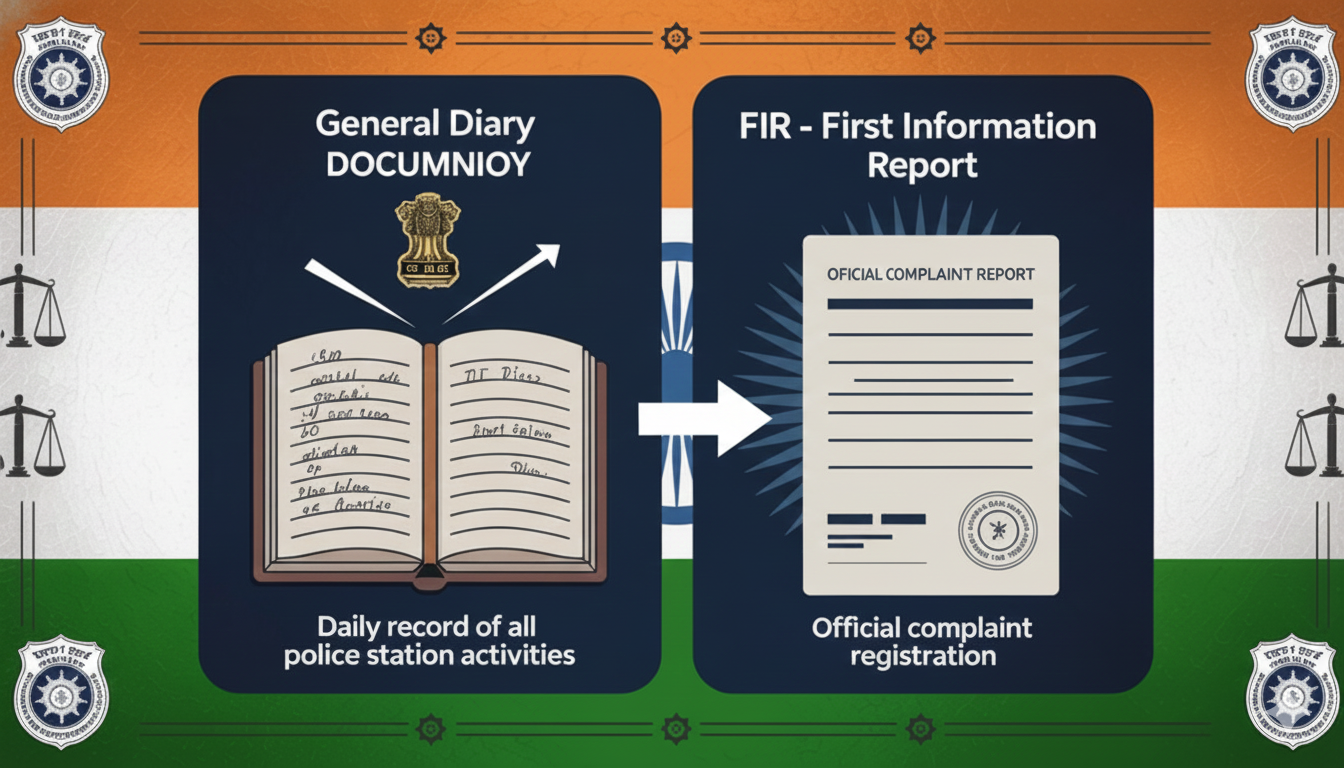
The General Diary is a daily official record maintained by every police station in India. It logs all significant events, actions, and orders related to the functioning of the station — from routine patrol movements to complaints received and significant orders executed.
Key Features of GD:
- It is chronological — entries are logged in the exact order events occur.
- It records not just complaints, but all noteworthy happenings at the station.
- It serves as an archival record for internal administrative use, investigation tracking, and later verification if disputes arise.
- Entries are usually made by a designated officer, often the Duty Officer on a given day.
In simple terms, GD functions like a police station’s daily journal — a formal diary of all activities and reports.
What Is an FIR?
An FIR (First Information Report), conversely, is a documented complaint that is officially written by the police when they get to know about a cognizable crime. The term cognizable crime means an offense in which the police can open an inquiry without a court order.
The FIR is a legal document with significant consequences:
- It initiates the police investigation.
- It fixes the timeline and facts of the complaint.
- It enables police to arrest without a warrant in certain situations.
- It serves as primary evidence in court proceedings.
While GD is administrative and internal, an FIR is a criminal justice document that can lead to prosecution.
Purpose of the General Diary
The General Diary serves multiple purposes:
1. Administrative Record-Keeping
Police stations are dynamic workplaces with a wide range of activities every day. From staff movements to public complaints, the GD records all such events — no matter how routine.
2. Tracking Complaints and Orders
Sometimes complaints do not qualify as cognizable offenses or may require verification before an FIR is filed. These are logged in the GD first.
3. Evidence Trail
In cases of controversy or allegation of negligence, the GD provides a verifiable record of actions taken by police — such as visits, verifications, orders received, or communications made.
4. Reference for Investigations
Investigating officers often return to the GD to check when a complaint was received, what actions were taken, and who was responsible.
5. Accountability and Transparency
The existence of a GD ensures that police actions are not arbitrary — everything significant is recorded for future reference.
What Are the Usual Entries in a General Diary?
Typical information included in a GD may consist of:
- Receipt of verbal or written complaints
- Orders from higher-ranking officers or courts
- Movement of officers (e.g., patrol, deputation)
- Arrests made or suspects brought in
- Details of seizures or recoveries
- Reports of lost property
- Court summons received or sent
- Verification reports prepared by police
- Any unusual events logged during the day
Each entry is typically signed by the officer making it and dated with the exact time.
How Is the General Diary Related to an FIR?
Although both GD and FIR are records maintained by police, their purpose and legal effect are different. However, they are often interconnected in practice.
1. First Step in Recording Information
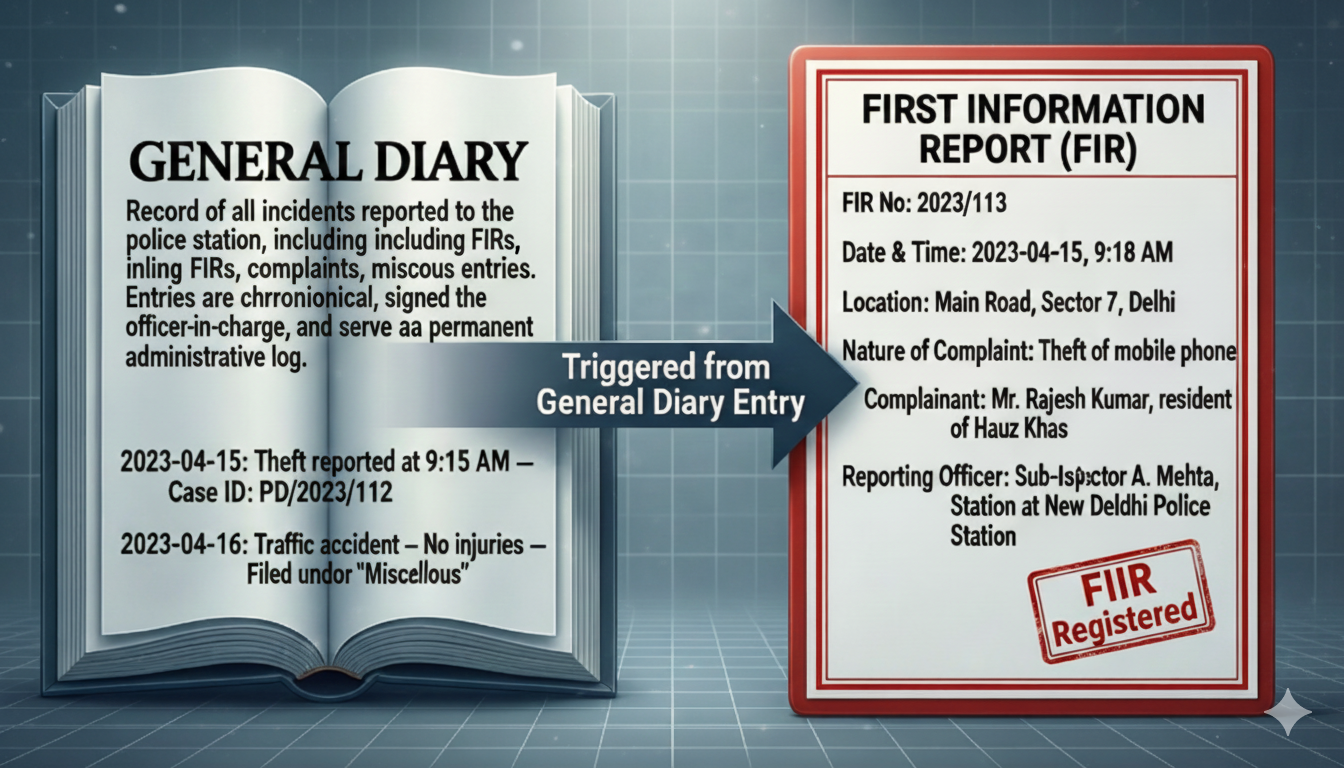
When a person arrives at a police station and reports information — whether it pertains to a crime or not — it is common for the first step to be logging the matter in the General Diary. Subsequently, the officer evaluates whether the information amounts to a cognizable offense.
2. GD Before FIR
Before immediate registration of an FIR, the police may first make a GD entry noting the receipt of information. If the matter is identified as a cognizable offense, the police are then required to register an FIR.
For example:
- A person walks in to report suspected fraud.
- The police officer notes the complaint in the GD with date and time.
- Upon review, if the information discloses a criminal offense, the officer prepares an FIR from that GD entry.
This dual-record approach ensures both administrative tracking and legal recording.
3. GD as Evidence of Timeline
If there is disagreement later — for example, if the complainant claims that police delayed FIR registration — the GD entry can serve as evidence of when the complaint was first received.
Differences Between General Diary and FIR
| Feature | General Diary (GD) | FIR |
| Purpose | Administrative daily record | Initiates criminal investigation |
| Legal Impact | Internal; not directly admissible as evidence | Admissible and crucial in court |
| Initiation | Any information or event | Only cognizable offenses |
| Registration | Does not require formal FIR process | Requires legal formalities |
| Public Access | Not routinely provided to public | FIR copy can be issued to complainant |
Why Do Police Log in GD Before FIR?
There are several practical reasons:
1. Verification and Assessment
Not all complaints amount to a cognizable offense. Logging the complaint in GD allows police to assess and verify before FIR registration.
2. Record of Action
If police choose to investigate informally before FIR registration (for example, verifying details of a complaint), those preliminary steps must be documented — GD is the tool for that.
3. Proof of Receipt
GD entries establish a timestamped record of when information was received, even if an FIR is delayed.
Legal Significance of the General Diary
Although GD is not a statutory document like an FIR, courts have recognized its importance:
- It shows the sequence of events at the police station.
- It reflects police response times and actions.
- It is used by courts when deciding whether there was unreasonable delay in FIR registration.
- It can help determine police conduct and compliance with procedures.
In many cases, lawyers request certified copies of GD entries to support arguments about police action or timing.
Can a Citizen Ask for a GD Entry Copy?
While there is no statutory right to automatically receive a GD copy (unlike an FIR), citizens can:
- Ask for a certified copy of GD entry relevant to their case
- Use Right to Information (RTI), if necessary, to access certain entries
- Request action when police refuse to record a GD entry
Many legal advisors recommend always ensuring a GD entry is recorded before arranging an FIR, especially in sensitive situations where timing is critical.
Common Misconceptions
Myth 1: GD is the same as an FIR
Fact: GD is a log book — FIR is a legal criminal complaint.
Myth 2: Nothing happens until an FIR is filed
Fact: GD can trigger preliminary investigation and accountability even before FIR.
Myth 3: Police can avoid registering FIR by using GD
Fact: If information discloses a cognizable offense, police must register an FIR — GD alone isn’t enough.
FAQs
1. What is the primary difference between GD and FIR?
Answer: GD is an internal record of activities and complaints, while an FIR is a formal legal complaint used to initiate a criminal investigation.
2. Can police refuse to record a GD entry?
Answer: Police should not refuse. If they do, the citizen can escalate the matter to senior officers or approach higher judicial authorities.
3. Is GD admissible as evidence in court?
Answer: GD is not directly evidence of guilt but can be used to support arguments about timelines or police action.
4. Should every complaint be followed by an FIR?
Answer: Not necessarily. Only complaints disclosing a cognizable offense require an FIR. Others may remain as GD entries or be referred elsewhere.
5. Does a GD entry guarantee FIR registration?
Answer: No. A GD entry records the complaint, but police must evaluate and determine if it qualifies as a cognizable offense before registering an FIR.
Conclusion
The General Diary and FIR are two major components of policing and criminal justice system in India. Even though the GD is an administrative chronological record, the FIR is a legal instrument that gives a start to investigation and prosecution. They work together to bring about transparency, accountability, and justice—if at all, the police and citizens both know their roles and rights.