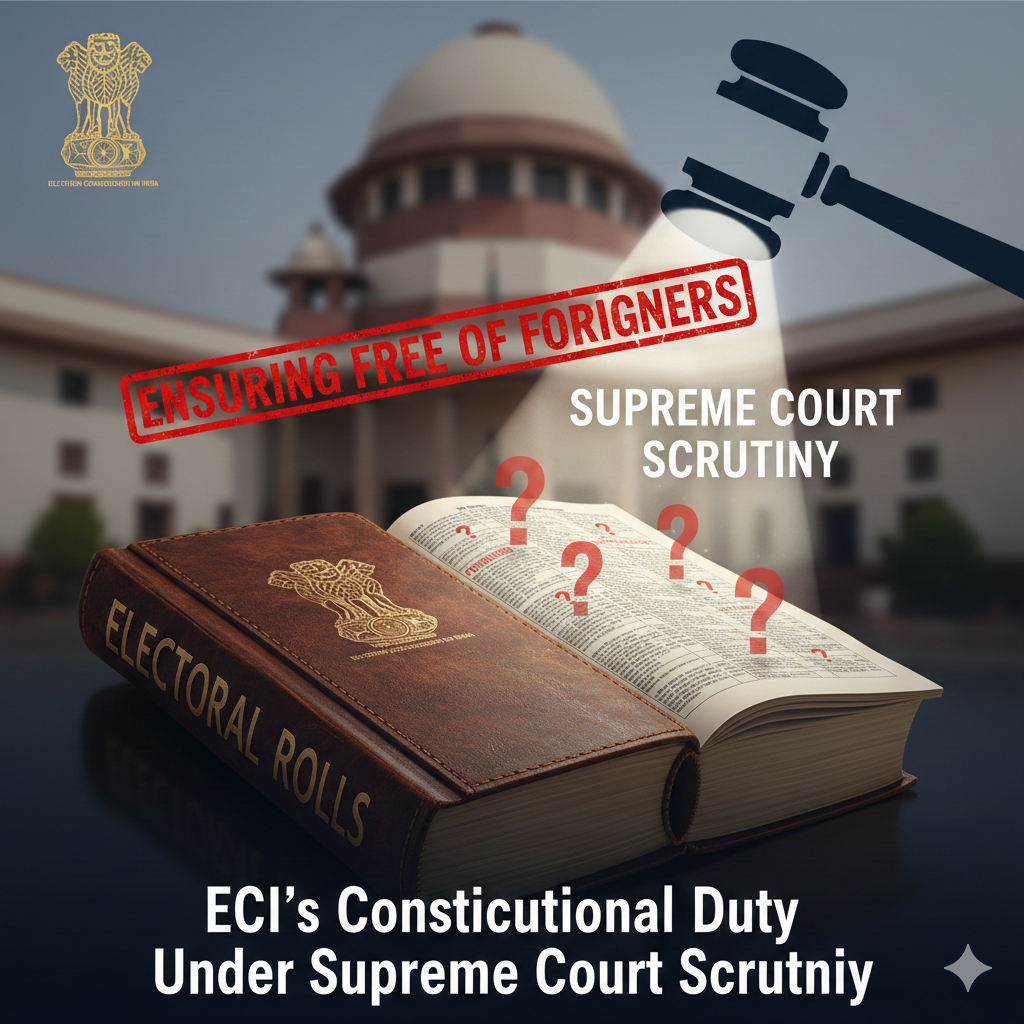
On January 6‑7, 2026, the Election Commission of India (ECI) appeared before a Constitution Bench of the Supreme Court of India, defending the legality and necessity of the ongoing Special Intensive Revision (SIR) of electoral rolls being conducted across multiple States. At the heart of the debate was the Commission’s assertion that it has a constitutional duty to ensure that India’s electoral rolls do not contain foreign nationals, a stance that has ignited political debates across the country.
The hearing emerged from a batch of public interest litigations (PILs) challenging the validity and timing of the SIR process, with critics describing it as potentially disenfranchising millions of voters and equating it with a parallel National Register of Citizens (NRC) exercise.
What Is Special Intensive Revision (SIR)?
The (SIR) Special Intensive Revision is a deep audit and clean‑up of electoral rolls conducted by the Election Commission. It goes beyond routine updating and involves:
- House‑to‑house verification of registered voters
- Removal of duplicate, incorrect, or ineligible entries
- Reconciliation of data with previous electoral rolls
- Issuing draft and final voter lists with opportunities for claims and objections.
The current SIR cycle has taken place in States like Bihar and Uttar Pradesh, resulting in millions of names being stricken from draft lists. For example, in Uttar Pradesh alone, the draft voter list reflects around 12.55 crore registered voters, with approximately 2.89 crore names removed during the revision stage.
ECI’s Core Submission: A Constitutional Mandate
In court, the ECI’s senior counsel Rakesh Dwivedi argued that the Indian Constitution is fundamentally citizen‑centric — meaning that all electoral processes must prioritize the integrity of voter lists and ensure that only Indian citizens are eligible to vote.
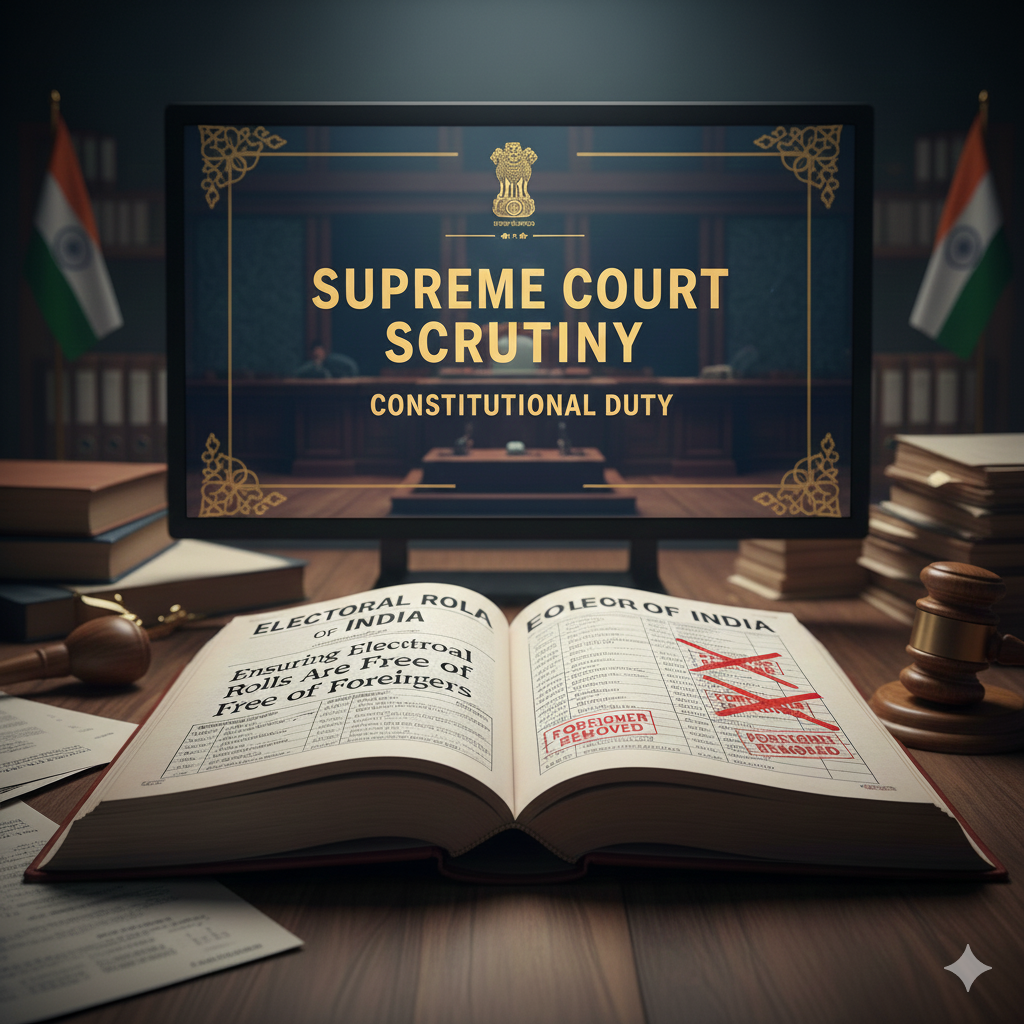
To support its position, the ECI referenced several constitutional provisions:
1. Articles 323, 325 and 326
- Article 325 mandates that no person shall be ineligible for inclusion in electoral rolls or continued registration on grounds only of religion, race, caste, or sex.
- Article 326 guarantees universal adult franchise, but only to eligible citizens of India.
- Article 323 defines the powers and functions of election tribunals and related processes.
The ECI argued these provisions implicitly require an accurate electoral roll reflecting only qualified citizens.
2. Representation of the People Act (RPA)
Sections within the RPA, 1950 and 1951 (such as Sections 15, 16, 19 and 21) govern the preparation, revision, and correction of electoral rolls. The Commission stressed that the law does not exclude comprehensive roll revision simply because it is intensive; rather, the rules accommodate such exercises as long as reasons are recorded.
3. Broader Constitutional Context
The ECI highlighted that many key constitutional roles — such as the President, Vice‑President, Members of Parliament and State Legislatures, and Judges — explicitly require Indian citizenship. Dwivedi underscored that this “citizen‑centric” requirement logically extends to the electoral process itself: foreigners should not be listed as electors.
Indeed, Article 102(d) disqualifies an MP if they are not a citizen of India or have voluntarily acquired foreign citizenship, and Article 103 empowers the President to decide disqualification on the basis of the ECI’s opinion.
The Commission therefore stated before the Supreme Court that its constitutional duty includes ensuring electoral rolls do not contain foreigners, and that SIR is one means of fulfilling that obligation.
Is SIR an NRC in Disguise? The ECI’s Response
One of the central criticisms of the SIR process — raised by opposition parties and civil society groups — is that it resembles, or could morph into, a de facto National Register of Citizens (NRC) exercise, an idea resisted at the national level due to political and social sensitivities.
In response, the ECI made a clear distinction:
- NRC aims to establish whether individuals are citizens based on historical records, often requiring documentary proof of ancestry or historical presence — a highly complex and controversial process historically seen in Assam.
- SIR, on the other hand, targets the accuracy of the voter database within the parameters of existing electoral law, focusing on data fidelity and removing inaccurate or ineligible entries.
The ECI’s counsel labelled assertions of SIR equating NRC as “political rhetoric,” noting that the Commission is focused on democratic processes and voter list integrity, not broad citizen verification for citizenship status beyond electoral eligibility.
Controversy and Political Pushback
While the ECI maintains it has legal authority to conduct SIR and uphold the integrity of rolls, opposition parties argue that:
- The process could disenfranchise legitimate voters if not implemented fairly.
- The timing — often close to election cycles — raises concerns about its impact on electoral participation.
- Lack of transparency or adequate notification to voters may hurt marginalised communities.
For example, some civil society voices claim that SIR may inadvertently suppress votes among poorer and minority groups who lack easy access to document verification, a claim that has fuelled political debate around the legitimacy of the revision exercise.
Supreme Court’s Role and Ongoing Proceedings
The Supreme Court, led by Chief Justice Surya Kant and Justice Joymalya Bagchi, has taken a balanced approach in the matter:
- It has not stayed the SIR process but is actively hearing arguments on its constitutional limits and procedural adequacy.
- Earlier judicial commentary emphasised that while ECI may have the power to conduct SIR, the process must remain voter‑friendly and reasonable.
Further hearings are scheduled, with the Court examining whether SIR complies with legal safeguards and whether procedural fairness is being maintained — especially for voters whose names are removed, and who might face barriers to claims or corrections.
Broader Implications for Indian Democracy
The ECI’s stance before the Supreme Court highlights several important themes relevant to electoral governance in India:
1. Electoral Integrity vs. Voter Inclusion
At its core, the debate juxtaposes roll accuracy with equitable voter inclusion. While ensuring that only eligible Indian citizens vote is foundational to democratic legitimacy, excessive or poorly communicated revision processes can risk excluding legitimate voters. The challenge is finding the right balance.
2. Constitutional Interpretation
The ECI’s argument that electoral integrity is a constitutional requirement reinforces the principle that democratic processes must reflect the sovereign will of qualified Indian citizens. However, how this principle is operationalised — especially through measures like SIR — involves intricate interpretation of statutory and constitutional law.
3. Political and Social Sensitivities
Accusations that SIR resembles an NRC exercise tap into broader anxieties about citizenship verification and alien exclusion — debates that have long political and social implications in India’s diverse polity.
Conclusion
The Supreme Court discussions regarding the Election Commission’s Special Intensive Revision of voters’ lists have brought to the surface an essential issue: up to what point India’s election process should defend the purity of voter lists at the cost of permitting the democratic right to vote? The Election Commission’s (EC) claim that it has a constitutional obligation to make sure that electoral rolls do not include aliens is indicative of its loyalty to the Constitution. However, the exists a wider discussion — where to put the limitations on legal power, procedural fairness, and the political consequences of extensive electoral roll revision.
Which way the Supreme Court sets the limits for SIR will probably make a big difference in the future direction of electoral administration and the role of the public in India’s democratic process.
FAQs
1. What is a Special Intensive Revision (SIR)?
SIR is a comprehensive audit of voter lists conducted by the Election Commission to verify voter data, remove duplicates, errors, and ineligible entries to ensure the electoral roll’s accuracy.
2. Does the Election Commission have the authority to conduct SIR?
Yes. The ECI argues that constitutional provisions and the Representation of the People Act empower it to undertake thorough revisions, including SIR.
3. Why has SIR been challenged in the Supreme Court?
Petitioners claim that the process could disenfranchise legitimate voters, that it may lack procedural safeguards, and that it resembles an NRC‑type exercise.
4. Is SIR the same as NRC (National Register of Citizens)?
No. The ECI contends that SIR focuses only on electoral roll accuracy, whereas NRC is a broader citizenship determination exercise.
5. What happens to voters removed during SIR?
Draft voters’ lists are published with a period for claims and objections, after which final rolls are prepared. Voters can submit evidence to reinstate their names.