
proceeding system of India. The law relating to crime is now entirely governed by the Bharatiya Nyaya Sanhita, 2023, while Babasaheb Ambedkar’s procedural aspects fall under the BNSS. A provision at the heart of the law is Section 4 of BNSS, which in effect decides the forum for the trials of criminal cases. It explains the procedure for the Trial of Offences under BNSS, thus giving the Indian criminal justice system the needed clarity and uniformity in the application of law.
Understanding Section 4 BNSS
Section 4 of the BNSS unambiguously indicates that the provisions of BNSS will apply to all crimes liable to punishment under the Bharatiya Nyaya Sanhita, 2023, as well as under other statutes, which means that such crimes will be investigated, inquired into, tried, and otherwise disposed of in accordance with BNSS provisions—unless a special law prescribes a different procedure.
This section establishes BNSS as the default procedural law governing the Trial of Offences under BNSS across India.
Trial of Offences under BNSS: Core Principle
Trial of Offences under BNSS as a General Rule
The primary principle under Section 4 is simple:
- Substantive law defines the offence
- BNSS defines the procedure
This ensures that the Criminal procedure under BNSS applies uniformly unless expressly excluded by a special statute. The Trial of Offences under BNSS thus becomes the backbone of criminal trials in India.
Purpose and Objective of Section 4 BNSS
Section 4 serves multiple legal and practical purposes within the Indian criminal justice system:
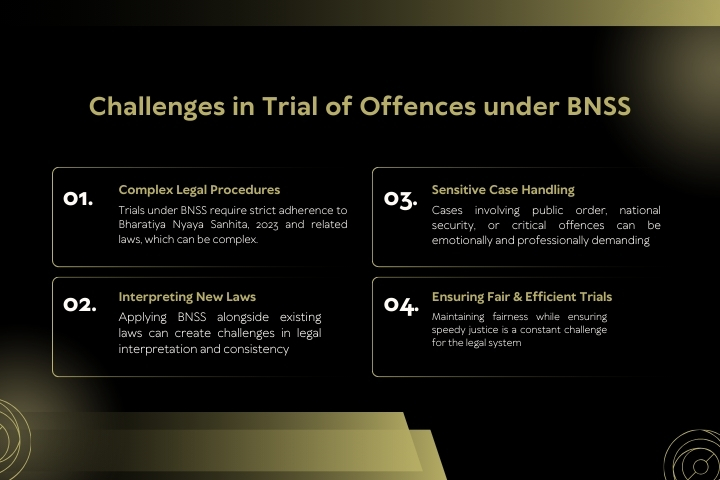
Key Objectives:
- To establish BNSS as the general procedural law
- To maintain uniformity in Trial of offences in India
- To avoid conflict between general and special laws
- To guide courts and investigating agencies
By clarifying procedural applicability, Section 4 prevents uncertainty during criminal proceedings.
Trial of Offences under Bharatiya Nyaya Sanhita, 2023
Offences defined under the Bharatiya Nyaya Sanhita, 2023 are substantive in nature. Their procedural journey—from registration of FIR to judgment—is governed by BNSS legal provisions.
Procedure Includes:
- Registration of FIR
- Investigation by police
- Arrest and custody
- Filing of charge-sheet
- Conduct of trial
- Pronouncement of judgment
All these stages fall squarely within the scope of the Trial of Offences under BNSS.
Trial of Offences under Other Laws
Section 4 BNSS also applies to offences under other legislations such as economic laws, cyber laws, and environmental laws.
Important Rule:
- If a special law prescribes a specific procedure, that procedure applies
- If silent, Criminal procedure under BNSS applies
This balances the relationship between Special laws and BNSS, ensuring procedural harmony.
Relationship Between BNSS and Special Laws
Section 4 follows the well-settled legal principle that:
A special law overrides a general law only to the extent of inconsistency.
Practical Effect:
- BNSS applies by default
- Special procedural provisions prevail only where clearly stated
This principle strengthens the structure of the Trial of Offences under BNSS while respecting legislative intent.
Jurisdiction of Criminal Courts BNSS
Another important aspect governed indirectly by Section 4 is the Jurisdiction of criminal courts BNSS.
Courts Determine:
- Which court has the authority to try an offence
- Which procedure applies
- Whether BNSS or a special statute governs the trial
This ensures lawful exercise of judicial power and procedural fairness.
BNSS vs CrPC Trial Procedure
A significant aspect of Section 4 is its continuity with earlier principles under the CrPC, while adapting them to modern legal needs.
Key Differences in BNSS vs CrPC trial procedure:
- BNSS aligns with new substantive laws
- Enhanced procedural clarity
- Better coordination with special laws
- Updated framework for modern offences
Despite changes, the central idea of procedural uniformity remains intact.
Importance of Trial of Offences under BNSS in Practice
The Trial of Offences under BNSS has wide-ranging implications:
For Courts:
- Clear procedural guidance
- Reduced interpretational disputes
For Police:
- Lawful investigation framework
- Reduced procedural errors
For Accused and Victims:
- Fair trial guarantees
- Predictable legal process
This reinforces confidence in the Indian criminal justice system.
Practical Illustrations
- Offence under Bharatiya Nyaya Sanhita → BNSS applies
- Offence under NDPS Act → NDPS procedure applies where specified
- Offence under a law with no procedure → Trial of Offences under BNSS applies
Such clarity flows directly from Section 4 BNSS.
Conclusion
Section 4 – Bharatiya Nagarik Suraksha Sanhita (BNSS) is a foundational provision that governs the Trial of Offences under BNSS across India. By establishing BNSS as the general procedural framework, it ensures consistency, legality, and fairness in criminal trials. At the same time, it respects the authority of Special laws and BNSS by allowing special procedures where legislatively intended.
With its explicit instructions on Criminal procedure under BNSS, Jurisdiction of criminal courts BNSS, and the relationship between general and special laws, Section 4 sews procedural dependability in the Trial of offenses in India. Grasping this provision is a must for anyone dealing with criminal law, as it mainly influences the way that justice is dispensed under the contemporary legal system.