
The enactment of the Bharatiya Nagarik Suraksha Sanhita (BNSS), 2023 marked a major reform in India’s criminal procedural framework. As a general procedural law, BNSS governs investigation, inquiry, and trial of criminal cases. However, India’s legal system contains several special and local laws with their own procedures. To maintain balance between the general law and such special statutes, Section 5 BNSS plays a crucial role.
Section 5 BNSS, which is often referred to as the saving provision, guarantees that the implementation of BNSS will not affect or eliminate the procedures prescribed by special or local laws. This provision maintains the legal status quo and avoids any overlap in procedures.
Meaning and Scope of Section 5 BNSS
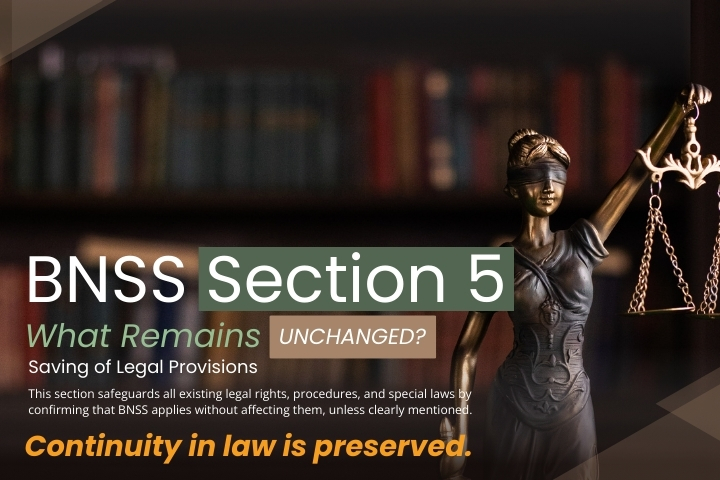
Section 5 of the BNSS basically means that the existing law would remain unchanged, and the special procedure prescribed under that law would continue to be followed unless there was a clear statement contrary to that made in BNSS.
In other words, BNSS is a general rule but if a special law indicates a different way the rule will still apply. This is consistent with the notion that the general procedural rules have to observe the legislative exceptions.
Section 5 BNSS and the Saving Clause Concept
Section 5 BNSS as a Saving Clause
The concept of a saving clause exists to protect existing legal arrangements. The BNSS Saving clause ensures that the enforcement of BNSS does not unintentionally override established procedures under other laws.
Why a Saving Clause Is Necessary:
- To avoid conflicts between laws
- To preserve the intent of special legislation
- To prevent uncertainty in court proceedings
- To ensure stability in criminal procedure
The Saving clause in criminal procedure thus functions as a protective legal mechanism.
Purpose and Objectives of Section 5 BNSS
The primary objectives of Section 5 BNSS include:
- Safeguarding special and local criminal laws
- Ensuring smooth Application of BNSS
- Preventing overlap between general and special procedures
- Maintaining consistency in judicial interpretation
Without this provision, courts and authorities would face confusion while determining which procedural law applies.
Special Laws and BNSS: How Section 5 Works
Special laws and BNSS coexist through Section 5
India has several special criminal laws, such as:
- NDPS Act
- Prevention of Money Laundering Act (PMLA)
- Unlawful Activities (Prevention) Act (UAPA)
- Arms Act
- Information Technology Act
These statutes often prescribe specific rules for investigation, arrest, bail, and trial. Section 5 BNSS ensures that such procedures remain unaffected by BNSS.
Key Principle:
- BNSS applies generally
- Special procedures override BNSS where provided
This reflects the overriding effect of special laws.
Section 5 BNSS and BNSS Legal Provisions
While BNSS lays down uniform procedural rules, BNSS legal provisions are subject to limitations imposed by Section 5.
Practical Impact:
- General provisions of BNSS apply only where special laws are silent
- Special procedural safeguards remain intact
- Courts must examine the governing statute before applying BNSS
This ensures lawful and consistent administration of criminal justice.
Criminal Procedure under BNSS and Saving Protection
The Criminal procedure under BNSS includes arrest, investigation, inquiry, trial, and appeal. However, Section 5 BNSS restricts the automatic application of these procedures in cases governed by special statutes.
Examples:
- Strict bail conditions under NDPS Act remain applicable
- Separate investigation mechanisms under PMLA continue
- Designated special courts retain jurisdiction
Thus, Section 5 protects procedural diversity within the criminal justice system.
Section 5 BNSS vs CrPC Saving Clause
The BNSS vs CrPC saving clause comparison shows continuity rather than departure.
Similarities:
- Both protect special and local laws
- Both prevent general procedure from overriding special procedures
- Both uphold legislative intent
Difference:
- Section 5 BNSS aligns with new substantive criminal laws
- It reflects updated procedural structure under BNSS
The saving principle remains a cornerstone of criminal procedural law.
Application of Section 5 BNSS in Court Practice
Courts rely heavily on Section 5 BNSS to resolve procedural disputes.
Courts Examine:
- Whether a special law applies
- Whether it prescribes a special procedure
- Whether BNSS provisions are overridden
This judicial approach ensures correct Application of BNSS and prevents procedural errors.
Importance of Section 5 BNSS in the Criminal Justice System
Section 5 BNSS plays a vital role in maintaining balance within the criminal justice system.
For Courts:
- Provides clarity in procedural conflicts
- Supports consistent interpretation
For Investigating Agencies:
- Prevents unlawful application of procedure
- Ensures investigations follow correct legal framework
For Accused and Victims:
- Protects statutory rights
- Ensures fairness and predictability
By preserving special procedures, Section 5 supports lawful administration of justice.
Conclusion
Section 5 of the BNSS acts as a basic regulation that brings about this general integration between the BNSS’s overall procedural framework and the specific procedures laid down in other criminal laws. Being a saving clause, it saves the special statutes from being canceled and thus maintains consistency in law.
The highlighting of the paramountcy of special laws by Section 5 of BNSS clearly has the effect of increasing certainty in procedures as well as the credibility of the criminal justice system. It is relevant for judges, lawyers, police officers, and even students who are going to be working with the new legal framework in criminal procedure to possess a clear understanding of this provision.