The Supreme Court of India issued a historic ruling which examined whether probation under the Probation of Offenders Act, 1958 removes the conviction record from an offender’s disciplinary records. The judges Justice Prashant Kumar Mishra and Justice N.V. Anjaria established that probation release does not remove conviction records, which means probation cannot serve as a factor to reduce internal departmental penalties.
The article investigates the case background together with the court’s interpretation of the Probation of Offenders Act, 1958 and its effects on legal practice, which the ruling establishes separation between remission and conviction according to Indian legal standards.
Background of the Case
The dispute arose from a disciplinary proceeding against a government employee who was convicted in a criminal case yet granted the benefit of probation under criminal law. After a departmental inquiry, the employee was dismissed from service due to misconduct. The Madras High Court changed the original punishment to mandatory retirement after determining that the employee had received probation release for his criminal case.
The Supreme Court intervened to evaluate whether the High Court correctly applied the Probation of Offenders Act, 1958 in such a context.
Key Legal Question
The critical issue before the Supreme Court was:
Does the fact that an offender has been released on probation in a criminal case justify reducing the departmental punishment which was imposed because of that criminal conviction?
The Supreme Court answered this forcefully, clarifying the legal effect of probation and conviction.
Supreme Court’s Analysis and Ruling
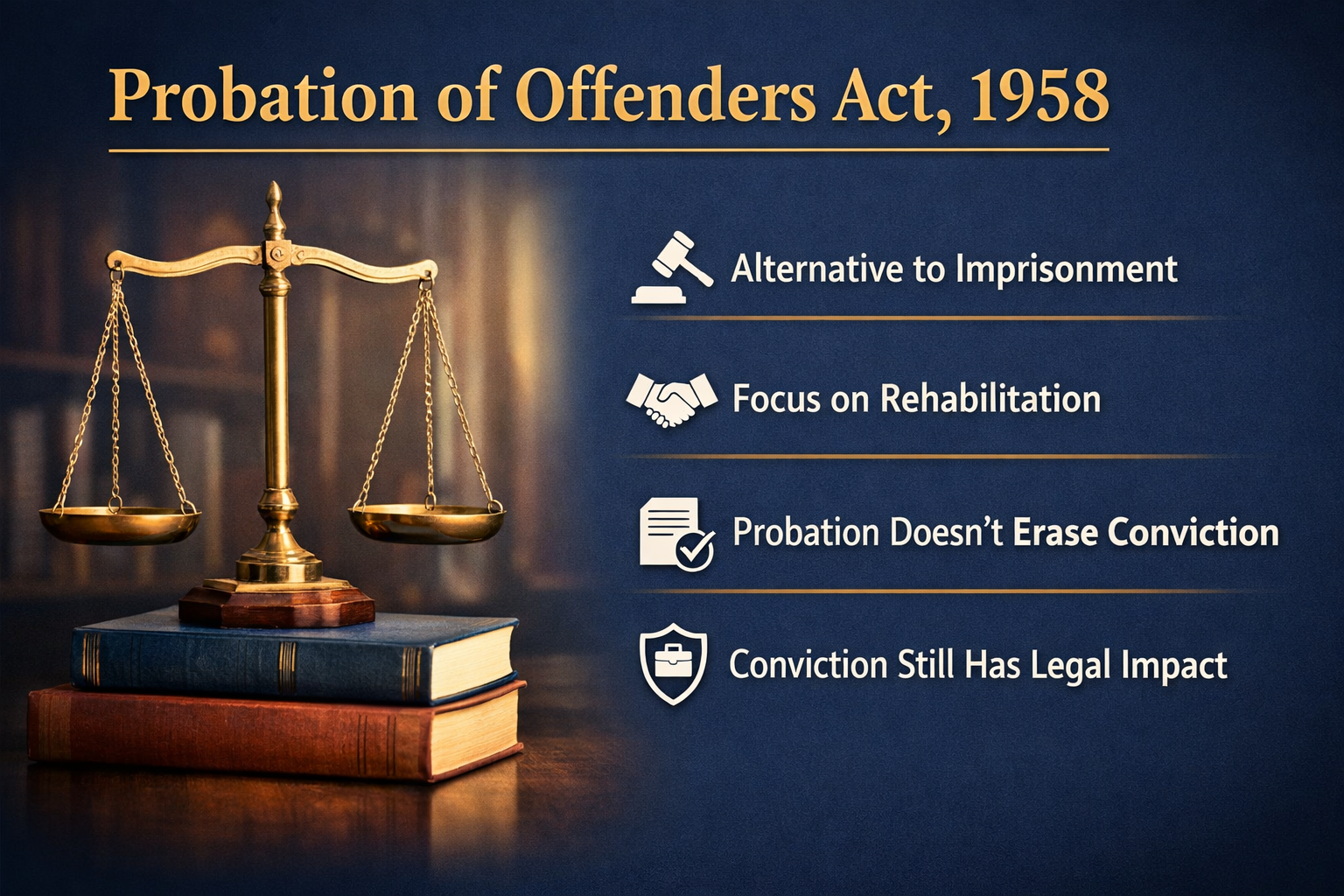
Probation Does Not Erase Conviction
The court ruled that the Probation of Offenders Act, 1958, allows for probation release but does not eliminate the legal consequences of a criminal conviction. The law considers an offender to be still convicted because probation exists as a method for restricted emancipation instead of complete freedom from guilt.
An employee who receives probation after conviction will still maintain his conviction status which departments can use as grounds to proceed with disciplinary measures that include termination.
High Court’s Error
The Supreme Court ruled that Madras High Court judges made an incorrect decision because they reduced penalties from their original level based on probation assessment. The High Court had wrongly assumed that probation equated to a removal of the conviction’s effects which runs contrary to established legal principles.
Instead, the apex court reaffirmed precedents like Union of India vs. Bakshi Ram (1990) which holds that probation does not eliminate the legal consequences of conviction itself.
Departmental Punishment Versus Criminal Conviction
Even though probation provides relief in terms of sentencing or social rehabilitation, it does not nullify:
- The formal finding of guilt
- The existence of conviction
- Legal disabilities attached to conviction in other proceedings
It established a principle that makes probation in criminal law cases to be untenable without unfair scaling down of that one’s punishment when faced with a trial in any respect in the case for Departments Inquiries to be initiated through the misconduct prescribing the same having criminal elements.
Conceptual Framework of the Probation of Offenders Act, 1958
The Probation of Offenders Act, 1958 enables first-time offenders and minor offenders to receive rehabilitation opportunities which help them become reintegrated into society.
Purpose of the Act
The Act aims to:
- Avoid incarceration for minor offenders
- Encourage voluntary good conduct
- Help offenders become law-abiding citizens
However, probation does not expunge the conviction itself, a distinction that is central to the Supreme Court’s ruling.
What Section 4 of the Act Provides
Section 4 of the Probation Act empowers courts to release certain offenders on probation of good conduct. It is discretionary but mandatory to consider probation in eligible cases unless excluded by other laws.
This means that courts should assess whether an offender qualifies for probation based on statutory criteria but a grant of probation does not equate to setting aside the conviction.
Broader Legal Context
The Supreme Court’s decision aligns with earlier case law showing that probation does not remove conviction’s legal consequences. For example:
- Courts must consider probation where applicable under Section 360 CrPC or Section 4 of the Act.
- The stigma and consequences of conviction continue even if probation is granted.
This distinction is crucial when evaluating cases involving:
- Employment and service law
- Professional licensing and rehabilitation
- Sentencing and pardons
Implications of the Ruling
1. Departmental and Service Law Cases
Government employees convicted of offences face departmental action independent of probation. This ruling ensures that convictions remain valid grounds for disciplinary consequences even when probation is granted.
2. Rehabilitation vs Legal Consequences
While probation supports rehabilitation, the legal consequence of conviction—such as disqualification or dismissal from service—may still persist. This maintains balance between reformative justice and accountability.
3. Consistency in Sentencing Practice
The judgment reiterates that courts must clearly distinguish between sentencing relief (like probation) and the actual legal status of conviction.
Conclusion
The Supreme Court’s decision about the Probation of Offenders Act, 1958 establishes that probation can lead to reduced penalties and treatment for offenders but does not eliminate their conviction status. The legal system considers conviction to be permanent because it creates ongoing effects that include impacting departmental disciplinary actions. This interpretation of probation protects legal standards while stopping defendants from using probation as a means to avoid responsibility for their actions.