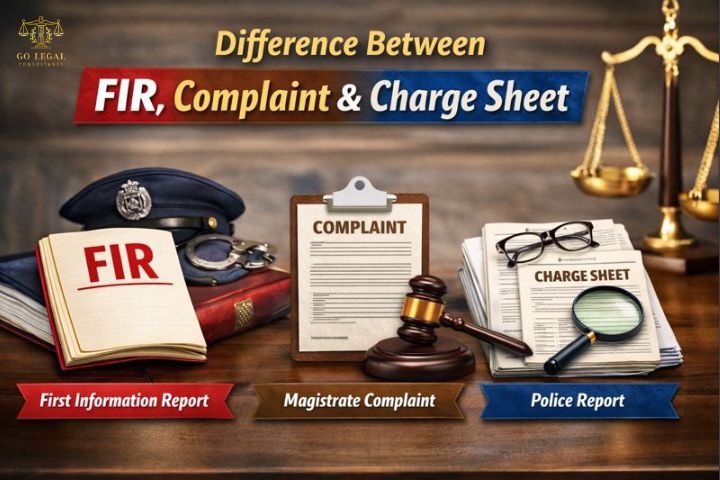
To understand how the criminal justice system in India operates people must learn how FIR vs complaint vs chargesheet differ from one another. The Bharatiya Nagarik Suraksha Sanhita, 2023 (BNSS) which replaces the CrPC establishes a new procedural framework that maintains its existing structural design while introducing new terminology and time requirements. The legal system recognizes FIRs and complaints and charge sheets as distinct stages because each stage requires different governmental bodies to execute particular functions that result in specific legal outcomes.
The article explains the FIR vs complaint vs chargesheet processes through a detailed analysis which includes their definitions and related legal requirements and procedural guidelines and police and Magistrate authority and their significance throughout stages of criminal cases in India to criminal procedure under BNSS
Meaning of FIR, Complaint and Charge Sheet Under Criminal Law
FIR Meaning Under Criminal Law
An FIR, or First Information Report, is the initial information that the police record whenever they find out or are made aware of a cognizable crime being committed..
Key points:
- It is recorded under FIR under BNSS
- It sets criminal law into motion
- Police can investigate without court permission
In simple terms, what is FIR in criminal procedure? It is the foundation of police investigation.
What Is a Complaint in Criminal Law
A complaint is an allegation made to a Magistrate regarding the commission of an offence, usually non-cognizable in nature.
Important aspects:
- Filed directly before a Magistrate
- Police investigation requires court direction
- Covered under complaint under BNSS
This is where the complaint vs FIR distinction becomes legally significant.
Charge Sheet Meaning
A charge sheet is a formal police report submitted after investigation.
Key features:
- Filed after completion of investigation
- Lists accused, evidence, witnesses
- Governed by charge sheet under BNSS 2023
Understanding charge sheet meaning is critical because it decides whether a trial will begin.
FIR vs Complaint vs Chargesheet – Core Difference Explained
| Aspect | FIR | Complaint | Charge Sheet |
| Stage | Beginning | Beginning (Court-based) | After investigation |
| Filed before | Police | Magistrate | Magistrate |
| Police power | Direct investigation | Only after court order | Investigation ends |
| Applicable law | FIR under BNSS | Complaint under BNSS | Charge sheet under BNSS 2023 |
This table highlights the practical FIR complaint charge sheet difference.
Legal Provisions and Sections Involved
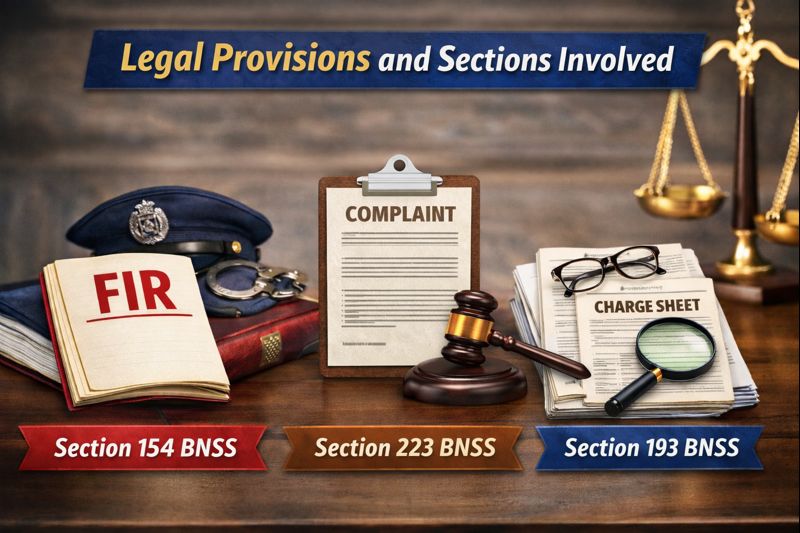
FIR – Legal Section and Power
- Police must register FIR for cognizable offences
- Refusal allows complainant to approach Superintendent or Magistrate
- Magistrate has supervisory powers
This reinforces the magistrate authority in criminal investigation.
Complaint – Legal Process and Powers
Complaint procedure includes:
- Filing before Magistrate
- Magistrate examination of complainant
- Inquiry or investigation direction
This forms part of criminal procedure under BNSS and judicial oversight.
Charge Sheet – Legal Framework
- Filed after police investigation
- Must be submitted within statutory timeline
- Delay may give rise to default bail
This shows the importance of police investigation and charge sheet filing.
Stages of Criminal Case in India Under BNSS
The stages of criminal case in India generally follow this order:
- Information of offence
- FIR or Complaint
- Police investigation
- Filing of charge sheet
- Cognizance by Magistrate
- Trial
The FIR vs complaint vs chargesheet distinction lies in who initiates, who controls, and who decides at each stage.
Powers of Police and Magistrate at Each Stage
Police Powers
- Register FIR
- Conduct search, seizure, arrest
- File charge sheet or closure report
Police authority operates mainly between FIR and charge sheet.
Magistrate Powers
- Order FIR registration
- Monitor investigation
- Accept or reject charge sheet
- Order further investigation
This reflects judicial oversight in the investigation of BNSS.
FIR Under BNSS – What Has Changed
While structure remains similar:
- Timelines are stricter
- Digital FIR permitted
- Greater accountability of police
Yet, the essence of FIR vs complaint vs chargesheet remains unchanged.
Complaint Under BNSS – Procedural Control
Under BNSS:
- Magistrate scrutiny is stronger
- False complaints attract consequences
- Police role is secondary unless ordered
This strengthens judicial control.
Charge Sheet Under BNSS 2023 – Final Outcome
A charge sheet:
- Leads to framing of charges
- Can be challenged for defects
- Is not proof of guilt
Courts examine whether sufficient grounds exist to proceed.
Why FIR vs Complaint vs Chargesheet Distinction Matters
Understanding FIR vs complaint vs chargesheet helps citizens:
- Choose correct legal remedy
- Prevent misuse of criminal process
- Protect fundamental rights
Misuse at any stage can cause unlawful prosecution.
Practical Example to Understand the Difference
- Theft reported → FIR registered → Investigation → Charge sheet
- Defamation allegation → Complaint before Magistrate → Inquiry → Summons
- After evidence → Charge sheet submitted
This clearly shows FIR vs complaint vs chargesheet in action.
Conclusion
The FIR vs complaint vs chargesheet framework forms the backbone of criminal justice in India. Each step has a distinct legal purpose, authority, and consequence under the criminal procedure under BNSS. FIR initiates police action, complaint invokes judicial process, and charge sheet concludes investigation.
People who understand the difference between a FIR complaint charge sheet difference can use that knowledge to navigate the legal system while staying within legal boundaries. The implementation of BNSS 2023 has established better procedures because it now requires judicial oversight and more organized processes for handling cases.