
The Bharatiya Nagarik Suraksha Sanhita, 2023 (BNSS) has therefore completely substituted the previous Criminal Procedure Code (CrPC), resulting in drastic changes to the whole process of the criminal justice system in India. One such provision and perhaps the most significant one in the new legislation is Section 12 BNSS, which determines the local jurisdiction of the Judicial Magistrates. It is a must for the legal profession, law students, police officials and even the common man who has to do with criminal courts to be aware of this section.
The present article will deal with the matter of Section 12 BNSS, its meaning, scope, legal significance, and how it affects the criminal trial process in India.
Understanding Section 12 BNSS
Section 12 of the Bharatiya Nagarik Suraksha Sanhita specifies the local jurisdiction of Judicial Magistrates. It explains in a straightforward manner where a Judicial Magistrate is permitted to use his or her legal powers. Jurisdiction is a core concept in criminal law since an offence cannot be heard or decided by a court unless the court has proper authority over the geographical area where the offence took place.
According to Section 12 BNSS, the State Government or the High Court determines the local limits within which the Judicial Magistrates are allowed to operate.
Meaning of Local Jurisdiction of Judicial Magistrates
Local jurisdiction of a Judicial Magistrate is based on the area that a Magistrate can work, it is the geographical area within which the magistrate can administer justice.
- Take cognizance of offences
- Conduct trials
- Pass judicial orders
- Issue warrants and summons
According to Section 12 BNSS, every Judicial Magistrate is appointed for a specific local area, and their authority is strictly confined to that area unless the law provides otherwise.
Legal Framework of Section 12 BNSS
1. Appointment of Judicial Magistrates
Under the BNSS framework, Judicial Magistrates are appointed by the State Government, generally in consultation with the High Court. Once appointed, their local jurisdiction is officially notified.
2. Determination of Local Limits
Section 12 BNSS empowers the State Government to define:
- District-wise jurisdiction
- Sub-divisional jurisdiction
- Special jurisdiction for specific courts
These local limits ensure administrative efficiency and prevent overlapping authority among courts.
Why Section 12 BNSS Is Important
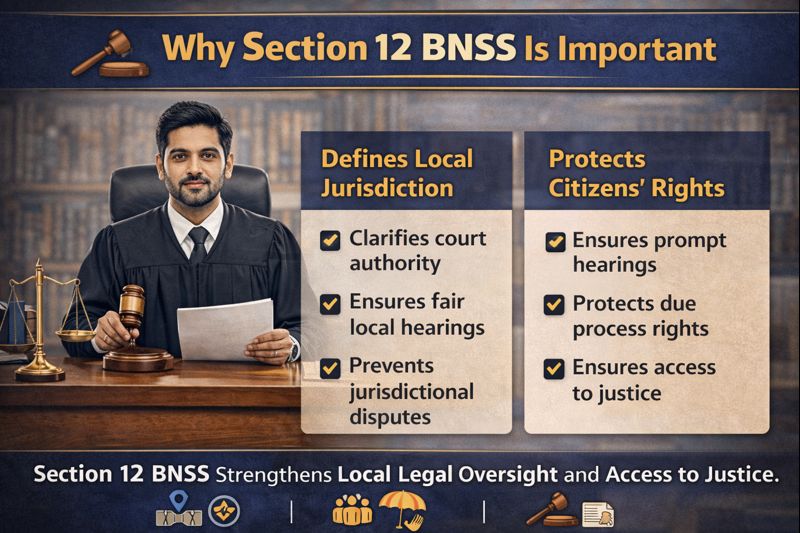
The importance of Section 12 BNSS lies in maintaining order, legality, and fairness in criminal proceedings.
Prevents Jurisdictional Conflicts
- Clear local jurisdiction avoids confusion when multiple courts exist within a district. Without Section 12 BNSS, two Magistrates could potentially claim authority over the same matter.
Ensures Fair Trial
- Jurisdictional clarity ensures that cases are tried close to the place of offence, which is convenient for witnesses, victims, and accused persons.
Strengthens Rule of Law
- By strictly defining the judicial magistrate local jurisdiction, BNSS ensures that no court exceeds its legal authority.
Section 12 BNSS vs CrPC: What Has Changed?
Although Section 12 BNSS closely resembles the earlier provisions under CrPC, the BNSS framework introduces better clarity and modernization.
| Aspect | CrPC | BNSS |
| Legal Language | Traditional | Simplified & modern |
| Administrative Clarity | Limited | Improved |
| Digital Compatibility | Minimal | Encouraged |
| Jurisdiction Structure | Basic | More structured |
The local jurisdiction under BNSS is more aligned with present-day judicial needs.
Role of Judicial Magistrates Under BNSS
Under Judicial Magistrate jurisdiction BNSS, Magistrates play a vital role in criminal justice, including:
- Taking cognizance of offences
- Conducting summary and warrant trials
- Granting bail
- Issuing search and arrest warrants
- Recording confessions
However, all these powers can only be exercised within their local jurisdiction as defined under Section 12 BNSS.
Practical Example of Section 12 BNSS
Imagine an illegal act being performed in District A. The Judicial Magistrate designated for District B cannot, by law, get to know about the illegal act. The matter can only be taken up by a Magistrate whose local jurisdiction includes District A.
In case a Magistrate goes beyond their jurisdiction, a higher court may rule their orders as void.
Transfer of Cases and Exceptions
While BNSS Section 12 local jurisdiction is strict, certain exceptions exist:
- Transfer of cases by the High Court
- Special orders from Sessions Courts
- Emergency powers under specific BNSS provisions
However, such exceptions must follow legal procedures to remain valid.
Impact on Police and Investigation
Police officers must file charge sheets and present accused persons before the correct Judicial Magistrate as per Section 12 Bharatiya Nagarik Suraksha Sanhita. Filing a case in the wrong jurisdiction can delay justice and weaken prosecution.
Importance for Citizens
For ordinary citizens, understanding Section 12 BNSS explained helps in:
- Knowing where to file complaints
- Understanding which court will hear their case
- Preventing harassment due to improper jurisdiction
It enhances legal awareness and protects constitutional rights.
Judicial Interpretation of Local Jurisdiction
Indian courts have consistently held that jurisdiction is not a technical formality but a substantive legal requirement. Orders passed without jurisdiction violate principles of natural justice and are liable to be set aside.
With BNSS replacing CrPC, courts are expected to interpret Section 12 BNSS in a progressive and citizen-friendly manner.
Conclusion
Section 12 – Bharatiya Nagarik Suraksha Sanhita (BNSS) – Local Jurisdiction of Judicial Magistrates has become a key part of the modern criminal procedure framework in India. Section 12 BNSS by clearly drawing the geographical limits of judicial authority guarantees the efficiency, fairness, and legality in criminal trials.
No matter if you are a legal expert, academic or ordinary person, knowledge of the local jurisdiction under BNSS is a must for the proper operation in the criminal justice system. Provisions like the local jurisdiction of Judicial Magistrate will be very important in reinforcing faith in the rule of law as India moves completely to the BNSS system.