
The Bharatiya Nagarik Suraksha Sanhita 2023 (BNSS) implementation has introduced major changes to the operational procedures of India’s criminal justice system. The law’s most disputed section concerns the Attachment of Property Under BNSS which defines how courts can use their coercive authority during criminal trials. A recent case from Rajasthan has reignited discussion on how far these powers extend, the role of Magistrates, and the safeguards available to individuals whose property is attached.
The article presents the statutory framework and judicial interpretation of Latest Rajasthan case on attachment of property. The article establishes the constitutional and procedural framework of the case which examines how property attachment works.
Understanding Attachment of Property Under BNSS
The Attachment of Property Under BNSS refers to the legal process by which a court orders seizure or attachment of movable or immovable property belonging to an accused or a proclaimed person.
This power exists to ensure:
- The presence of the accused during trial
- Prevention of absconding
- Preservation of property linked to crime
- Enforcement of court orders
The Attachment of property under Bharatiya Nagarik Suraksha Sanhita is not punitive in nature but preventive. It must strictly follow statutory conditions and judicial safeguards.
Statutory Framework: BNSS Attachment of Property Provisions
The BNSS attachment of property provisions are broadly carried forward from the Code of Criminal Procedure, 1973, with procedural refinements. These provisions empower courts to attach property when an accused:
- Absconds to evade arrest
- Fails to appear despite proclamation
- Is declared a proclaimed offender
The law mandates that attachment is not automatic. Judicial satisfaction and recorded reasons are essential.
Key Legal Objectives
- Compel appearance of the accused
- Secure the administration of justice
- Prevent dissipation of assets
Procedure for Attachment of Property Under BNSS
The Procedure for attachment of property under BNSS follows a structured judicial process.
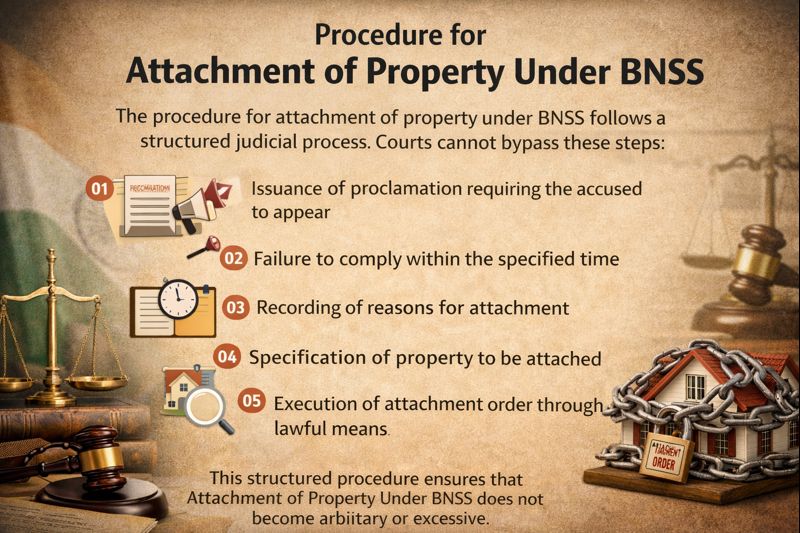
Courts cannot bypass these steps:
- Issuance of proclamation requiring the accused to appear
- Failure to comply within the specified time
- Recording of reasons for attachment
- Specification of property to be attached
- Execution of attachment order through lawful means
This structured procedure ensures that Attachment of Property Under BNSS does not become arbitrary or excessive.
Provisional Attachment of Property BNSS: Scope and Limits
Provisional attachment of property BNSS allows temporary seizure in urgent situations, especially where delay could frustrate justice.
However, courts have clarified that:
- Provisional attachment is exceptional
- It must be proportionate
- It cannot continue indefinitely
- Judicial review is mandatory
The Rajasthan courts have emphasized that provisional attachment should not amount to a punishment before conviction.
Magistrate Powers for Attachment of Property Under BNSS
One of the most litigated questions concerns Magistrate powers for attachment of property under BNSS.
Magistrates are empowered to:
- Issue proclamations
- Order attachment after due satisfaction
- Modify or withdraw attachment orders
However, these powers are not unfettered. Magistrates must ensure compliance with constitutional guarantees under Articles 14 and 300A (right to property).
The Attachment of Property Under BNSS must always be backed by recorded reasons and judicial application of mind.
Latest Rajasthan Case on Attachment of Property
The Latest Rajasthan case on attachment of property brought judicial scrutiny to the misuse of attachment powers by lower courts. In this matter, property was attached at a preliminary stage without adequate satisfaction that the accused was absconding intentionally.
The Rajasthan High Court intervened, observing that:
- Attachment is a serious intrusion into property rights
- Mechanical orders violate due process
- Courts must first exhaust less intrusive measures
This Rajasthan attachment of property BNSS case has become a guiding precedent for subordinate courts.
Rajasthan High Court on Attachment of Property BNSS
The Rajasthan High Court on attachment of property BNSS reiterated several important principles:
- Attachment cannot be used as a tool of pressure
- Mere non-appearance does not justify immediate attachment
- Proper service of summons and warrants is mandatory
The Court clarified that Attachment of Property Under BNSS must balance state interest with individual liberty and property rights.
Supreme Court View on Attachment of Property Under BNSS
While BNSS is relatively new, courts continue to rely on earlier precedents for guidance. The Supreme Court view on attachment of property under BNSS emphasizes that:
- Property attachment affects constitutional rights
- Due process is non-negotiable
- Judicial discretion must be exercised sparingly
The Supreme Court has consistently held that attachment provisions are coercive and must be strictly construed.
BNSS Property Attachment Explained with Case Law
When BNSS property attachment explained with case law, a consistent judicial theme emerges:
- Attachment is preventive, not punitive
- Courts must act with restraint
- Procedural lapses invalidate attachment
The Rajasthan High Court judgment aligns with earlier Supreme Court rulings that disapprove of routine or casual attachment orders.
Legal Safeguards in Attachment of Property BNSS
The Legal safeguards in attachment of property BNSS are designed to protect individuals from misuse of state power.
These safeguards include:
- Right to be heard
- Requirement of reasoned orders
- Judicial review by higher courts
- Restoration of property if attachment is unjustified
These protections ensure that Attachment of Property Under BNSS does not violate principles of natural justice.
Recent Judgment on Attachment of Property Under BNSS
The Recent judgment on attachment of property under BNSS from Rajasthan reinforces that:
- Attachment must follow strict procedure
- Courts must justify urgency
- Property rights deserve constitutional respect
This ruling serves as a warning against casual invocation of attachment powers and strengthens procedural accountability.
Conclusion
The evolving jurisprudence around Attachment of Property Under BNSS reflects the judiciary’s effort to strike a balance between effective law enforcement and protection of individual rights. The Rajasthan High Court’s intervention highlights that attachment is a serious legal measure, not a routine administrative step.
As BNSS continues to be interpreted by courts, the principles laid down in the Latest Rajasthan case on attachment of property will guide Magistrates, investigating agencies, and litigants alike. Ultimately, the legitimacy of the criminal justice system depends on how responsibly such coercive powers are exercised.