
The Bharatiya Nagarik Suraksha Sanhita, 2023 (BNSS) embodies one of the principal reforms in the criminal procedural law of India. Promoted by the old and obsolete Criminal Procedure Code (CrPC), BNSS not only modernizes but also streamlines the administrative and preventive aspects of criminal justice, paving the way for new interpretations of clarity, accountability, and responsiveness. Section 15 BNSS being a part of this transformative legal scheme has the power to the State Government to appoint Special Executive Magistrates. This measure is aimed at enhancing preventive justice, boosting law enforcement capability, and guaranteeing public safety in various scenarios ranging from the most to the least extreme ones.
Therefore, having a knowledge of Section 15 BNSS is essential for legal professionals, judiciary aspirants, and law students, but also for administrators and ordinary people who deal with the law enforcement and governance systems at different levels.
1. Understanding the Purpose and Context of Section 15 BNSS
Section 15 of the Bharatiya Nagarik Suraksha Sanhita, 2023 empowers the State Government to appoint individuals as Special Executive Magistrates for certain purposes or areas at its discretion and also to bestow upon such persons the powers deemed fit under the Sanhita. The powers granted in this context are, in fact, those that would generally be exercised by the Executive Magistrates but are customized for the specific scenarios or functions.
The law under this provision accepts that in exceptional, emergency or local situations requiring increased administrative power, the regular administrative hierarchy may not be sufficient in terms of dealing. Thus, Section 15 BNSS, as a consequence, permits the criminal justice system greater flexibility and responsiveness.
2. Legal Text of Section 15 BNSS
The bare text of Section 15 – Special Executive Magistrates reads:
“The State Government might engage Executive Magistrates or any police officials not below the rank of Superintendent of Police or equal as Special Executive Magistrates for certain territories or for discharging certain duties and invest such Special Executive Magistrates with such of the powers as are conferred under this Sanhita on Executive Magistrates, as it may consider appropriate.”
This language confirms that:
- Appointments can be term‑based and situational.
- Officers appointed can include both regular Executive Magistrates and senior police officers (SP rank or above).
- Powers conferred can be customized based on situational needs.
3. Purpose of Special Executive Magistrates
The core of Section 15 BNSS is preventive governance, which allows the public authorities to take prompt, situation-specific measures for keeping order and ensuring safety. As opposed to the regular Executive Magistrates (whose powers and responsibilities are predetermined), the Special Executive Magistrates BNSS have been designated for specific events, locations, or tasks demanding strict surveillance that go over the regular administrative procedures.
For example:
- Large public events or gatherings such as festivals or political rallies may involve complex law‑and‑order challenges.
- High‑risk situations like communal tensions, protests, or emergency response scenarios frequently demand authoritative coordination between civil and police administration.
- Sensitive geographic areas requiring regular monitoring and preventive action may also benefit from focused magistrate oversight.
4. Who Can Be Appointed as a Special Executive Magistrate?
Under Section 15 BNSS, the State Government has significant discretion in appointments:
- Executive Magistrates currently serving in the district or sub‑division may be appointed as Special Executive Magistrates for specific functions.
- Police Officers of rank Superintendent of Police (SP) or equivalent — even if they do not normally serve as Executive Magistrates — can be appointed as Special Executive Magistrates. This reflects an acknowledgment that experienced police officers can play a preventive administrative role when the situation demands, especially given their operational expertise.
This expansion of eligibility enables the government to operationalize preventive functions more swiftly and efficiently, particularly in scenarios requiring strong law enforcement coordination.
5. Functional Role of Special Executive Magistrates
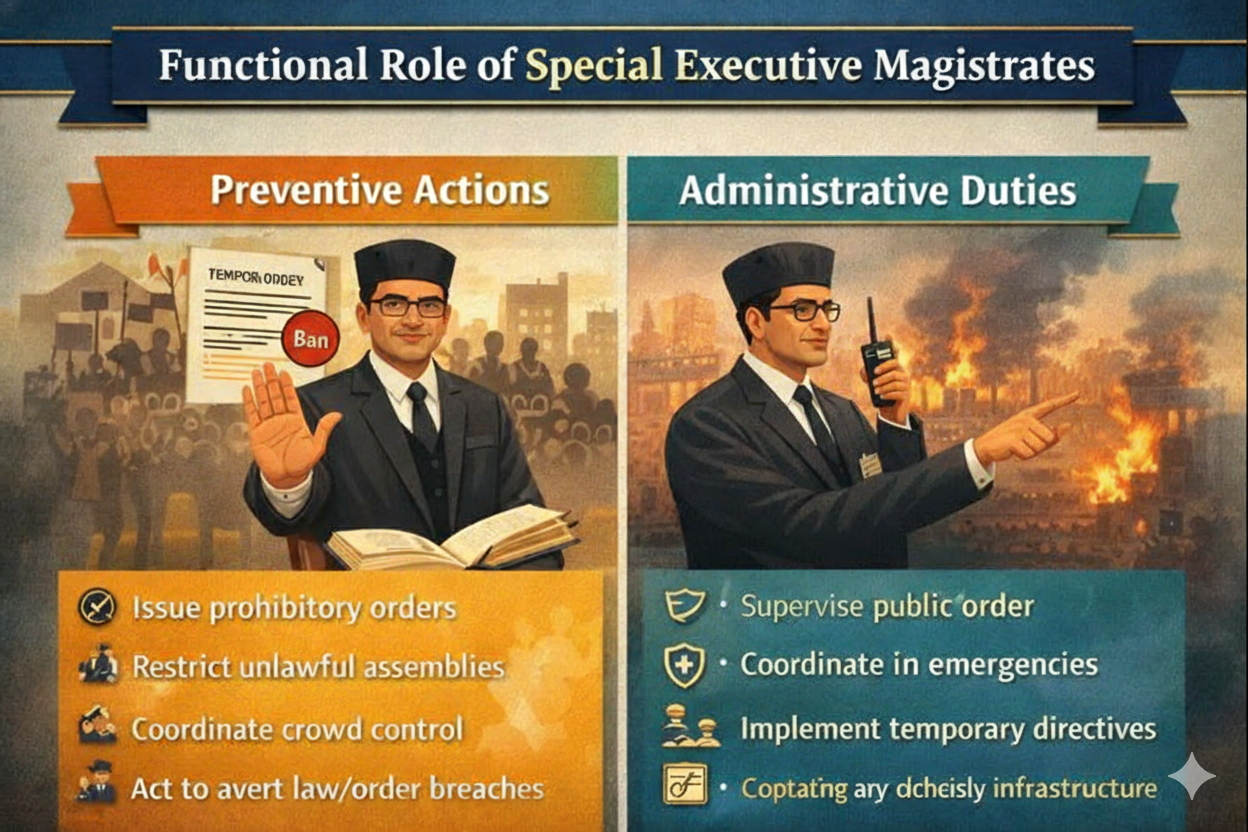
a. Preventive Actions
One of the core responsibilities of Special Executive Magistrates is preventive justice — taking pre‑emptive action to stop harmful events before they escalate into criminal incidents.
Their preventive powers may include the authority to:
- Issue temporary prohibitory orders tailored to an event, location, or period.
- Restrict or prevent unlawful assemblies or gatherings which may threaten public peace.
- Coordinate crowd‑control measures during public events or protests.
- Take immediate action to avert foreseeable breaches of law and order.
The ability to act in a preventive capacity helps authorities reduce the likelihood of offenses occurring in the first place, thereby protecting citizens and infrastructure.
b. Administrative Duties
Besides preventive measures, Special Executive Magistrates may also be tasked with administrative functions such as:
- Supervising public order arrangements at high‑risk sites.
- Coordinating with police and civil agencies during emergencies.
- Assisting in implementing temporary restrictions or directives, as warranted by circumstances.
Through these roles, the State Government ensures that the administrative machinery remains nimble and capable of responding effectively to dynamic challenges.
6. Difference Between Special and Regular Executive Magistrates
The key differences between Special Executive Magistrates BNSS and regular Executive Magistrates under Section 14 BNSS can be summarized as follows:
| Feature | Special Executive Magistrates | Regular Executive Magistrates |
|---|---|---|
| Nature of Appointment | Temporary / situational | Permanent / district‑wide |
| Authority | Powers conferred specifically for event or area | Broad administrative and preventive powers |
| Eligibility | Executive Magistrates or senior police officers (SP rank) | Usually civil administrative officers |
| Function Focus | Event/issue‑specific | Ongoing administrative functions |
This distinction ensures that the criminal justice and administrative system can respond flexibly to exceptional needs without diluting regular administrative structures.
7. Practical Applications of Section 15 BNSS
To appreciate how Section 15 BNSS operates on the ground, consider these real‑world applications:
a. Festival and Public Event Management
During major festivals or civic celebrations, crowd management and public safety become critical. Special Executive Magistrates may be appointed months in advance to:
- Coordinate with law enforcement and municipal agencies.
- Plan crowd control routes and emergency response protocols.
- Issue temporary orders to prevent congestion and ensure public safety.
This mitigates risks and safeguards participants.
b. Election‑Related Duties
Elections often trigger heightened political activity and public gatherings. Appointing Special Executive Magistrates for elections helps ensure:
- Peaceful conduct in polling areas.
- Proper coordination between law enforcement, election officials, and civil administration.
- Timely preventive action against disruptions.
In such scenarios, rapid administrative adaptability becomes invaluable.
c. Emergency Response and Localized Disturbances
In the event of sudden communal tensions, natural disasters, or civil unrest, a Special Executive Magistrate may be deployed to lead a focused response, ensuring:
- Immediate identification of potential threats.
- Deployment of preventive measures.
- Co‑ordination of multi‑agency responses in real time.
Such action often helps prevent escalation and promotes stability.
8. Judicial Oversight and Accountability
Although Special Executive Magistrates may exercise significant powers, their actions do not occur in isolation. They remain accountable under law through:
- Hierarchical supervision by District Magistrates and State Government authorities.
- Judicial review mechanisms, where courts may examine the legality and propriety of actions taken.
- Adherence to constitutional and procedural safeguards to balance effectiveness with citizens’ rights.
These checks ensure that power is responsibly exercised without violating fundamental rights or legal principles.
9. Relationship with Other Sections (14, 16, 17) of BNSS
Section 15 BNSS does not operate in a vacuum. It fits into a broader framework of executive authority under BNSS:
- Section 14 defines regular Executive Magistrates and their general powers.
- Section 16 describes the local jurisdiction of Executive Magistrates.
- Section 17 determines the subordination of Executive Magistrates to higher officials like the District Magistrate.
Thus, these provisions form a united and an orderly administration.
10. Future Significance of Section 15 BNSS
With the complete rollout of the BNSS framework in India, the significance of Section 15 is expected to increase in the following ways:
- Increased Preventive Capacity: The provision of the law adds a new tool for the proactive administration that precedes the reactive judicial steps.
- Administrative Severity: Section 15 gives the power of governments to adjust their administrative strength in accordance to the needs of the situation.
- Public First Law Enforcement: The powers that are targeted serve to protect the public with the least interference in the normal course of life.
Facing a complex societal challenge, such as mass gatherings to cyber-linked mobilizations, the flexibility that Section 15 provides makes the criminal justice system more adaptive and responsive.
Frequently Asked Questions (FAQs)
Q1. What is a Special Executive Magistrate under BNSS?
A Special Executive Magistrate, appointed by the State Government under Section 15 BNSS, is an officer who carries out certain functions of preventive justice, public safety or administrative nature in located areas or available situations.
Q2. Who can be appointed as a Special Executive Magistrate?
The State Government is permitted to designate regular Executive Magistrates or police officers with a minimum rank equal to or that of Superintendent of Police (SP) as Special Executive Magistrates.
Q3. What powers does a Special Executive Magistrate have?
The Sanhita can authorize the exercise of such powers, which can be executive magistristrates, depending on the circumstances. This comprises, among other things, the power to control crowds and issue short-term prohibitory orders, as well as the application of other precautionary measures.
Q4. How is a Special Executive Magistrate different from a regular Executive Magistrate?
Apppointment of Special Executive Magistrates is for particular events, places or tasks and may include high-ranking police officers while the general Executive Magistrates have wider, continuing administrative responsibilities.
Q5. Can the actions of a Special Executive Magistrate be reviewed by courts?
Yes — the actions of Special Executive Magistrates are subjected to judicial review and administrative oversight to ensure legality and the rights of citizens are protected.