
The domestic violence cases which occur in India present a fundamental legal question which needs to be answered through judicial decisions about when police should arrest an abusive husband. Many people assume that filing a domestic violence complaint automatically leads to arrest. The actual legal situation exists in a more complex state. The Husband arrest in DV case depends on specific statutory conditions, judicial satisfaction, and subsequent conduct of the respondent.
The article describes the circumstances when is the husband arrested in a DV case while discussing the Domestic Violence Act 2005 and the responsibilities of Magistrates and police and the legal standards which permit arrests according to Indian law.
Understanding the Domestic Violence Act Framework
The Protection of Women from Domestic Violence Act, 2005 functions as a civil law. The law exists to give women who experience domestic violence protection and immediate assistance. The DV Act establishes measures to prevent domestic violence and protect victims instead of using criminal law enforcement to deliver punishment.
Therefore, Husband arrest in DV case is not automatic on the filing of a domestic violence complaint. Arrest occurs only under specific legal circumstances recognized by law.
Husband Arrest in DV Case – General Legal Position
Under the DV Act:
- Filing a DV complaint does not by itself result in arrest
- The Act provides civil remedies such as protection orders, residence orders, and monetary relief
- Arrest becomes possible only when there is violation of court orders or involvement of separate criminal offences
Thus, understanding when can husband be arrested in DV case requires examining additional legal triggers.
Arrest of Husband under DV Act – Key Situations
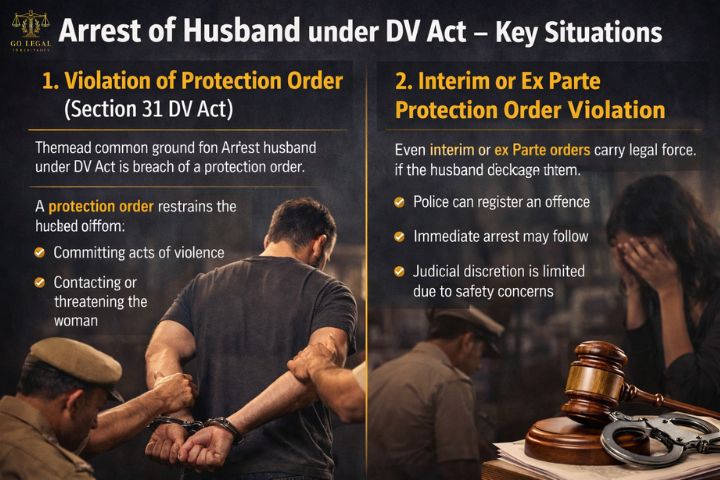
1. Violation of Protection Order (Section 31 DV Act)
The most common ground for Arrest of husband under DV Act is breach of a protection order.
A protection order restrains the husband from:
- Committing acts of violence
- Contacting or threatening the woman
- Entering her workplace or residence
If the husband violates such directions, Husband arrest Section 31 DV Act applies.
Legal consequences include:
- Cognizable and non-bailable offence
- Arrest without warrant
- Imprisonment up to one year or fine or both
This makes breach of protection order the strongest basis for Husband arrest in DV case.
2. Interim or Ex Parte Protection Order Violation
Even interim or ex parte orders carry legal force. If the husband disobeys them:
- Police can register an offence
- Immediate arrest may follow
- Judicial discretion is limited due to safety concerns
This is often seen in urgent domestic violence case arrest India situations.
DV Act Arrest Procedure Explained
Understanding the DV Act arrest procedure is essential to avoid confusion.
The process generally involves:
- Magistrate passes a protection order
- Violation is reported to police or Magistrate
- Police register offence under Section 31
- Arrest is made as offence is cognizable
The arrest is legally justified only after procedural compliance.
When Can Husband Be Arrested in DV Case Apart from DV Act?
1. Registration of FIR for Criminal Offences
If the domestic violence complaint includes allegations under:
- Section 85 BNS (cruelty)
- Section 115 BNS (hurt)
- Section 351 BNS (criminal intimidation)
Then arrest can occur under criminal law, independent of DV Act proceedings.
This often overlaps with Domestic violence case arrest India scenarios.
2. Non-Compliance with Court Directions
Failure to comply with:
- Maintenance orders
- Residence orders
- Court summons
May result in coercive steps including arrest warrants, though this is usually a last resort.
Role of Police in Husband Arrest in DV Case
Police powers are not unrestricted. Supreme Court guidelines require:
- Application of mind
- Necessity of arrest assessment
- Compliance with procedural safeguards
Police cannot arrest merely because a DV application is filed.
This safeguards against misuse while preserving protection for victims.
Judicial Safeguards Against Automatic Arrest
Indian courts have repeatedly held that:
- DV Act is not punitive by default
- Arrest must be proportionate
- Civil remedies should be prioritized
Courts emphasize balancing personal liberty with victim safety in Husband arrest in DV case matters.
Common Myths About Husband Arrest in DV Case
Myth 1: Filing DV case means immediate arrest
Reality: Arrest occurs only upon violation or criminal offence
Myth 2: DV Act is a criminal law
Reality: It is primarily civil in nature
Myth 3: Police must arrest husband on complaint
Reality: Arrest requires legal justification
Additional Section: Difference Between DV Act and Criminal Arrest
| DV Act | Criminal Law |
| Civil remedies | Penal consequences |
| Protection-focused | Punishment-focused |
| Arrest only on breach | Arrest possible on FIR |
Understanding this distinction clarifies when can husband be arrested in DV case.
Importance of Section 31 DV Act
Section 31 acts as the enforcement mechanism of the DV Act. Without it, protection orders would lack authority. This section ensures:
- Compliance with court directions
- Immediate deterrence
- Safety of the aggrieved woman
Thus, Husband arrest Section 31 DV Act is central to effective implementation.
Conclusion
The Husband arrest in DV case is not automatic or arbitrary. Indian law follows a structured approach where arrest is permitted only under specific circumstances such as violation of protection orders or commission of separate criminal offences. The DV Act arrest procedure balances the woman’s right to safety with the husband’s right to personal liberty.
Understanding when can husband be arrested in DV case helps remove fear, misinformation, and misuse while ensuring that genuine victims receive timely protection. The legal system in domestic violence case arrest India situations aims to prevent abuse, not punish without cause.