The Bharatiya Nagarik Suraksha Sanhita, 2023 (BNSS) marks a transformative evolution in India’s criminal justice system. Replacing the Criminal Procedure Code (CrPC), BNSS incorporates modern legal principles, strengthens institutional accountability, and refines procedural law in the interest of efficiency and fairness. One of the cornerstone provisions in BNSS is Section 18 – Public Prosecutors. This section establishes a structured framework for the appointment, role, and responsibilities of prosecuting authorities at various levels of the judiciary.
Public prosecutors play a significant role in the criminal justice system as they represent the State legally, determine prosecution strategy, and ensure that justice is done equally and sustainably. The purpose of this article is to unearth the particulars of Section 18 BNSS, to demonstrate its practical effect, to explore the developments along with it and to give a peep into the changing function of prosecution in the legalized ecosystem that has been reformed in India.
1. What Is Section 18 BNSS?
Section 18 of the Bharatiya Nagarik Suraksha Sanhita, 2023 is titled “Public Prosecutors.” It regulates the appointment and functioning of public prosecutors at the High Court, district, and local levels. The provision recognizes the need for legally qualified, experienced advocates to represent the State in criminal adjudication, appeal proceedings, and other legal forums specified under BNSS.
Broadly, Section 18 outlines:
- Who appoints public prosecutors;
- Where appointments are made (High Court, district, and local levels);
- Eligibility and qualification criteria;
- Special public prosecutors for specific cases;
- Processes involving panels prepared by district authorities.
2. Key Provisions under Section 18 BNSS
Appointment at the High Court Level
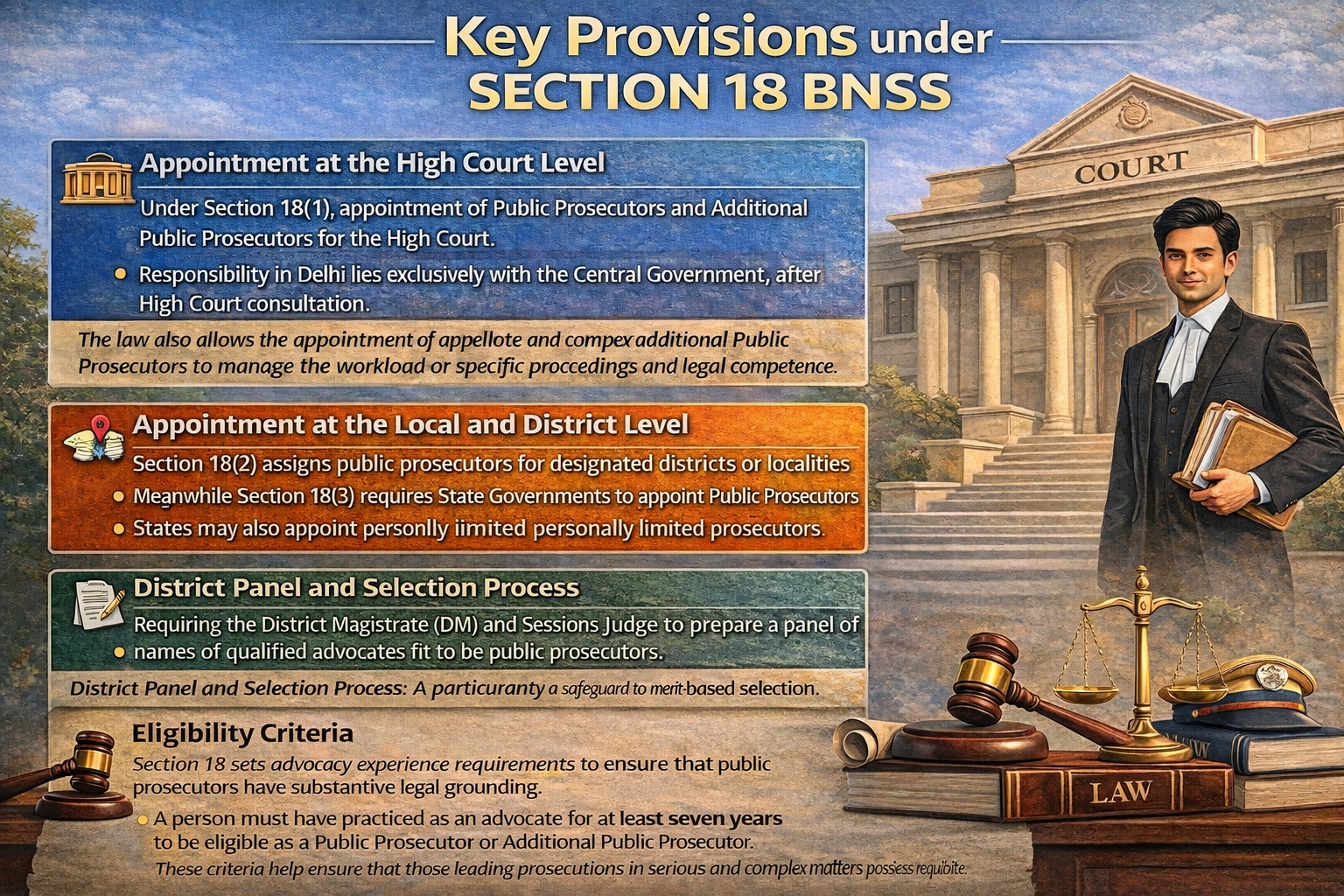
Under Section 18(1), either the Central Government or the State Government, after consulting the relevant High Court, must appoint a Public Prosecutor for that High Court. The law also allows the appointment of one or more Additional Public Prosecutors to manage the workload or specific proceedings.
For the National Capital Territory (NCT) of Delhi, this responsibility lies exclusively with the Central Government, acting after consultation with the High Court of Delhi.
These provisions ensure that the prosecution’s highest leaders in appellate and complex criminal matters have the endorsement of judicial authorities, preserving a balance between administrative decision‑making and legal competence.
Appointment at the Local and District Level
Under Section 18(2), the Central Government is empowered to assign one or more public prosecutors for designated districts or localities. This is crucial for cases where central laws are concerned or where the crimes committed affect the whole nation.
Meanwhile, Section 18(3) obligates every State Government to appoint a Public Prosecutor for each district. States may also appoint one or more Additional Public Prosecutors for district-level work. A unique feature here is that a public prosecutor appointed for one district may also serve another district — ensuring administrative flexibility in regions with limited availability of qualified prosecutors.
District Panel and Selection Process
A particularly significant procedural innovation under Section 18 is the requirement for the District Magistrate (DM), in consultation with the Sessions Judge, to prepare a panel of names of qualified advocates deemed fit to be public prosecutors for the district.
Under Section 18(5), the State Government may appoint someone as public prosecutor only if their name appears on this panel. This serves as a safeguard to ensure merit‑based selection and judicial oversight of prosecutorial appointments.
Regular Prosecutor Cadre and Eligibility
The BNSS also accounts for states that have a regular cadre of prosecuting officers — a structured administrative hierarchy of legal officers focused on prosecution. In such states, the government must appoint public prosecutors from this cadre, except in cases where no suitable candidate exists; in that event, it may select from the district panel.
The stipulation enshrined in this provision not only reinforces the institutional continuity and career pathways for specialized prosecutors but also retains the option to utilize capable private advocates when needed.
Eligibility Criteria
Section 18 sets advocacy experience requirements to ensure that public prosecutors have substantive legal grounding:
- A person must have practised as an advocate for at least seven years to be eligible as a Public Prosecutor or Additional Public Prosecutor.
- The appointment of a Special Public Prosecutor for specialized or specific categories of cases can be made by either the Central Government or State Government, and the appointed person must have a practice experience of at least ten years.
These criteria help ensure that those leading prosecutions in serious and complex matters possess requisite professional experience.
3. Functions and Powers of Public Prosecutors
Public prosecutors represent the central cog in criminal adjudication. While Section 18 does not list all functions exhaustively, the role broadly includes:
a. Representing the State in Court
Public prosecutors present the case on behalf of the State Government or Central Government in trials, appeals, and judicial proceedings covered by BNSS. Ever since the reformed criminal procedure came into force, prosecutors have a heightened role in ensuring fair presentation of evidence and adherence to procedural safeguards.
b. Advising Law Enforcement Agencies
Though police authorities usually lead the way in operational investigations, public prosecutors can still support legal issues with their guidance. Such guidance may include advice aimed at safeguarding the admissibility of evidence, securing compliance with constitutional rights, and ensuring procedural correctness.
c. Monitoring and Case Strategy
In reality, the role of prosecutors encompasses the planning of the litigation strategy, the assessment of the evidence, and the decision on whether to go ahead with charges, appeals, or discontinuing the case in difficult situations.
d. Compliance with Contemporary Reforms
With BNSS reforms emphasizing victim rights, transparency, and digital procedural tools, prosecutors must adapt strategies to incorporate audio‑video record evidence, compliance with timelines, and enhanced victim support mechanisms.
4. Subordination and Directorate Structure
Although Section 18 itself does not detail the complete hierarchy of prosecutorial administration, BNSS includes related structures such as the Directorate of Prosecution (under Section 20) and appointments like Director, Deputy, and Assistant Directors of Prosecution.
Recent training materials show that under this integrated system:
- Public Prosecutors, Additional Public Prosecutors, and Special Public Prosecutors for High Courts are subordinate to the Director of Prosecution.
- Similarly, district prosecutors and Assistant Public Prosecutors are subordinate to Deputy Directors or Assistant Directors of Prosecution.
This aligns prosecutorial functions with strategic oversight and managerial accountability — a departure from the more ad‑hoc structures under CrPC.
5. Significance of Section 18 BNSS
A. Strengthening Rule of Law
By mandating consultation with High Courts and involving District Magistrates and Sessions Judges in panel formation, Section 18 promotes appointments grounded in legal competence and judicial oversight — essential to ensuring balanced prosecution.
B. Ensuring Continuity and Expertise
Requiring prior legal practice (seven to ten years) ensures that prosecutors come equipped with both advocacy skills and legal understanding — critical for handling complex legal issues in modern criminal proceedings.
C. Promoting Merit‑Based Appointment
The panel system and cadre requirement combine judicial vetting with institutional continuity, discouraging appointments based solely on executive discretion.
D. Enhancing Accountability and Case Management
The hierarchical subordination of the prosecution directorates guarantees that the prosecutorial functions are not only controlled by the judiciary but also through institutional coordination — thus improving the monitoring of cases and strategic handling.
6. Contemporary Challenges and Development Trends
Nevertheless, the progressive framework has its drawbacks, and one of them is the appointment of public prosecutors not being made in a timely manner. As an example, the judicial concerns raised recently indicated that delays in filling prosecutorial vacancies in certain areas had a negative effect on the prosecution services being effective. The Times of India
This indicates a wider problem of implementation: legal provisions must not only be matched with the administrative capacity but also with the infrastructure development (prosecution directorates, for instance) and the training initiatives for prosecutors to fully utilize the capabilities of Section 18.
7. Comparison with CrPC
Under the old Criminal Procedure Code (CrPC), similar provisions existed for public prosecutors, but BNSS clarifies and expands roles:
- TNBNSS introduces structured panels and clear eligibility criteria.
- BNSS emphasizes consultation with the judiciary for appointments.
- Integration with prosecution directorates enhances professional status and accountability of prosecutors.
Thus, Section 18 represents a refinement rather than a departure from conventional practices, providing clarity on roles, appointments, and institutional support.
8. Contribution to the Criminal Justice System
The public prosecutors are the key figures in the justice system:
- They act as intermediaries between the State and the defendants, guaranteeing proper application of the law.
- They make a fair process of legal procedures and using prosecutors’ discretion at the same time.
- Their professional skills help the judiciary in the process of forming opinions on the weight of evidence and the correctness of legal reasoning.
The prosecutor’s position has become increasingly organized and backed by unambiguous legal rules and accountability systems as India moves towards the BNSS system.
Frequently Asked Questions (FAQs)
Q1. What does Section 18 BNSS deal with?
It concerns the appointment, eligibility, and role of Public Prosecutors in High Courts, districts, and local areas under BNSS.
Q2. Who appoints Public Prosecutors under Section 18?
The High Court prosecutors get appointed by either the Central or State Governments after a consultation with the High Court, while the State Government appoints the district prosecutors.
Q3. What are the eligibility criteria for Public Prosecutors?
Public prosecution necessitates that the prosecutor has a minimum of seven years of experience as an attorney, while a Special Public Prosecutor needs to have at least ten years of practice as an advocate.
Q4. Can a Public Prosecutor serve in more than one district?
Yes — a public prosecutor appointed for one district may also be appointed for another district.
Q5. What is the role of a panel prepared by the District Magistrate?
States must select public prosecutors from this panel as it consists of advocates considered suitable for the appointment.