The Bharatiya Nagarik Suraksha Sanhita, 2023 (BNSS) represents a pivotal transformation in India’s criminal justice system, replacing the Criminal Procedure Code (CrPC) to reflect the needs of contemporary governance, technology, and legal practice. Among its core provisions are the roles and responsibilities that underpin prosecution in criminal cases — including the appointment and functioning of Assistant Public Prosecutors, as laid down in Section 19 BNSS.
Assistant Public Prosecutors (APPs) serve as indispensable supporting officers in the prosecution machinery, especially in courts of Magistrates. Section 19 not only defines who must be appointed as an APP, but also how gaps in appointments should be filled — ensuring that prosecution is not stalled due to administrative delays or vacancies. This article explores Section 19 in depth, discusses its legal foundations, contextualizes its application under the new legal regime, and highlights key practical and policy issues.
1. Understanding Section 19 BNSS
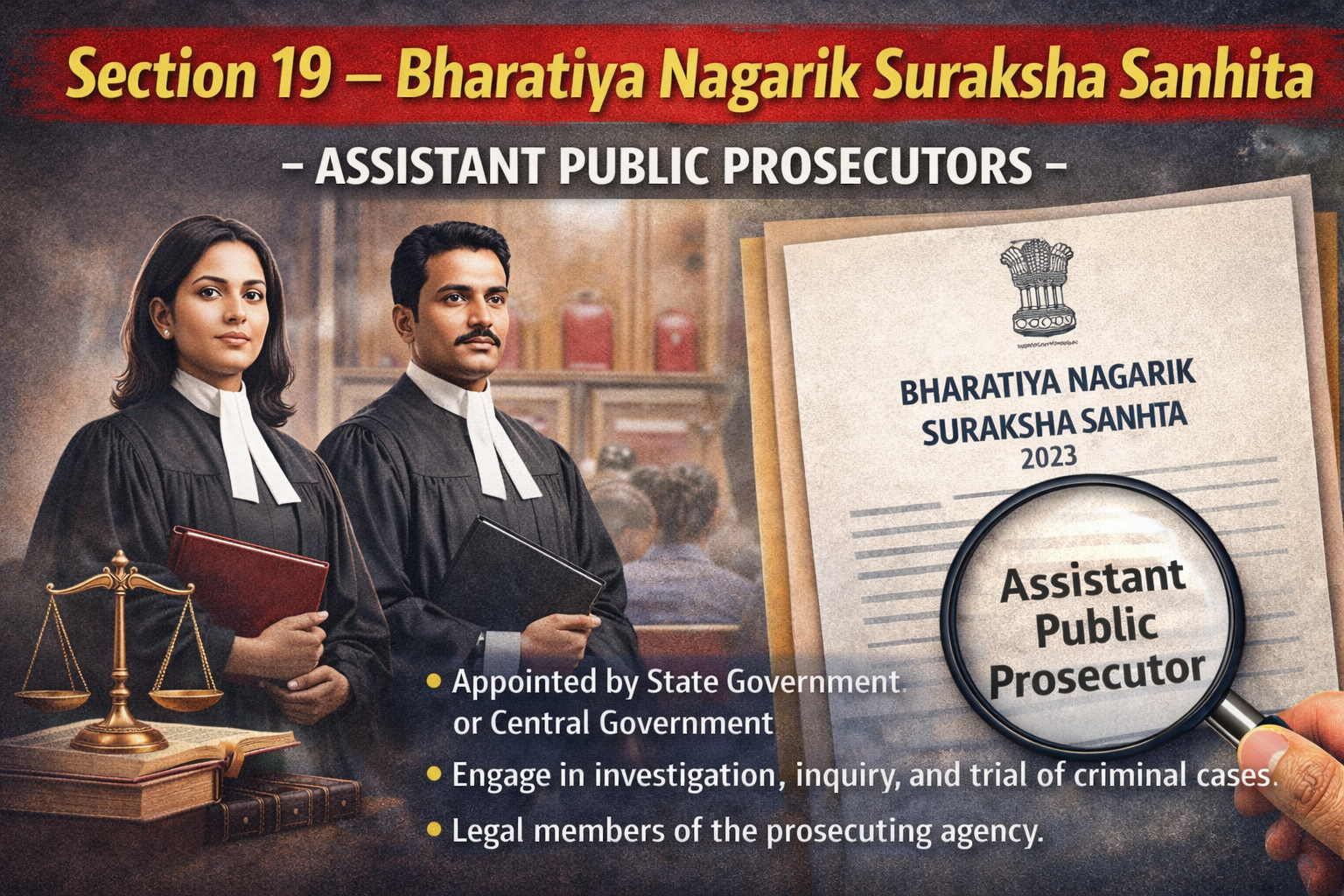
Section 19 of BNSS, titled Assistant Public Prosecutors, establishes the statutory framework for appointing APPs at the district level and in Magistrates’ courts. The text of the section reflects a tripartite scheme:
- State Governments must appoint one or more Assistant Public Prosecutors in every district for prosecutions in Magistrates’ courts.
- The Central Government may appoint one or more Assistant Public Prosecutors to handle specific cases or classes of cases in Magistrate courts.
- Where no APP is available for a particular case, the District Magistrate may appoint another person as APP for that case after issuing a 14‑day notice to the State Government.
The statute also contains critical eligibility safeguards: a police officer cannot be appointed as an Assistant Public Prosecutor if they (a) participated in the investigation of the specific offence or (b) are below the rank of Inspector.
2. The Rationale Behind Section 19
The inclusion of Section 19 BNSS reflects several core principles of effective criminal justice administration:
a. Ensuring Proper Representation in Magistrate Courts
Magistrate courts are where most criminal prosecutions begin and are conducted. APPs ensure that the State’s case is presented accurately, professionally, and efficiently, safeguarding the prosecution’s interests while ensuring due process. Magistrates’ courts deal with summary and warrant trials, bail applications, preventive orders, and critical evidentiary hearings, making consistent prosecutorial presence indispensable.
b. Avoiding Prosecution Gaps
One of the challenges under the old CrPC regime was vacancies or unavailability of prosecutorial officers, leading to adjournments and stalled proceedings. Section 19 expressly allows the District Magistrate to step in and appoint an alternative, subject to safeguards, ensuring continuity of prosecution.
c. Separating Investigators From Prosecutors
The proviso barring police officers involved in the investigation from serving as APPs in the same case protects the independence of prosecution and prevents conflicts of interest. It also discourages investigatory officers from prosecuting their own cases — which could compromise fairness.
3. Detailed Breakdown of Section 19 Provisions
1 Appointment by the State Government
Under Section 19(1), the State Government must appoint one or more Assistant Public Prosecutors in every district. This obligation is mandatory — recognizing that the burden of prosecution in lower courts largely falls on APPS, who handle evidence presentation, bail arguments, charge framing hearings, and trial advocacy.
These APPs typically support the Public Prosecutor appointed under Section 18 (who handles broader prosecution strategy, appeals, and complex matters). Together, they form the frontline prosecutorial workforce in the criminal justice system.
2 Appointment by the Central Government
Under Section 19(2), the Central Government may appoint one or more APPs to conduct prosecutions in Magistrates’ courts for specified cases or classes of cases. This provision recognizes that certain matters — such as central enactment offences or cases of national importance — may require dedicated prosecutorial officers appointed by the Centre rather than by the state.
This dual system — state‑level and central‑level appointment — allows specialization and avoids overdependence on the state machinery for cases with cross‑jurisdictional significance.
3 Appointment by District Magistrates
A unique feature of Section 19 is Section 19(3), which empowers the District Magistrate (DM) to appoint an APP for a particular case where none is available, after giving 14 days’ notice to the State Government. This administrative safety valve ensures that justice does not wait for bureaucratic delays in appointments.
However, the safeguard of a mandatory notice period means that the State Government retains an opportunity to respond or appoint a regular APP in the interim, balancing administrative control with operational flexibility.
3.4 Eligibility Restrictions
The statute prohibits police officers from being appointed as APPs in any case where they:
- Took part in the investigation of that very offence; or
- Are below the rank of Inspector.
This provision underscores two principles: the independence of prosecution and the need for adequate legal expertise and maturity. While senior law enforcement officers could theoretically have legal training, the prospect of prosecuting one’s own investigations can create conflicts of interest and fairness concerns.
4. Subordination and Prosecution Directorate Structure
While Section 19 defines appointment and availability mechanisms for APPs, it links into a broader prosecution ecosystem established under BNSS.
According to the BNSS arrangement in Section 20, State Governments may establish a Directorate of Prosecution with hierarchical prosecutors such as Director, Deputy Director, and Assistant Director. Assistant Public Prosecutors appointed under Section 19 are subordinate to Deputy Directors or Assistant Directors of Prosecution. This ensures unified leadership, accountability, and standardized procedural guidance across districts.
Such hierarchical organization mirrors modern prosecutorial departments that focus on case management, quality control, and oversight — a departure from the ad‑hoc approach under the old CrPC system.
5. Practical Implications in Criminal Adjudication
1 Strengthening Routine Prosecutions
Assistant Public Prosecutors handle the bulk of routine prosecutions: presenting evidence, examining witnesses, arguing motions, and assisting Magistrates in interpreting procedural law. Their presence helps Magistrate courts function smoothly and avoids cosmetic or unskilled representation that could jeopardize justice or cause unnecessary delays.
Clear statutory backing ensures that state and central authorities cannot ignore district‑level prosecution needs.
2 Filling Gaps and Reducing Adjournments
One of the historic challenges with criminal trials has been frequent adjournments due to the absence of prosecutors. Section 19’s provision for DM‑appointed APPs helps reduce needless adjournments, ensuring continuity in trials and reducing backlog — a critical issue in Indian courts.
This innovation is consistent with broader criminal justice reforms across jurisdictions to streamline lower court proceedings.
3 Maintaining Legal Integrity
By barring police officers involved in investigations from prosecuting those same cases, Section 19 helps prevent procedural bias and reinforces the independence and impartiality of prosecution — a core tenet of natural justice.
This aligns with international standards that distinguish investigative functions from advocacy functions to preserve objectivity and fairness.
6. Implementation Challenges and Recent Developments
Although Section 19 provides a robust framework, implementation has faced challenges in some jurisdictions. A recent Delhi High Court directive highlighted delays in filling vacancies for prosecutors, including assistant public prosecutors, noting that prolonged vacancies harm effective prosecution and compromise justice delivery. The Court urged authorities to expedite appointments and formalize rules for recruitment, emphasizing the role of prosecutors in the justice system.
This underscores an important reality: legal reform must be matched with administrative action — filling ranks, developing recruitment rules, and ensuring prosecutors are trained and resourced.
7. Comparison With CrPC
Under the old Criminal Procedure Code (CrPC), provisions existed for appointing prosecutors — including assistant prosecutors — but were often less structured and more dependent on executive discretion. BNSS formalizes appointments, fills gaps proactively (via DM intervention), and integrates prosecution into a clearer institutional framework.
Key differences include:
- Statutory requirement of APPs in every district under Section 19 BNSS.
- Empowerment of District Magistrates to make interim appointments.
- Explicit eligibility constraints to avoid conflicts of interest.
These improvements aim to make prosecution more consistent, accountable, and professional.
8. Best Practices and Recommendations
To realize the full potential of Section 19, jurisdictions should focus on:
- Timely recruitment and staffing of Assistant Public Prosecutors.
- Training programs to enhance prosecutors’ legal and procedural expertise.
- Digital case management to support prosecutors in trial preparation and evidence handling.
- Coordination protocols between police investigators and prosecutors, ensuring information flow without compromising independence.
Supportive measures such as adequate infrastructure, legal research access, and continuous professional development can help APPs function effectively.
Frequently Asked Questions (FAQs)
Q1. What is an Assistant Public Prosecutor under BNSS?
An Assistant Public Prosecutor (APP) is a prosecutorial officer appointed to conduct prosecutions in Magistrates’ courts. Section 19 BNSS requires State Governments to appoint one or more APPs in every district.
Q2. Can the Central Government appoint Assistant Public Prosecutors?
Yes. The Central Government may appoint one or more APPs for specific cases or classes of cases in Magistrates’ courts as per Section 19(2).
Q3. What happens if no APP is available for a case?
If no APP is available, the District Magistrate may appoint another suitable person to act as APP for that case, after giving 14 days’ notice to the State Government.
Q4. Can police officers be appointed as Assistant Public Prosecutors?
Police officers who were involved in investigating the offence or those below the rank of Inspector cannot be appointed as APPs for that case.
Q5. How do Assistant Public Prosecutors fit into the prosecution hierarchy?
APPs appointed under Section 19 are subordinate to prosecution leaders such as Deputy Directors or Assistant Directors under the prosecution directorate structure.