The judicial system uses bail as a fundamental element which enables people to maintain their freedom while law enforcement officials conduct their investigations and the judicial process moves forward. The Bharatiya Nagarik Suraksha Sanhita 2023 BNSS which will replace the Code of Criminal Procedure 1973 CrPC maintains existing bail regulations through new procedures. Legal professionals and students and people involved in criminal cases are searching for information about the Difference Between Anticipatory Bail and Regular Bail Under BNSS because it has become one of the most popular legal inquiries.
The essential difference between anticipatory bail and regular bail requires understanding because these two types of bail function through different stages of criminal proceedings while they exist for distinct legal purposes. The article provides a basic explanation of the Difference Between Anticipatory Bail and Regular Bail Under BNSS which achieves complete accuracy in legal terms.
What Is Bail Under BNSS?
Under BNSS, bail refers to the temporary release of an accused person from custody, subject to conditions imposed by the court. Authorities seek to achieve dual goals through their detention of the accused, which includes ensuring their court presence while maintaining their constitutional right to personal freedom described in Article 21 of the Constitution of India.
BNSS continues the classification of offences into:
- Bailable offenses are those for which every citizen has the right to bail, while
- Non-bailable offenses are those for which whether or not to grant bail is left to the discretion of the Court.
The main types of bail for non-bailable offences are anticipatory bail and regular bail, The Difference Between Anticipatory Bail and Regular Bail Under BNSS consists of three distinct elements which are timing purposes and legal outcomes.
What Is Anticipatory Bail Under BNSS?
Anticipatory bail serves as a pre-arrest legal safeguard which protects individuals who fear they will be arrested for non-bailable offenses. BNSS anticipatory bail enables a person to obtain court protection before law enforcement officers make an official arrest.
The purpose of anticipatory bail is to protect individuals from:
- Arbitrary or motivated arrests
- Political or personal vendetta
- Abuse of police powers
If anticipatory bail is granted, the person cannot be arrested for the specified offence and must cooperate with the investigation as per court directions.
What Is Regular Bail Under BNSS?
Regular bail is a post-arrest remedy. It applies when a person has already been arrested or is in police or judicial custody. The accused then approaches a Magistrate or Sessions Court seeking release on bail.
Regular bail focuses on:
- Nature and gravity of the offence
- Evidence on record
- Possibility of absconding
- Chances of influencing witnesses
Thus, the Difference Between Anticipatory Bail and Regular Bail Under BNSS becomes evident from the stage at which each is applied.
Difference Between Anticipatory Bail and Regular Bail Under BNSS
1. Stage of Application
The most fundamental Difference Between Anticipatory Bail and Regular Bail Under BNSS is the timing.
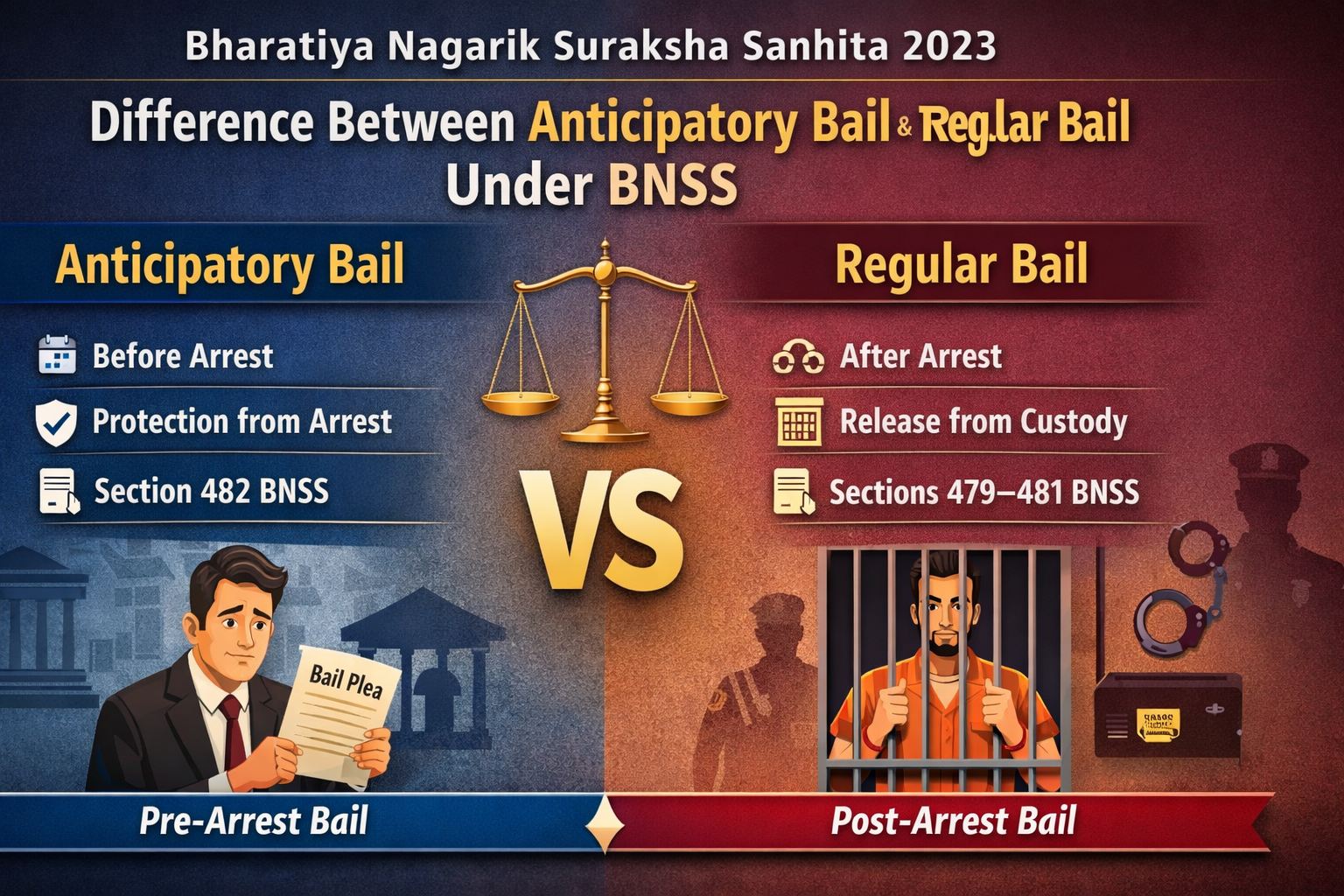
- Anticipatory bail is sought before arrest.
- Regular bail is sought after arrest.
2. Nature of Protection
Anticipatory bail provides protection from arrest, whereas regular bail provides release from custody after arrest.
3. Legal Objective
Anticipatory bail aims to prevent misuse of arrest powers, while regular bail ensures that detention is not prolonged unnecessarily.
4. Court Jurisdiction
Anticipatory bail is generally granted by a Sessions Court or High Court, whereas regular bail may be granted by a Magistrate, Sessions Court, or High Court, depending on the offence.
5. Conditions Imposed
Both types of bail involve conditions such as:
- Cooperation with investigation
- No tampering with evidence
- No inducement or threat to witnesses
However, anticipatory bail often carries stricter conditions because the accused has not yet been arrested.
Why the Difference Between Anticipatory Bail and Regular Bail Under BNSS Matters
Understanding the Difference Between Anticipatory Bail and Regular Bail Under BNSS is not merely academic. It has serious practical implications:
- Filing the wrong type of bail application can lead to rejection
- Delay in seeking anticipatory bail may result in arrest
- Regular bail may be harder to obtain after custody begins
For advocates, choosing the correct legal remedy at the correct stage is critical to protecting the client’s liberty.
Comparison : Anticipatory Bail vs Regular Bail Under BNSS
| Basis | Anticipatory Bail Under BNSS | Regular Bail Under BNSS |
| Stage of Bail | Before arrest | After arrest |
| Nature of Relief | Protection from arrest | Release from custody |
| Applicable When | Person apprehends arrest in a non-bailable offence | Person is already arrested or detained |
| Relevant BNSS Section | Section 482 BNSS | Sections 479–481 BNSS |
| Who Can Grant Bail | Sessions Court or High Court | Magistrate, Sessions Court, or High Court |
| Custody Required | No custody required | Accused must be in custody |
| Objective | Prevent misuse of arrest powers | Prevent unnecessary detention |
| Conditions Imposed | Generally stricter (joining investigation, no travel, etc.) | Conditions depend on facts and seriousness |
| Cancellation | Can be cancelled if conditions violated | Can be cancelled for misuse of liberty |
| Example Situation | Fear of false implication or motivated FIR | Arrest already made by police |
BNSS Section Numbers Explained
Section 482 BNSS – Anticipatory Bail
- Corresponds to Section 438 CrPC
- Allows a person to apply for bail in anticipation of arrest
- Court may impose conditions such as:
- Joining investigation
- No inducement or threat to witnesses
- Restriction on travel
This section forms the statutory basis for anticipatory bail and is central to understanding the Difference Between Anticipatory Bail and Regular Bail Under BNSS.
Section 479 BNSS – Bail in Bailable Offences
- Bail is a matter of right
- Accused must be released on furnishing bail or bond
Section 480 BNSS – Bail in Non-Bailable Offences
- Bail is discretionary
- Court considers:
- Gravity of offence
- Criminal antecedents
- Possibility of absconding
Section 481 BNSS – Special Powers of High Court or Sessions Court
- High Court or Sessions Court may grant bail in any case
- Broader discretionary powers compared to Magistrate
Judicial Approach to Bail Under BNSS
The legal system has established that “bail is the rule and jail is the exception.” This principle continues under BNSS. The courts exercise discretion in anticipatory bail cases although this right does not exist as an absolute right.
The courts assess ongoing detention needs in regular bail cases to determine its necessity for investigation and trial purposes. The Difference Between Anticipatory Bail and Regular Bail Under BNSS shows different outcomes which apply to both kinds of bail.
Anticipatory Bail vs Regular Bail: A Practical Example
The person who fears arrest because of business-related conflict needs to obtain anticipatory bail as their legal solution. The police can only arrest individuals who exist in their custody whom they have already brought to the Magistrate. The actual situation demonstrates how Anticipatory Bail and Regular Bail operate differently according to BNSS regulations.
Conclusion
The Difference Between Anticipatory Bail and Regular Bail Under BNSS shows different results because it uses two distinct stages of criminal proceedings and two different types of legal relief and two separate functions of court protection. Anticipatory bail protects individuals from wrongful arrest whereas regular bail provides a process to regain freedom after police custody.
With BNSS replacing CrPC, the bail system maintains its focus on freedom yet demands better understanding of its procedures. Understanding the Difference Between Anticipatory Bail and Regular Bail Under BNSS is essential for all litigants law students and legal professionals to successfully use legal remedies while safeguarding their basic rights.