
...

Section 20 – Bharatiya Nagarik Suraksha Sanhita (BNSS) – Directorate of Prosecution

Home / Section Details

Table of Contents

Section 20 – Bharatiya Nagarik Suraksha Sanhita (BNSS) – Directorate of Prosecution The Bharatiya Nagarik Suraksha Sanhita, 2023 (BNSS) marks a significant transformation in India’s criminal procedural landscape, replacing the old Code of Criminal Procedure (CrPC) with a modern framework designed for effectiveness, clarity, and administrative coherence. One of the most consequential innovations under BNSS is the establishment of the Directorate of Prosecution under Section 20 — a feature aimed at institutionalizing and professionalizing prosecution in India. The content of this article is focused on Section 20 BNSS - Directorate of Prosecution which is critically analyzed to the legal provisions, structure, roles, eligibility, and governance aspects and even to the challenges of implementation and the significance of it in the future. It will also be accompanied by FAQs with short answers for the purpose of guiding the practitioners, students, and citizens' possible concerns regarding this matter. 1. What Is Section 20 BNSS? BNSS's Section 20 portrays the Directorate of Prosecution idea. The provision enables State Governments to create: A State Directorate of Prosecution presided over by a Director of Prosecution with accompanying Deputy Directors of Prosecution and other officers as necessary. A District Directorate of Prosecution in each district with Deputy Directors and Assistant Directors of Prosecution as staff members. The main goal of this directorate is to turn prosecution into an institution, improve the standard of criminal litigation, and provide continuous monitoring of prosecutorial activities, especially in the major cases. This institutional method is a major change from the rather informal prosecutorial processes under the CrPC. 2. Why Was the Directorate of Prosecution Introduced? The establishment of a Directorate of Prosecution under Section 20 of BNSS is not only a matter of formality but rather it serves several key purposes: Professionalization of Prosecution: The establishment of non-civil servant practitioners who have a complete understanding of criminal law would mean better quality advocacy and strategy in the processes of trial and appeals. Hierarchical Oversight: Decides, through supervision, the relationship between prosecutors, public prosecutors, and their directors thus ensuring decision making is uniform. Case Monitoring: Assigns roles that are different in terms of the seriousness of offences — thus getting more serious cases to be appropriately noticed and resourced Accountability and Coordination: Enhances the communication between the detectives and the lawyers thus resulting in faster delivery of justice. BNS Sections Increased staffing in the Directorate of Prosecution was recently pointed out as being of utmost importance by the Delhi High Court, which remarked that delays in recruitment have been one of the reasons for ineffective prosecutions under BNSS. The Times of India 3. Key Features of the Directorate of Prosecution 1. Establishment and Structure According to Section 20(1): State Directorate: It can have a Director of Prosecution and additionally as many Deputy Directors as the State Government thinks necessary. District Directorate: A district can be equipped with a directorate consist of Deputy Directors and Assistant Directors of Prosecution. A A P Tax Law This bifurcated structure of state and district levels not only provides macro-level policy oversight but also facilitates micro-level case management. 2. Eligibility for Appointments Section 20(2) specifies eligibility qualifications: Director of Prosecution / Deputy Director: Must have practiced as an advocate for at least 15 years or be a current/former Sessions Judge. Assistant Director of Prosecution: Must have practiced as an advocate for at least 7 years or have served as a First Class Magistrate. These criteria ensure that prosecutorial leadership is held by experienced legal professionals with deep expertise in criminal law. 3. Administrative Control The Directorate of Prosecution will operate under the administrative control of the Home Department of the respective state. This ensures alignment with overall law and order strategy while maintaining prosecutorial autonomy in execution. 4. Subordination and Hierarchy Deputy and Assistant Directors are subordinate to the Director of Prosecution. Public Prosecutors and related officers (including Additional and Special Public Prosecutors for High Court matters) are also placed under the directorate’s supervision. District‑level prosecutors and Assistant Public Prosecutors report to Deputy/Assistant Directors at the district level. This structure creates a clear chain of command and enhances accountability across prosecutorial functions. 5. Functions and Powers While the statute provides a broad outline, the general powers and functions are usually determined by subsequent rules notified by the State Government. However, Section 20 and related guidance materials emphasize the following roles: a. Monitoring Serious Cases The Directorate, especially the Director and Deputy Directors, is entrusted with overseeing cases of significant gravity: Director of Prosecution: Typically monitors cases with offences punishable with 10 years’ imprisonment, life imprisonment, or death. Deputy Director: Focuses on cases punishable with 7–10 years. Assistant Director: Monitors cases where punishment is less than 7 yearsI b. Review of Police Reports and Appeals The Directorate has the mandate to scrutinize police reports, facilitate the expeditious disposal of cases, and provide opinions on the filing of appeals. Such stratification helps prioritize resource allocation and improves prosecutorial precision. 4. How Section 20 Differs from the Old CrPC Framework Under the Criminal Procedure Code (CrPC), the prosecution function did not have a centralized state‑level directorate with clear hierarchical supervision. While public prosecutors and assistant prosecutors existed, there was no uniform prosecutorial administrative structure. The BNSS reform, therefore: Introduces a structured prosecution service akin to services in some common law jurisdictions. Provides clear eligibility standards for senior positions. Clarifies the supervisory chain among prosecutorial officers. Institutionalizes case monitoring protocols. These enhancements mark a major shift toward treating prosecution as an institutional specialty, not merely an extension of general legal representation. 5. Broader Role in Modern Criminal Justice 1. Improving Case Outcomes By centralizing and standardizing prosecutorial decision‑making, Section 20 BNSS seeks to reduce instances where cases are poorly presented, leading to acquittals or procedural errors. 2. Supporting Rule of Law With dedicated prosecution leadership, the justice system is better equipped to uphold constitutional values, protect victims’ interests, and mitigate miscarriages of justice. 3. Reducing Backlogs Effective monitoring and expertise can help expedite cases, particularly those involving serious offences, which historically contribute to court backlog. 4. Enhanced Coordination With Investigating Agencies The Directorate’s geographical footprint — spanning state and district levels — allows for better coordination between prosecutors and law enforcement agencies, ensuring that investigations are legally sound and judicial expectations are met. 6. Implementation Challenges Despite the promise of Section 20, implementation has encountered obstacles: a. Slow Recruitment and Vacancies The Delhi High Court recently flagged delays in filling critical prosecution directorate posts, noting vacancies for prosecutors and deputies that have hindered effective prosecution under BNSS. The Court directed timely finalization of recruitment rules and urged administrative action to fill vacancies swiftly. This situation highlights a broader administrative challenge: without recruitment rules and timely appointments, the directorate structure cannot function as intended. b. Capacity Building States must invest in training, infrastructure, and support systems for the directorate to effectively monitor and manage cases, particularly complex ones involving technology, forensic evidence, or specialized legal issues. c. Policy Harmonization Drafting appropriate state rules that align with Section 20’s objectives while remaining practical and context‑sensitive is crucial. This involves consultations with judiciary, ministries, and legal experts. 7. Future Prospects and Relevance As BNSS becomes fully operational across India, the Directorate of Prosecution under Section 20 is poised to: Professionalize prosecution services across states Elevate quality of criminal litigation Ensure consistency and accountability in prosecution Facilitate specialized strategies for serious crime categories In the long term, the directorate model could become a benchmark for other jurisdictions seeking to modernize their prosecutorial framework. 8. Conclusion The BNSS's Section 20 which is the Directorate of Prosecution is a primary reform that seeks to fortify the criminal justice system in India by making prosecution an institutional part of the system. The directorate model talks about professional management of prosecution, not just that but also the alignment with the general legal and societal objectives strategically through the various facets such as eligibility criteria, hierarchical structure, functional roles, and case monitoring. The implementation has not been challenging at all; in fact, it has been the legal intent behind Section 20 that has been a "visionary stride" toward the future of an efficient, accountable, and high-quality prosecutorial system in India. Section 20 – Bharatiya Nagarik Suraksha Sanhita (BNSS) – Directorate of Prosecution

The Bharatiya Nagarik Suraksha Sanhita, 2023 (BNSS) marks a significant transformation in India’s criminal procedural landscape, replacing the old Code of Criminal Procedure (CrPC) with a modern framework designed for effectiveness, clarity, and administrative coherence. One of the most consequential innovations under BNSS is the establishment of the Directorate of Prosecution under Section 20 — a feature aimed at institutionalizing and professionalizing prosecution in India.

The content of this article is focused on Section 20 BNSS – Directorate of Prosecution which is critically analyzed to the legal provisions, structure, roles, eligibility, and governance aspects and even to the challenges of implementation and the significance of it in the future. It will also be accompanied by FAQs with short answers for the purpose of guiding the practitioners, students, and citizens’ possible concerns regarding this matter.

1. What Is Section 20 BNSS?

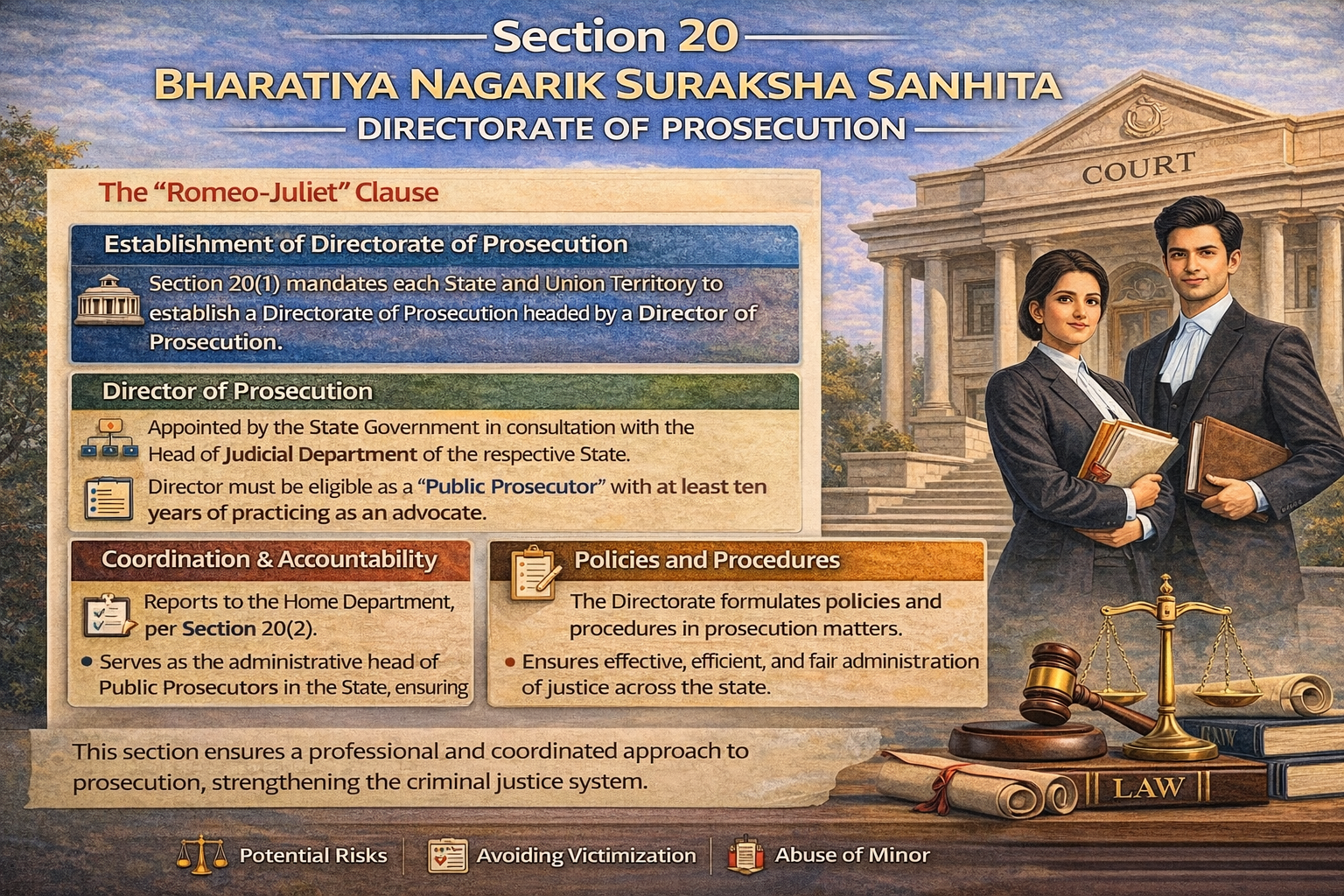
  • BNSS’s Section 20 portrays the Directorate of Prosecution idea. The provision enables State Governments to create:
  • A State Directorate of Prosecution presided over by a Director of Prosecution with accompanying Deputy Directors of Prosecution and other officers as necessary.
  • A District Directorate of Prosecution in each district with Deputy Directors and Assistant Directors of Prosecution as staff members.

The main goal of this directorate is to turn prosecution into an institution, improve the standard of criminal litigation, and provide continuous monitoring of prosecutorial activities, especially in the major cases. This institutional method is a major change from the rather informal prosecutorial processes under the CrPC.

2. Why Was the Directorate of Prosecution Introduced?

The establishment of a Directorate of Prosecution under Section 20 of BNSS is not only a matter of formality but rather it serves several key purposes: 

  • Professionalization of Prosecution: The establishment of non-civil servant practitioners who have a complete understanding of criminal law would mean better quality advocacy and strategy in the processes of trial and appeals.
  • Hierarchical Oversight: Decides, through supervision, the relationship between prosecutors, public prosecutors, and their directors thus ensuring decision making is uniform.
  • Case Monitoring: Assigns roles that are different in terms of the seriousness of offences — thus getting more serious cases to be appropriately noticed and resourced
  • Accountability and Coordination: Enhances the communication between the detectives and the lawyers thus resulting in faster delivery of justice. BNS Sections

Increased staffing in the Directorate of Prosecution was recently pointed out as being of utmost importance by the Delhi High Court, which remarked that delays in recruitment have been one of the reasons for ineffective prosecutions under BNSS. The Times of India

3. Key Features of the Directorate of Prosecution

1. Establishment and Structure

According to Section 20(1):

  1. State Directorate: It can have a Director of Prosecution and additionally as many Deputy Directors as the State Government thinks necessary.
  2. District Directorate: A district can be equipped with a directorate consist of Deputy Directors and Assistant Directors of Prosecution. A A P Tax Law

This bifurcated structure of state and district levels not only provides macro-level policy oversight but also facilitates micro-level case management.

2. Eligibility for Appointments

Section 20(2) specifies eligibility qualifications:

  • Director of Prosecution / Deputy Director: Must have practiced as an advocate for at least 15 years or be a current/former Sessions Judge.
  • Assistant Director of Prosecution: Must have practiced as an advocate for at least 7 years or have served as a First Class Magistrate.

These criteria ensure that prosecutorial leadership is held by experienced legal professionals with deep expertise in criminal law.

3. Administrative Control

The Directorate of Prosecution will operate under the administrative control of the Home Department of the respective state. This ensures alignment with overall law and order strategy while maintaining prosecutorial autonomy in execution.

4. Subordination and Hierarchy

  • Deputy and Assistant Directors are subordinate to the Director of Prosecution.
  • Public Prosecutors and related officers (including Additional and Special Public Prosecutors for High Court matters) are also placed under the directorate’s supervision.
  • District‑level prosecutors and Assistant Public Prosecutors report to Deputy/Assistant Directors at the district level.

This structure creates a clear chain of command and enhances accountability across prosecutorial functions.

5. Functions and Powers

While the statute provides a broad outline, the general powers and functions are usually determined by subsequent rules notified by the State Government. However, Section 20 and related guidance materials emphasize the following roles:

a. Monitoring Serious Cases

The Directorate, especially the Director and Deputy Directors, is entrusted with overseeing cases of significant gravity:

  • Director of Prosecution: Typically monitors cases with offences punishable with 10 years’ imprisonment, life imprisonment, or death.
  • Deputy Director: Focuses on cases punishable with 7–10 years.
  • Assistant Director: Monitors cases where punishment is less than 7 years.

b. Review of Police Reports and Appeals

The Directorate has the mandate to scrutinize police reports, facilitate the expeditious disposal of cases, and provide opinions on the filing of appeals. 

Such stratification helps prioritize resource allocation and improves prosecutorial precision.

4. How Section 20 Differs from the Old CrPC Framework

Under the Criminal Procedure Code (CrPC), the prosecution function did not have a centralized state‑level directorate with clear hierarchical supervision. While public prosecutors and assistant prosecutors existed, there was no uniform prosecutorial administrative structure.

The BNSS reform, therefore:

  • Introduces a structured prosecution service akin to services in some common law jurisdictions.
  • Provides clear eligibility standards for senior positions.
  • Clarifies the supervisory chain among prosecutorial officers.
  • Institutionalizes case monitoring protocols.

These enhancements mark a major shift toward treating prosecution as an institutional specialty, not merely an extension of general legal representation.

5. Broader Role in Modern Criminal Justice

1. Improving Case Outcomes

By centralizing and standardizing prosecutorial decision‑making, Section 20 BNSS seeks to reduce instances where cases are poorly presented, leading to acquittals or procedural errors.

2. Supporting Rule of Law

With dedicated prosecution leadership, the justice system is better equipped to uphold constitutional values, protect victims’ interests, and mitigate miscarriages of justice.

3. Reducing Backlogs

Effective monitoring and expertise can help expedite cases, particularly those involving serious offences, which historically contribute to court backlog.

4. Enhanced Coordination With Investigating Agencies

The Directorate’s geographical footprint — spanning state and district levels — allows for better coordination between prosecutors and law enforcement agencies, ensuring that investigations are legally sound and judicial expectations are met.

6. Implementation Challenges

Despite the promise of Section 20, implementation has encountered obstacles:

a. Slow Recruitment and Vacancies

The Delhi High Court recently flagged delays in filling critical prosecution directorate posts, noting vacancies for prosecutors and deputies that have hindered effective prosecution under BNSS. The Court directed timely finalization of recruitment rules and urged administrative action to fill vacancies swiftly.

This situation highlights a broader administrative challenge: without recruitment rules and timely appointments, the directorate structure cannot function as intended.

b. Capacity Building

States must invest in training, infrastructure, and support systems for the directorate to effectively monitor and manage cases, particularly complex ones involving technology, forensic evidence, or specialized legal issues.

c. Policy Harmonization

Drafting appropriate state rules that align with Section 20’s objectives while remaining practical and context‑sensitive is crucial. This involves consultations with judiciary, ministries, and legal experts.

7. Future Prospects and Relevance

As BNSS becomes fully operational across India, the Directorate of Prosecution under Section 20 is poised to:

  • Professionalize prosecution services across states
  • Elevate quality of criminal litigation
  • Ensure consistency and accountability in prosecution
  • Facilitate specialized strategies for serious crime categories

In the long term, the directorate model could become a benchmark for other jurisdictions seeking to modernize their prosecutorial framework.

8. Conclusion

The BNSS’s Section 20 which is the Directorate of Prosecution is a primary reform that seeks to fortify the criminal justice system in India by making prosecution an institutional part of the system. The directorate model talks about professional management of prosecution, not just that but also the alignment with the general legal and societal objectives strategically through the various facets such as eligibility criteria, hierarchical structure, functional roles, and case monitoring.

The implementation has not been challenging at all; in fact, it has been the legal intent behind Section 20 that has been a “visionary stride” toward the future of an efficient, accountable, and high-quality prosecutorial system in India.


Details

Date

Author

More Related

Section 19 BNSS

Section 19 – Bharatiya Nagarik Suraksha Sanhita (BNSS) – Assistant Public Prosecutors

February 9, 2026

9 min read

Section 18

Section 18 – Bharatiya Nagarik Suraksha Sanhita (BNSS) – Public Prosecutors: An In‑Depth Analysis

February 7, 2026

9 min read

Section 17 BNSS– Subordination of Executive Magistrates

Section 17 – Bharatiya Nagarik Suraksha Sanhita (BNSS) – Subordination of Executive Magistrates

February 6, 2026

9 min read

Seraphinite AcceleratorOptimized by Seraphinite Accelerator
Turns on site high speed to be attractive for people and search engines.