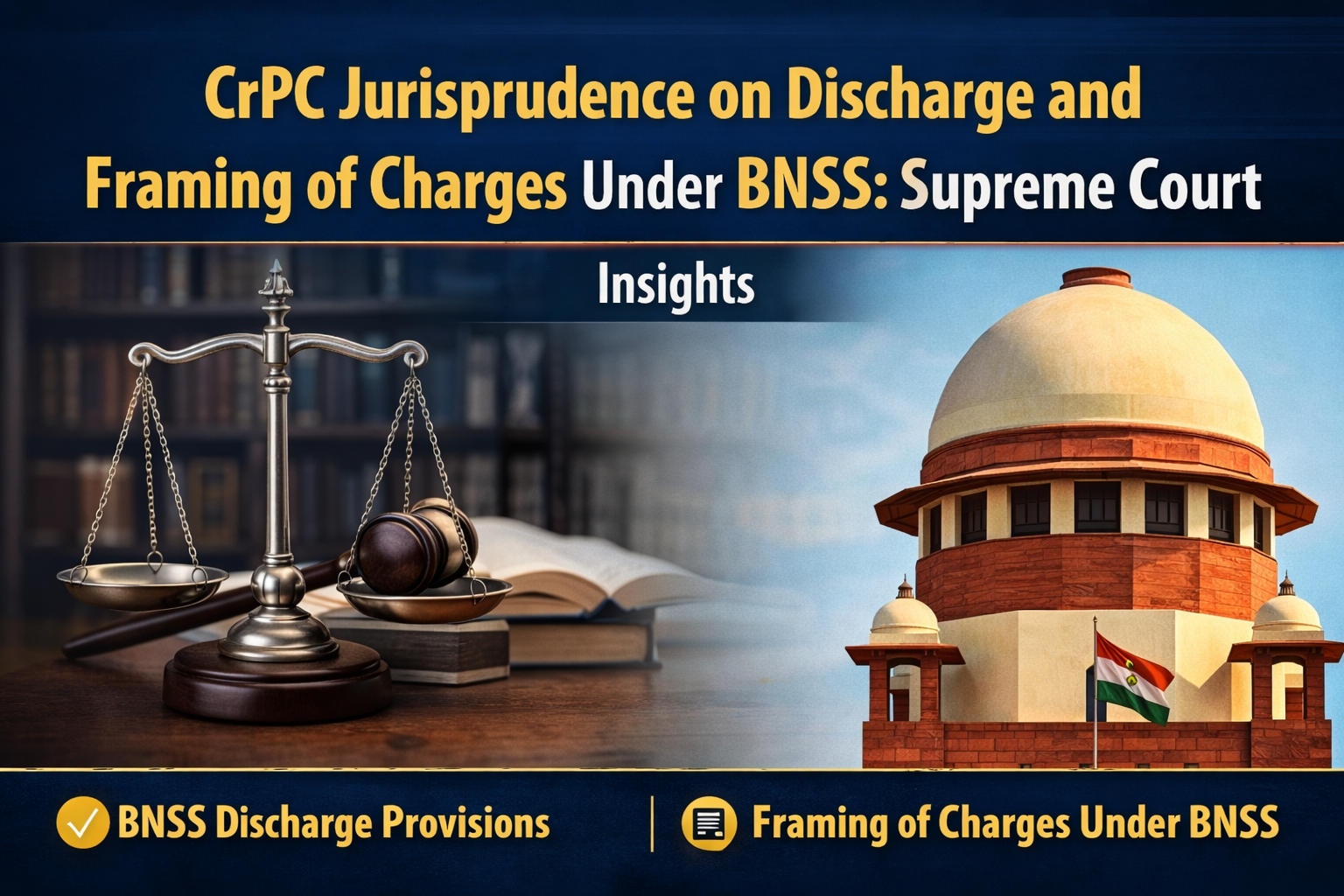
The landscape of Indian criminal law has seen a tectonic shift with the implementation of the Bharatiya Nagarik Suraksha Sanhita (BNSS), 2023. However, a common question among legal practitioners and litigants is whether the decades of established legal principles under the old Code of Criminal Procedure (CrPC) still hold water. In a landmark observation, the Supreme Court latest judgment on BNSS has clarified that the substantive CrPC Jurisprudence on Discharge and Framing of Charges Under BNSS will continue to apply, ensuring that the transition from CrPC to BNSS does not result in a legal vacuum or arbitrary procedures.
CrPC Jurisprudence on Discharge and Framing of Charges Under BNSS
The Supreme Court has emphasized that while the nomenclature and section numbers have changed, the core CrPC principles applicable under BNSS remain intact. The judicial role at the pre-trial stage—specifically concerning the protection of an accused from groundless trials—is a substantive right that the new Sanhita does not dilute.
1. The Continuation of Substantive Standards
The Supreme Court on BNSS and CrPC recently noted that the level of scrutiny required to put an accused on trial has not changed. The CrPC Jurisprudence on Discharge and Framing of Charges Under BNSS dictates that a judge must still apply their mind to the record and documents to see if a prima facie case in charge framing exists.
- Judicial Mind Application: Courts cannot act as a “post office” for the prosecution.
- Consistency: The legal tests for “sufficient ground for proceeding” (Sessions cases) and “groundless” charges (Warrant cases) are carried forward into the BNSS.
2. Identifying the Section Relating to Discharge Under BNSS
Under the old regime, Section 227 (Sessions) and Section 239 (Warrant cases) were the primary BNSS discharge provisions. In the new code:
- Sessions Court discharge under BNSS is now governed by Section 250.
- Discharge in Warrant cases (on police report) is governed by Section 262.
Despite these new numbers, the CrPC Jurisprudence on Discharge and Framing of Charges Under BNSS ensures that the “grave suspicion” test established in cases like Union of India v. Prafulla Kumar Samal remains the gold standard.
The Charge Framing Test Under Criminal Law
When a court decides not to discharge an accused, it proceeds to the next stage: framing of charges under BNSS 2023. This is a critical juncture in the criminal trial procedure under BNSS.
1. Presumption of Guilt vs. Probabilities
The charge framing test under criminal law does not require proof beyond reasonable doubt at this stage. Instead, the court looks for a “ground for presuming” that the accused has committed the offence. CrPC Jurisprudence on Discharge and Framing of Charges Under BNSS suggests that if the material on record creates a strong suspicion, the court is justified in framing charges.
2. Difference Between Discharge and Framing of Charge
The difference between discharge and framing of charge is essentially the difference between the absence of a case and the presence of a triable issue.
- Discharge: Occurs when the judge finds no “sufficient ground” to proceed.
- Framing of Charge: Occurs when the judge opines there is a “ground for presuming” the commission of an offence.
BNSS 2023 Criminal Procedure Reforms and Timelines
While the substantive law remains the same, the BNSS 2023 criminal procedure reforms introduce “regulatory discipline” through strict timelines. This is perhaps the most significant change in the transition from CrPC to BNSS.
1. The 60-Day Mandate
The CrPC Jurisprudence on Discharge and Framing of Charges Under BNSS is now bounded by time.
- Filing: An application for discharge must typically be filed within 60 days of committal or supply of documents.
- Framing: Under Section 251 of BNSS, the Sessions Court is now mandated to frame charges within 60 days from the date of the first hearing on the charge.
2. Standard for Discharge in Criminal Cases
The standard for discharge in criminal cases continues to prohibit a “mini-trial.” The judge is allowed to sift and weigh evidence only for the limited purpose of finding a prima facie case. This specific CrPC Jurisprudence on Discharge and Framing of Charges Under BNSS prevents the defense from introducing their own evidence prematurely during the discharge hearing.
Role of Superior Courts: High Court Powers in Discharge Matters
The High Court powers in discharge matters under Section 528 of BNSS (formerly Section 482 CrPC) remain a vital safety valve.
- Independent Application of Mind: The Supreme Court has reiterated that High Courts must independently examine the material when a charge-framing order is challenged.
- Correction of Errors: If a trial court frames charges without the basic ingredients of an offence being present, the High Court is duty-bound to intervene based on established CrPC principles applicable under BNSS.
Conclusion: Balancing Rights and Efficiency
The Supreme Court on BNSS and CrPC has provided much-needed clarity. The message is clear: the substantive soul of Indian criminal jurisprudence—the protection against arbitrary trial—remains alive. The CrPC Jurisprudence on Discharge and Framing of Charges Under BNSS acts as the bridge between the old and the new.
While the BNSS 2023 criminal procedure reforms aim for speed through electronic means and strict timelines, the standard for discharge in criminal cases and the prima facie case in charge framing will continue to be guided by the wisdom of the past. For legal professionals, the task is now to master the new section numbers while applying the classic jurisprudence that has “held the field” for decades.