
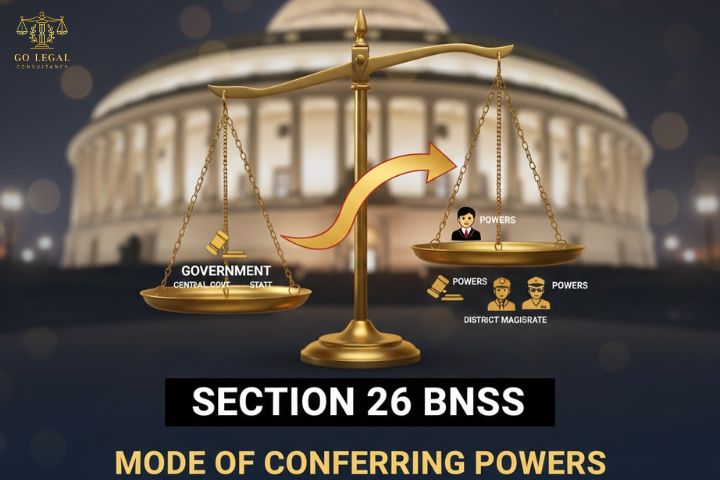
The enactment of the Bharatiya Nagarik Suraksha Sanhita marked a major shift in India’s criminal procedure framework, replacing the colonial-era Code of Criminal Procedure. Among its foundational administrative provisions is Section 26 Bharatiya Nagarik Suraksha Sanhita – Mode of Conferring Powers, which lays down the legal method by which criminal courts and authorities receive statutory powers.
Understanding Section 26 Bharatiya Nagarik Suraksha Sanhita – Mode of Conferring Powers is crucial because criminal jurisdiction depends not merely on appointment but on lawful delegation.The lack of proper delegation of authority may result in challenges to proceedings on jurisdictional grounds.
This article provides an in-depth analysis of section 26 BNSS to study the structure, purpose, and implications it has in the real world.
What is Section 26 BNSS?
Section 26 BNSS explained simply refers to the statutory mechanism that defines how powers under criminal procedure are granted to various authorities. The BNSS Section 26 legal provision ensures that no Magistrate or officer exercises criminal jurisdiction unless authority is legally conferred.
Under Section 26 Bharatiya Nagarik Suraksha Sanhita – Mode of Conferring Powers, powers may be granted:
- By the State Government
- By the High Court
- By statutory designation
- Through official notification
The provision regulates Conferring judicial powers under BNSS and distinguishes between administrative appointment and actual legal authority.
Legislative Purpose Behind Section 26 BNSS
The legislative intent behind Section 26 Bharatiya Nagarik Suraksha Sanhita – Mode of Conferring Powers is rooted in clarity, legality, and institutional control.
Key Objectives:
- Prevent Unauthorized Exercise of Authority
Only properly empowered officers can act under criminal procedure. - Maintain Hierarchical Structure
It protects the chain of command within the judiciary and executive. - Ensure Procedural Legitimacy
All criminal procedure powers under BNSS must originate from lawful delegation. - Strengthen Accountability
Written notification or statutory recognition prevents arbitrary assumption of power.
Thus, the Mode of conferring powers under BNSS ensures procedural discipline within the criminal justice system.
How Are Powers Conferred Under Section 26 BNSS?
Under Section 26 Bharatiya Nagarik Suraksha Sanhita – Mode of Conferring Powers, authority is granted in structured ways.
1. By Government Notification
The State Government may confer specific powers through official notification published in the Gazette.
2. By High Court Authorization
Judicial authority may be granted under the supervisory jurisdiction of the High Court.
3. By Designation or Appointment
Certain offices inherently carry statutory powers.
4. Through Statutory Provision
Some powers are automatically attached to particular judicial positions.
This structured approach ensures lawful Delegation of authority under BNSS 2023 and prevents misuse of criminal jurisdiction.
Powers of Magistrate Under BNSS
The Powers of Magistrate under BNSS depend on proper conferment. A Magistrate cannot issue warrants, take cognizance, or conduct inquiries unless powers are legally granted.
Examples of Magistrate Powers:
- Taking cognizance of offences
- Issuing summons and warrants
- Conducting inquiries and trials
- Granting bail in appropriate cases
Without proper conferment under Section 26 BNSS Mode of Conferring Powers, such acts may become legally questionable.
Judicial and Executive Powers Under BNSS
A key feature of Section 26 Bharatiya Nagarik Suraksha Sanhita – Mode of Conferring Powers is the distinction between Judicial and executive powers under BNSS.
- Judicial Magistrates exercise adjudicatory functions.
- Executive Magistrates perform preventive and administrative functions.
The separation ensures compliance with constitutional principles and prevents concentration of unchecked power.
Comparison With CrPC (Old Law)
The earlier Code of Criminal Procedure also contained provisions regarding conferment of powers. However, the BNSS Section 26 legal provision reorganizes and modernizes the structure.
Key Differences:
- Updated terminology
- Clearer delegation mechanisms
- Alignment with new judicial framework
While the philosophy remains similar, Section 26 BNSS analysis reveals structural clarity in the newer code.
Practical Importance in Criminal Proceedings
The importance of Section 26 Bharatiya Nagarik Suraksha Sanhita – Mode of Conferring Powers becomes evident during criminal litigation.
Why It Matters:
- Validity of arrest orders
- Legality of search and seizure
- Authority to conduct trial
- Jurisdiction to grant bail
If a Magistrate exercises powers without proper authorization, the accused may challenge the proceedings.
Thus, the Criminal procedure powers under BNSS must always trace back to lawful conferment.
Common Legal Issues Under Section 26 BNSS
Despite its clarity, disputes may arise regarding:
- Improper delegation of power
- Absence of notification
- Exercise of authority beyond jurisdiction
- Overlapping executive and judicial roles
Such issues often become grounds for revision petitions or challenges before higher courts.
The Mode of conferring powers under BNSS therefore plays a central role in jurisdictional disputes.
Judicial Safeguards and Accountability
Section 26 Bharatiya Nagarik Suraksha Sanhita – Mode of Conferring Powers incorporates safeguards to ensure fairness.
Safeguard Mechanisms:
- Written authorization
- High Court supervision
- Government notification requirement
- Review through appellate courts
These measures reinforce accountability in Conferring judicial powers under BNSS.
Why Legal Guidance is Important
When jurisdiction is disputed under Section 26 Bharatiya Nagarik Suraksha Sanhita – Mode of Conferring Powers, professional legal intervention becomes critical.
A criminal lawyer can:
- Verify legality of authority
- Challenge invalid proceedings
- File revision or quashing petitions
- Protect procedural rights
Jurisdictional defects can substantially affect case outcomes, making legal analysis essential.
Section 26 Bharatiya Nagarik Suraksha Sanhita – Mode of Conferring Powers
The central theme of Section 26 Bharatiya Nagarik Suraksha Sanhita – Mode of Conferring Powers is legality of authority. Criminal law functions within a strict framework of delegated powers. Without lawful conferment, judicial actions may lack validity.
The provision ensures:
- Structured delegation
- Clear separation of roles
- Transparent grant of authority
- Procedural legitimacy
In essence, Section 26 BNSS Mode of Conferring Powers safeguards the structural integrity of India’s criminal justice system.
FAQ Section
Q1. What is Section 26 BNSS?
It defines the statutory method for conferring judicial and executive powers under criminal procedure.
Q2. Who can confer powers under BNSS?
Primarily the State Government or the High Court, depending on the nature of power.
Q3. What happens if powers are not properly conferred?
The proceedings may be challenged for lack of jurisdiction.
Q4. Is Section 26 BNSS similar to CrPC?
Yes, but the structure has been reorganized under the new BNSS framework.
Conclusion
Section 26 Bharatiya Nagarik Suraksha Sanhita – Mode of Conferring Powers forms the backbone of lawful authority within the criminal justice system. By regulating Delegation of authority under BNSS 2023, it ensures that Criminal procedure powers under BNSS are exercised only by legally empowered officials.
Through structured delegation, separation of Judicial and executive powers under BNSS, and procedural safeguards, this provision maintains legality and institutional discipline. Any dispute relating to jurisdiction, authority, or improper conferment must be examined carefully under Section 26 BNSS analysis, as procedural validity often determines the legitimacy of criminal proceedings.