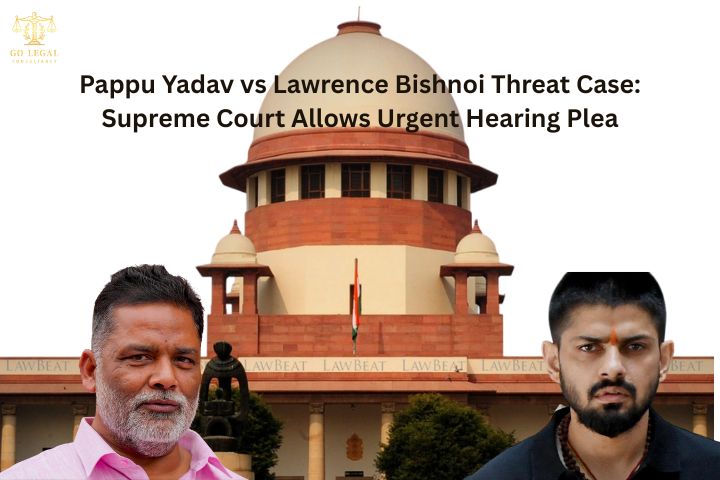
The legal system of India encounters an increasing problem because it needs to determine how organized crime attacks elected officials. The Pappu Yadav Lawrence Bishnoi Supreme Court death threat case establishes an important legal matter which pertains to Indian constitutional and criminal law.
The Supreme Court of India received a death threat complaint from Pappu Yadav, the current Member of Parliament representing Bihar, who accused the gang of Lawrence Bishnoi. The Supreme Court issued an important legal decision by permitting him to request immediate High Court review which protects the fundamental right to life and security and prompt legal proceedings for all citizens.
The Pappu Yadav Lawrence Bishnoi Supreme Court death threat case is not just about one politician. It establishes vital issues regarding Article 21 protection rights, State obligations to safeguard citizens from organized crime threats, and court responsibilities to stop procedural delays which lead to deadly outcomes.
Background of the Case
Pappu Yadav, formally known as Rajesh Ranjan, is a sitting Member of Parliament from the Purnia constituency in Bihar. In late 2024, he reported receiving serious death threats allegedly linked to the Lawrence Bishnoi gang — one of India’s most feared organized crime networks.
Key facts that made this case urgent:
- The threats involved a known, active organized crime syndicate
- Earlier threat reports had already been made by the petitioner
- His protection plea had been pending before the High Court since November 2024 with no hearing scheduled
- The petitioner sought enhanced security cover from the State
The Pappu Yadav Lawrence Bishnoi Supreme Court death threat case thus became a test of how quickly the Indian justice system can respond when a person’s life is genuinely at risk.
Who Is Lawrence Bishnoi?
Lawrence Bishnoi who exists as a prominent gangster presently remains imprisoned yet police officials claim he maintains control over an extensive criminal operation that spans multiple states.
Key facts about Lawrence Bishnoi:
- Origin: Abohar, Fazilka district, Punjab
- Criminal background: Linked to organized extortion, murder conspiracies, and targeted threats
- Network: Controls a gang spread across Rajasthan, Punjab, Haryana, Delhi, and other states
- High-profile links: The Bishnoi gang has been associated with threats to several celebrities, businessmen, and public figures
- Operational style: Despite being in custody, the gang allegedly operates through digital communication, coded messages, and external operatives
The Lawrence Bishnoi gang threat India has become a national security concern. Multiple agencies — including the National Investigation Agency (NIA) — have investigated the gang’s activities.
Old Law vs Current Law – Legal Framework Before and After
Before: Code of Criminal Procedure, 1973 (CrPC)
Under the old CrPC, protection from criminal threats was governed by provisions like:
- Section 107 CrPC – Executive Magistrate could bind over a person likely to commit breach of peace
- Section 144 CrPC – Allowed preventive orders in cases of imminent threat
- Section 151 CrPC – Police could arrest to prevent cognizable offences
- Writ jurisdiction of High Courts – Under Article 226, High Courts could order State authorities to provide protection
The limitation under the old law was speed. There was no dedicated fast-track mechanism for threat-based protection pleas. Petitioners had to wait in line like any ordinary case, even when lives were at risk.
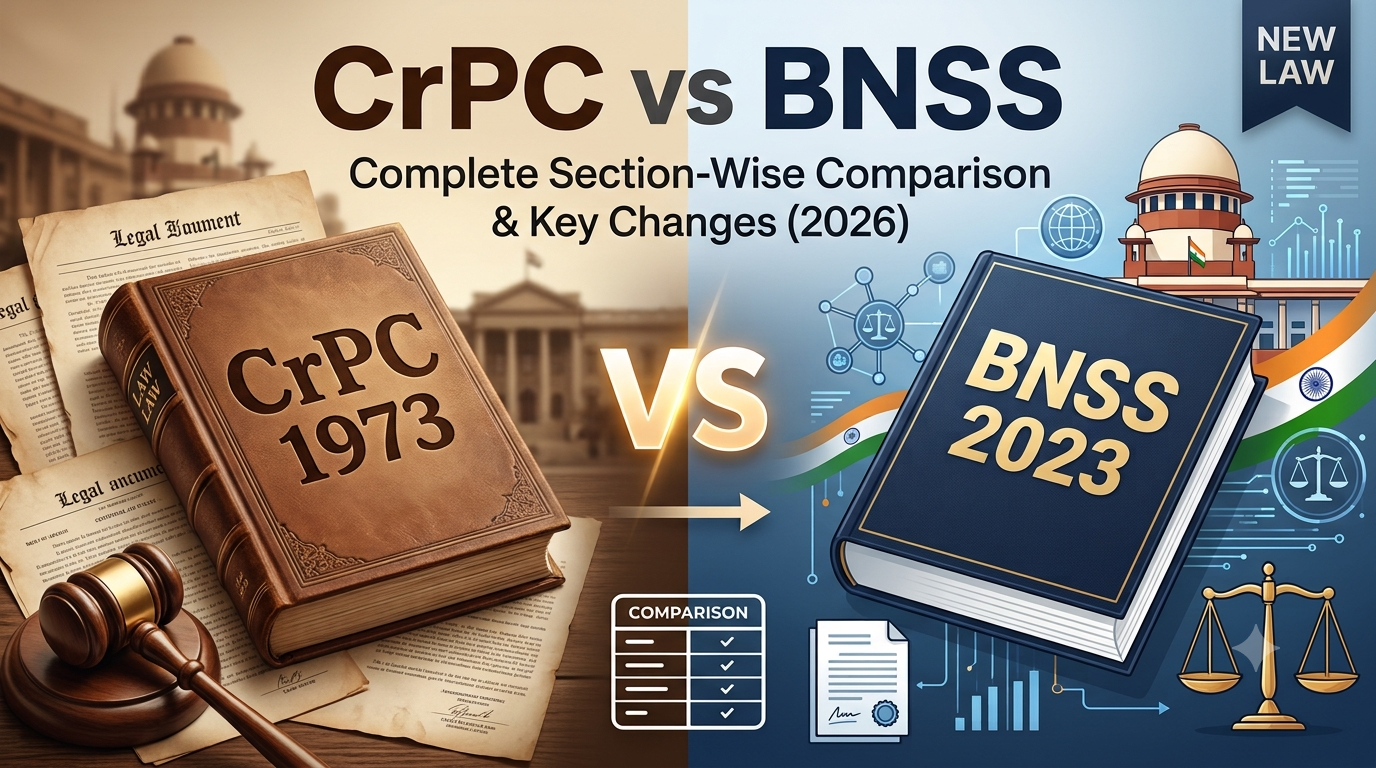
Now: Bharatiya Nagarik Suraksha Sanhita, 2023 (BNSS)
The BNSS, which replaced the CrPC from July 1, 2024, carries forward most protective provisions with added emphasis on timely justice. Relevant provisions include:
- Section 163 BNSS (formerly Section 144 CrPC) – Preventive orders by Executive Magistrate
- Section 170 BNSS – Police powers to prevent commission of cognizable offences
- Constitutional writ jurisdiction – Remains unchanged; High Courts can still order protection under Article 226
Comparison Table – Old Law vs New Law:
| Aspect | CrPC (Old Law) | BNSS (New Law) |
| Preventive Orders | Section 144 CrPC | Section 163 BNSS |
| Police Preventive Power | Section 151 CrPC | Section 170 BNSS |
| Criminal Intimidation | Section 503 IPC | Section 351 BNS |
| Writ Jurisdiction | Article 226 (unchanged) | Article 226 (unchanged) |
| Trial Timelines | No fixed timeline | Codified timelines added |
Supreme Court’s Key Observation and Direction
The Supreme Court bench that heard the Pappu Yadav Lawrence Bishnoi Supreme Court death threat case did not directly grant security or issue orders to law enforcement. Instead, it gave a crucial procedural direction:
“The Court allowed Pappu Yadav to approach the High Court for urgent listing of his pending petition.”
1. Judicial Hierarchy Was Respected
The Supreme Court did not take over the matter. It respected the established hierarchy — that the High Court is the appropriate forum for such protection pleas — while ensuring the petitioner was not left without remedy.
2. Access to Justice Was Preserved
By allowing urgent listing, the Court prevented a situation where a person facing a credible threat to life would have to wait months for a routine date before the High Court.
3. Article 21 Was Indirectly Enforced
The right to life under Article 21 includes the right to live without fear of imminent, credible threats. The Supreme Court’s direction ensured this constitutional right was not defeated by procedural inertia.
Pappu Yadav Lawrence Bishnoi Supreme Court Death Threat Case – Legal Issues Examined
Issue 1: Right to Life and Personal Liberty – Article 21
Article 21 of the Constitution provides that no person shall be deprived of their life or personal liberty except according to procedure established by law. The Supreme Court has consistently held that the right to life includes the right to live with dignity, free from constant fear of death.
The petitioner argued that:
- A credible, specific death threat from an organized gang amounts to a deprivation of the right to live freely
- The State has a positive duty to protect citizens from such threats
- Inaction by authorities, combined with judicial delay, compounds the constitutional violation
Issue 2: Delay in Judicial Proceedings
The petition had been pending since November 2024. This raised serious concerns about access to justice — particularly in matters involving threats to life. Why delays in such cases are dangerous:
- Threats can be carried out while the case is still pending
- Delay signals to criminal networks that legal remedies are ineffective
- It discourages victims of organized crime from approaching courts
Issue 3: State’s Duty to Protect Against Organized Crime
The Lawrence Bishnoi gang threat India is not a private dispute between two individuals. It involves a structured criminal organization. The State’s duty to protect citizens — especially public representatives — from such organizations is well established in Indian law.
Legal Provisions Involved in the Case
1. Criminal Intimidation – Section 351 BNS (formerly Section 503 IPC)
Threatening a person with death or grievous harm is a criminal offence under Section 351 BNS. Punishment: Up to 7 years imprisonment, or fine, or both — if the threat is to cause death or grievous hurt.
2. Organized Crime Laws – MCOCA and UAPA
- MCOCA (Maharashtra Control of Organised Crime Act) – Applies in Maharashtra; provides for stringent punishment for organized crime
- UAPA (Unlawful Activities Prevention Act) – May apply if the gang has terror-linked activities
- NIA Act – Allows the National Investigation Agency to investigate organized crime with national security implications
3. Security Cover Mechanism in India
The Government of India provides graded security cover based on threat perception:
| Security Category | Protection Level |
| X Category | 2 armed personnel |
| Y Category | 4–5 armed personnel + escort |
| Y+ Category | 6–7 armed personnel |
| Z Category | 10–22 armed personnel |
| Z+ Category | 36+ armed personnel (NSG) |
| SPG | Only for the Prime Minister |
4. Writ Jurisdiction of High Courts – Article 226
High Courts can issue writs including:
- Mandamus – Directing authorities to perform their legal duty (e.g., provide protection)
- Habeas Corpus – For illegal detention
- Certiorari – To quash illegal orders
Case Study: How Courts Have Handled Similar Threat Cases in India
Case Study 1: Journalist Shujaat Bukhari’s Case (2018)
Senior journalist Shujaat Bukhari was assassinated in Srinagar despite receiving prior threats. His murder established a judicial and policy precedent — that specific, credible threats must trigger immediate protective action, not bureaucratic deliberation.
Case Study 2: Salman Khan Threat Case (2022–2024)
Bollywood actor Salman Khan received multiple threat letters allegedly from the Lawrence Bishnoi gang. The Bombay High Court observed that threat perception from organized crime cannot be minimized and the State must act proactively. This case directly parallels the Pappu Yadav Lawrence Bishnoi Supreme Court death threat case in terms of the threatening party.
Case Study 3: Sidhu Moosewala Murder (2022)
Singer Sidhu Moosewala was shot dead days after his government security cover was withdrawn. The Punjab and Haryana High Court took suo motu cognizance. The case recognized that security cover withdrawal from a threatened individual can itself be a constitutional violation of Article 21.
Key Supreme Court Judgments on Right to Protection
1. Paramvir Singh Saini v. Baljit Singh (2020)
The Supreme Court reiterated that the State’s duty to protect citizens is a constitutional mandate, not a discretionary act.
2. DK Basu v. State of West Bengal (1997)
This landmark judgment reinforced that personal liberty and safety are non-negotiable rights that courts must actively protect. Inaction by the State in the face of a threat to life is itself a violation of fundamental rights.
3. Virender Gaur v. State of Haryana (1995)
The Supreme Court held that Article 21 encompasses the right to live with human dignity — free from fear, oppression, or criminal intimidation.
Importance of the Supreme Court’s Direction in This Case
The Supreme Court’s order in the Pappu Yadav Lawrence Bishnoi Supreme Court death threat case carries significance beyond the two parties involved:
- Reinforces the Right to Protection: Every citizen has the right to approach courts when facing credible threats to life
- Ensures Faster Justice: Procedural delays cannot be allowed to compromise personal safety
- Maintains Judicial Discipline: Respects the High Court’s jurisdiction while still providing immediate relief
- Signals to Law Enforcement: Police and State authorities cannot ignore threat complaints from individuals
Frequently Asked Questions (FAQs)
Q1. What exactly did the Supreme Court decide in the Pappu Yadav case?
The Supreme Court allowed Pappu Yadav to approach the High Court for urgent listing of his protection plea. It did not directly grant security or pass orders against the State.
Q2. Did the Supreme Court grant Pappu Yadav additional security?
No. The Supreme Court directed him to seek relief from the appropriate forum — the High Court — which has jurisdiction to issue directions to State authorities to provide security.
Q3. Why did the case go to the Supreme Court if the High Court has jurisdiction?
Because Pappu Yadav’s petition had been pending before the High Court since November 2024 with no hearing date fixed. He approached the Supreme Court to get a direction for urgent listing.
Q4. Who is Lawrence Bishnoi and why is his gang considered dangerous?
Lawrence Bishnoi is a jailed gangster who allegedly controls a criminal network across multiple Indian states. His gang has been linked to extortion, murder, and high-profile threat cases.
Q5. What legal remedy does a person have if they receive death threats?
- File a police complaint under Section 351 BNS
- Approach the Magistrate under preventive provisions of BNSS
- File a writ petition before the High Court seeking protection under Article 226
- Approach the Supreme Court if the High Court does not act urgently
Q6. Can the court order the government to provide security to any citizen?
Yes. Under the writ of mandamus, High Courts and the Supreme Court can direct State authorities to provide security where a credible threat to life exists under Article 21.
Q7. What is the legal basis for the State’s duty to protect citizens?
Article 21 of the Constitution — the right to life — has been interpreted by the Supreme Court to impose a positive duty on the State to protect citizens from credible threats, including threats from private actors like criminal gangs.
Conclusion
The Pappu Yadav Lawrence Bishnoi Supreme Court death threat case is far more than a legal dispute between a politician and a gangster. It is a powerful reminder that India’s constitutional framework — built on the foundation of Article 21 — places the protection of human life at the very center of State duty and judicial responsibility.
The Supreme Court’s direction to allow urgent listing before the High Court is a measured, disciplined, and constitutionally sound response. It preserves judicial hierarchy while ensuring that no person is left without remedy when their life is at genuine risk.
For every citizen of India, this case reaffirms a fundamental truth: the courts will hear you, and they will hear you urgently, when your life is on the line.
This article is written for general legal awareness and informational purposes only. It does not constitute legal advice. For specific legal matters, consult a qualified advocate.