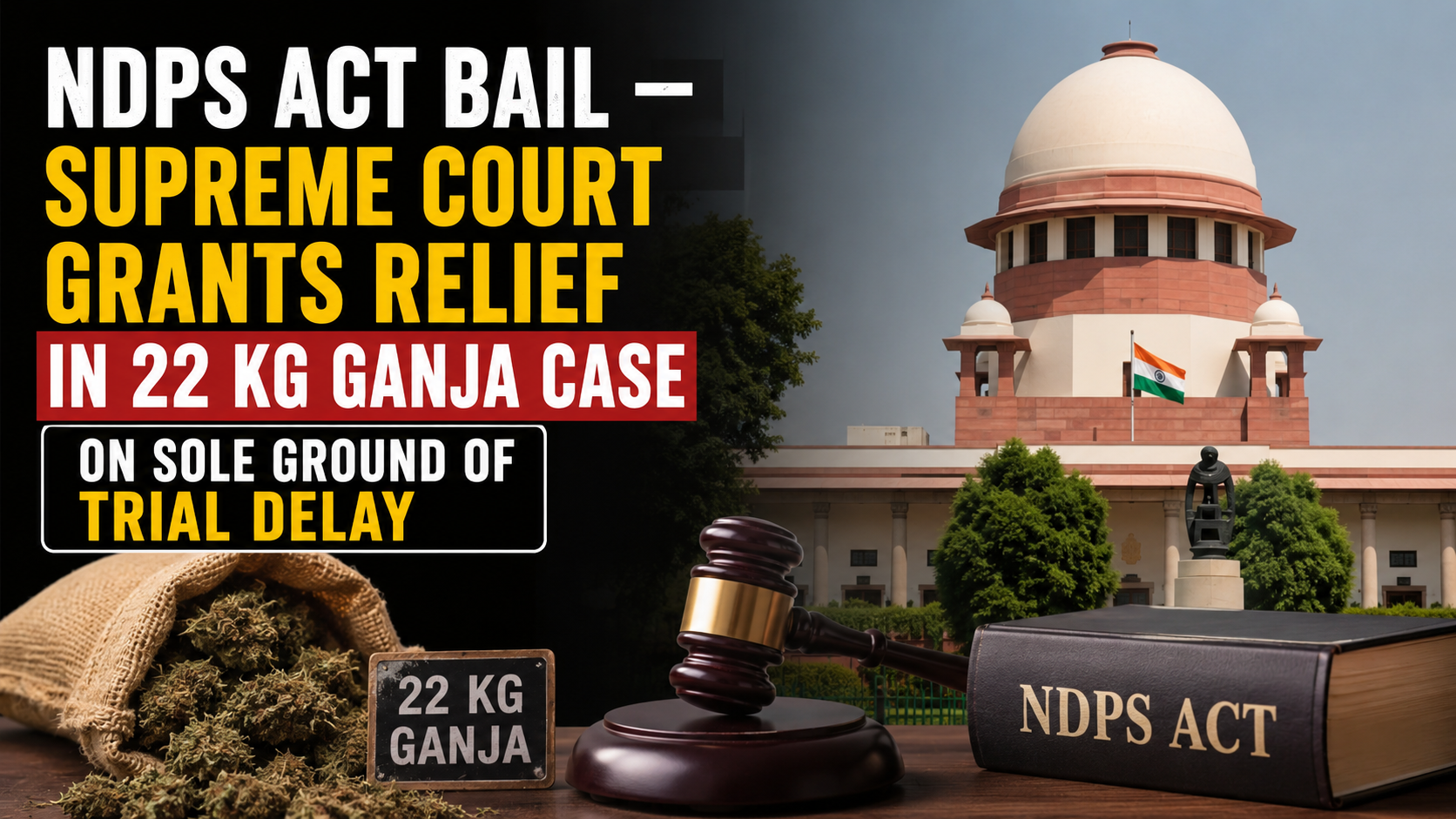
The Supreme Court of India has delivered a significant ruling on bail jurisprudence under narcotics law. A Bench of Justice JB Pardiwala and Justice KV Viswanathan granted regular bail to a man accused of possessing nearly 22 kg of ganja. The Court rested its decision on a single but powerful ground — prolonged delay in trial. This judgment once again reinforces that the right to a speedy trial forms part of personal liberty, even under the strict framework of the NDPS Act bail regime.
Background of the Case
The matter is reported as Rajadurai vs The State of Tamil Nadu .
The Appellant faced charges under:
- Section 8(c) NDPS Act — prohibition on dealing with narcotic substances.
- Section 20(b)(ii)(c) NDPS Act — possession of commercial quantity of cannabis.
- Section 29(1) NDPS Act — abetment and criminal conspiracy.
The seizure involved 22.950 kg of ganja, which falls within the commercial quantity bracket. The High Court had earlier rejected bail because of the strict bar under Section 37 of the NDPS Act.
Key Findings of the Supreme Court
The Supreme Court focused on the practical reality of the case rather than the strict statutory bar. The Bench observed:
- The Appellant had been in judicial custody for more than one year.
- The trial Court had already framed charges against the accused.
- Despite the framing of charges, not a single witness had been examined.
- The witness list was unusually long, signalling further delay.
On these facts, the Court held that continued detention without trial would defeat the constitutional promise under Article 21 — Right to Life and Personal Liberty.
NDPS Act Bail – Why Trial Delay Matters
The phrase NDPS Act bail carries a special weight in India’s criminal justice landscape. Bail under this statute is governed by Section 37 NDPS Act, which bars release unless the Court records satisfaction that:
- The accused is not guilty of the offence.
- The accused is unlikely to commit any offence while on bail.
These twin conditions make NDPS Act bail one of the toughest in India. However, the Supreme Court has consistently held that:
- Statutory rigour cannot defeat constitutional rights.
- Prolonged incarceration without trial violates Article 21.
- Trial delay itself becomes a valid ground for NDPS Act bail.
Article 21 and the Right to Speedy Trial
The Court drew strength from earlier rulings such as Hussainara Khatoon v. State of Bihar and Kashmira Singh v. State of Punjab. These cases firmly establish that:
- The right to speedy trial India is part of fundamental rights.
- An accused cannot rot in jail awaiting trial.
- Indefinite detention amounts to punishment without conviction.
By applying this principle, the Court widened the scope of NDPS Act bail for under-trial prisoners stuck in slow-moving cases.
Section 37 NDPS Act – The Twin Test Explained
Many readers ask how trial delay can override Section 37 NDPS Act. The answer lies in judicial balancing:
- Section 37 is a procedural rigour, not an absolute bar.
- The Constitution is the supreme document.
- When statutory provisions clash with fundamental rights, courts harmonise them.
The Bench held that the twin test must be read with Article 21 to avoid injustice in long pending trials.
Commercial Quantity NDPS – Stricter but Not Absolute
The case involved commercial quantity NDPS contraband. As a general rule:
- Commercial quantity attracts 10 to 20 years of imprisonment.
- Bail is rarely granted at the initial stage.
- Investigation and trial demand careful scrutiny.
The Supreme Court, however, clarified that even commercial quantity matters attract relief if:
- Trial gets delayed beyond a reasonable period.
- Evidence collection moves slowly.
- The accused has already served significant pre-trial custody.
Discretionary Bail Narcotics India – The Way Forward
The judgment broadens the doctrine of discretionary bail narcotics India. Earlier, courts hesitated to grant relief in commercial quantity matters. Now:
- Trial delay stands as a respected ground for NDPS Act bail.
- Each case must be decided on its own facts.
- Courts must protect the personal liberty of under-trial prisoners.
This reasoning aligns with the Supreme Court’s view in Mohd. Muslim v. State (NCT of Delhi), where similar relief was granted.
Significance for Under-Trial Prisoners
The ruling carries strong implications for under-trial prisoners India across the country:
- Hundreds of NDPS accused remain in jail without active trial.
- Witness examination often stretches over many years.
- The judgment offers them a constitutional path to NDPS Act bail.
It also pressures trial courts to expedite hearings in narcotics matters.
Old Section Detail – NDPS Act 1985 Bail Framework
The NDPS Act 1985 bail provisions have remained largely unchanged. Key features include:
- Section 36A — special courts for trial of NDPS offences.
- Section 37 — restrictive bail conditions for serious offences.
- Section 50 — safeguards during search and seizure.
The latest ruling does not alter these provisions. Instead, it tells the system that constitutional safeguards must operate alongside statutory rigour.
Case Study – Rajadurai vs The State of Tamil Nadu (2026)
The facts in Rajadurai serve as a clear precedent:
- The accused was caught with 22.950 kg of ganja.
- He spent over a year in judicial custody.
- The trial moved at a slow pace.
- The Supreme Court applied the Article 21 lens.
- NDPS Act bail was granted with appropriate conditions.
This judgment will guide future cases involving slow-moving narcotic trials.
Difference Between Old and New Approach
The shift in the Court’s approach can be seen clearly:
- Earlier approach: Section 37 was treated as an almost absolute bar.
- New approach: Section 37 must yield to Article 21 in cases of unreasonable delay.
This evolution shows the Indian judiciary’s growing concern for personal liberty under Article 21.
Frequently Asked Questions
Q1. What is NDPS Act bail? It refers to the conditional release of an accused under the Narcotic Drugs and Psychotropic Substances Act, 1985, after fulfilling statutory conditions.
Q2. Why is NDPS Act bail difficult to obtain? Because Section 37 lays down strict twin conditions before any release.
Q3. Can trial delay alone justify NDPS Act bail? Yes, the Supreme Court has confirmed that prolonged delay in trial stands as a valid ground for relief.
Q4. What was held in Rajadurai vs State of Tamil Nadu (2026)? The Court granted bail to the accused based on long custody and slow trial despite a 22 kg ganja recovery.
Q5. Does this ruling apply to all narcotics cases? Yes, the reasoning applies wherever trial delay violates Article 21.
Conclusion
The Supreme Court’s decision in the 22 kg ganja matter strengthens the link between NDPS Act bail and the right to a speedy trial. The judgment reminds investigating agencies and trial courts that justice delayed is justice denied. By weaving Article 21 into the strict framework of the NDPS Act, the Court has set a balanced and humane standard for the future of narcotics jurisprudence in India.