The Bharatiya Nyaya Sanhita (BNS), 2023 introduced a modern structure for criminal law in India by replacing the Indian Penal Code, 1860. Despite the structural change, many important legal principles have been retained to ensure continuity in criminal jurisprudence. One such principle is Accident in doing a lawful act, which is now codified under Section 18 BNS.
The doctrine of Accident in doing a lawful act protects individuals from criminal liability because they cause unintentional harm while conducting legal activities with sufficient caution. Indian criminal law requires proof of both intention and negligence because these elements establish guilt. The law considers an act to be nonoffensive when harm occurs because of pure accident without any criminal intent.
The Bharatiya Nyaya Sanhita general exceptions provide protection to people who act without criminal intent because this principle serves as a defense against their punishment. The legal concept of Accident in doing a lawful act establishes an equitable standard because it helps to differentiate between intentional misconduct and unintentional events.
Understanding Accident in Doing a Lawful Act Under Section 18 BNS
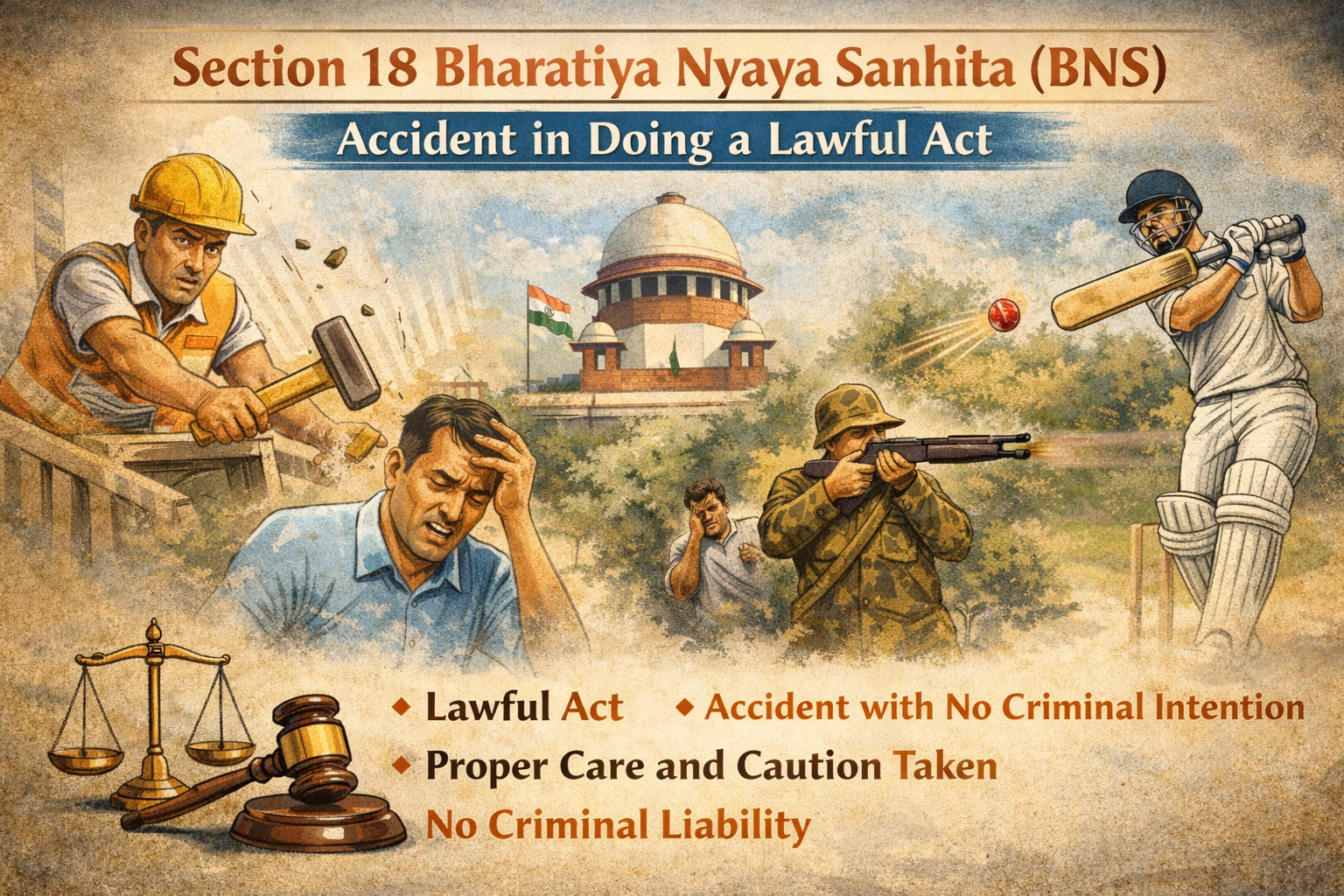
The concept of Accident in doing a lawful act is clearly recognized under Section 18 of the Bharatiya Nyaya Sanhita. The provision states that an act which occurs through accident or misfortune and which lacks any criminal intent or knowledge and which occurs during lawful activity and with proper care does not constitute an offence.
This provision is closely connected with the principle of Accident without criminal intention in law. Criminal law usually requires the presence of a guilty mind (mens rea) for punishment. When harm occurs accidentally and without negligence, the law recognizes that punishment would be unjust.
The legal principle of Accident in doing a lawful act protects people who execute their lawful duties. The law protects individuals from criminal charges when they cause unintended results that they could not foresee.
Essential Elements of Accident in Doing a Lawful Act
For the protection of Accident in doing a lawful act to apply, several legal conditions must be satisfied. Courts carefully evaluate these elements before granting the defence.
1. The Act Must Be Lawful
The activity being performed must be legally permitted. If the act itself is illegal, the protection of Accident in doing a lawful act cannot be claimed.
For example:
- A person legally cutting wood in his own field accidentally causes a branch to fall on a passerby.
In such circumstances, the situation may fall under Lawful act done accidentally BNS if all precautions were taken.
2. The Act Must Be Done in a Lawful Manner
The law requires people to conduct their activities according to proper procedures and responsible practices even when their actions remain within legal boundaries. The defence of Accident in doing a lawful act does not apply when the person conducts the activity with reckless behavior and safety rules unheeded.
Courts study the case to determine if the defendant acted according to established standards which apply to that particular situation. The requirement exists to make sure that people who act with negligence cannot avoid facing criminal charges.
3. The Use of Lawful Means
Another requirement is that the act must be performed using lawful means. If illegal tools or unlawful methods are used, the protection of Accident in doing a lawful act will not be available.
This element reinforces the idea that the law protects only those who act responsibly within legal limits.
4. Due Care and Caution Must Be Exercised
Due care and caution requirements represent the most essential component needed to prove lawful act existence during an accident investigation. The courts determine whether the defendant established proper safety measures to protect against potential harm.
If the person fails to take appropriate precautions, the accident may be considered negligence. In such situations, Criminal liability for accident BNS may arise.
This distinction between accident and negligence is essential for maintaining fairness in criminal law.
5. Absence of Criminal Intention
For Accident in doing a lawful act to apply, there must be no criminal intention or knowledge behind the act. This element reflects the principle of Accident without criminal intention in law.
Criminal liability generally arises when there is intention, knowledge, or recklessness. When none of these elements are present, the law recognizes that the event was accidental.
Role of Accident in Doing a Lawful Act in Criminal Law
The doctrine of Accident in doing a lawful act plays an important role in preventing unjust punishment. Without this principle, individuals could face criminal prosecution for events beyond their control.
This concept is deeply connected with the General exceptions under BNS, which protect individuals acting in good faith and without criminal intent.
Importance of the Doctrine
- Prevents punishment for genuine accidents
- Distinguishes accident from negligence
- Protects individuals performing lawful duties
- Maintains fairness in criminal justice
These principles form the foundation of the Accident defence in criminal law India.
Practical Examples of Accident in Doing a Lawful Act
Understanding real-life situations helps explain the application of this doctrine.
Sports Activity
During a football match, a player kicks the ball and accidentally injures another player.
If there has been no negligence, in fact, since the Act in question was done during a lawful sports activity, the incident would qualify as An accident in the course of doing a lawful act.
Construction Work
A construction worker following all safety rules accidentally drops equipment because of sudden mechanical failure.
If proper precautions were taken, the incident may fall under the Criminal act by accident legal defence.
Hunting Accident
A hunter legally hunting in a permitted area fires at an animal but unintentionally injures a person hidden in bushes.
Courts will analyze whether the hunter exercised proper caution before determining whether Accident in doing a lawful act applies.
Difference Between Section 18 BNS and Section 80 IPC
Before the introduction of the Bharatiya Nyaya Sanhita, the same principle existed under the Indian Penal Code.
Section 80 IPC – Old Law
Section 80 of the IPC provided protection for Accident in doing a lawful act when the act was performed without criminal intention and with proper care.
Key Points of Comparison
- Section 80 IPC existed under the Indian Penal Code, 1860
- Section 18 BNS now governs the principle under the Bharatiya Nyaya Sanhita, 2023
- The legal concept remains unchanged
Therefore, the Difference between Section 18 BNS and Section 80 IPC lies mainly in the legislative transition rather than a change in the underlying principle.
Courts often rely on earlier judicial interpretations of Section 80 IPC while interpreting Section 18 BNS.
Judicial Perspective on Accidental Acts
Indian courts consistently emphasize the importance of intention in criminal law. When determining cases involving Accident in doing a lawful act, courts typically examine:
- Whether the act was lawful
- Whether reasonable precautions were taken
- Whether negligence was present
- Whether the accused had criminal intention
If these factors indicate that the event was purely accidental, the defence under Accident in doing a lawful act may apply.
Conclusion
The principle of Accident in doing a lawful act establishes essential fairness standards which the criminal justice system must maintain. The rule recognizes that people can cause harm through their actions even when they act responsibly and lack any criminal intentions. The Bharatiya Nyaya Sanhita establishes this rule through Section 18 which maintains the traditional legal principle which separates criminal acts from accidental misfortunes. The general exceptions of the Bharatiya Nyaya Sanhita contain this provision as a fundamental element which safeguards people from punishment when they accidentally cause harm.